

Iran-Israel & US Conflict Escalates, Gold, Silver, Oil Prices Soar
On February 28, 2026, tensions between Iran and Israel escalated sharply. The United States and Israel launched large-scale coordinated strikes against Iran today — referred to by the U.S. as "Operation Epic Fury", and by Israel as a preemptive strike or "Lion's Roar." Reported objectives include neutralizing Iran's nuclear and missile capabilities. Explosions were reported across multiple locations, including Tehran. Iran has retaliated by launching missiles and drones toward Israel, triggering nationwide air-raid sirens. The region has entered a state of heightened military alert. This marks a new phase of direct military confrontation in the Middle East, far exceeding prior expectations following failed diplomatic negotiations.
Table: Impact of major Middle East conflicts on gold, silver, and oil prices
Below is a summary of the typical short-term market performance of gold, silver, and crude oil (WTI) during major historical Middle East conflicts and wars. The analysis focuses primarily on price movements from the initial outbreak through peak escalation, based on historical data and observed market reactions. These represent generalized patterns. Actual price movements depend on factors such as conflict scale, duration, involvement of major oil-producing nations and the Strait of Hormuz, and responses from OPEC. "Short term" refers to periods ranging from several days to several months after conflict onset.
| Conflict / war event | Period | Short-term performance of gold | Short-term performance of silver | Short-term performance of crude oil | Key drivers and notes |
| Yom Kippur War + Arab oil embargo | October 1973 – March 1974 | Surge ≈ +70–100% (from ≈$100/oz to $180+/oz) | Strong rally (higher elasticity over gold prices) | Spike ≈ +300% (from $3/bbl to $12/bbl) | OPEC embargo and production cuts triggered a classic energy crisis. Gold driven by safe-haven demand and inflation |
| Iranian Revolution + Iran–Iraq war (the Tanker War) | 1979–1980 | Spike ≈ +100–200% (from ≈$200 to a peak of $850) | Spike (silver prices often outpaced gold gains) | More than doubled (from ≈$15 to $39+) | Production disruption by the revolution and war damage caused the Second Oil Crisis |
| Gulf War (Iraq's invasion of Kuwait) | August 1990 – February 1991 | Short-term spike of 5–15% (from ≈$384 to $403+), followed by a pullback | Similar to gold, rose briefly before retreating | Spike ≈ +100–120% (from ≈$17 to $36–40) | The invasion triggered supply fears which drove prices higher; rapid war resolution reversed gains |
| Iraq War (U.S. invasion) | Around March 2003 | Rise ≈ +20–30% (from the $330–420 range) | Rise (industrial and safe-haven demand) | Short-term rally before the invasion followed by decline during the war | Risk premium built before invasion, with supply recovering during the war |
| Iran-U.S. tensions (including the Soleimani assassination) | Around January 2020 | Short-term spike of 5–10% (to $1547+) | Similar upward pattern | Short-term spike followed by a pullback | Limited conflict with no major supply disruption |
| Israel-Hamas war and Iran proxy conflict | October 2023 – 2024 | Rise ≈ +5–15% (short-term rally, followed by consolidation) | Moderate rise | Short-term +5–10%, then pullback | Limited regional spillover, with the Strait of Hormuz unaffected |
| Israel-Iran confrontation (including U.S.-Israel strikes) | June 2025 – February 2026 | Strong rally (breaking $5000/oz; staying above $5000 recently) | Higher elasticity ($90+ range with sharp volatility) | Rise (WTI ≈ $65–$67; Brent ≈ $70–$72+) | Safe-haven demand and oil risk premium, amplified by Hormuz disruption concerns |
Key observations and patterns
● Gold: Nearly all Middle East conflicts initially trigger rapid rallies in gold as a safe-haven asset, especially when Iran or the Strait of Hormuz is involved, creating a dual shock from inflation expectations and uncertainty. Typical short-term gains range from 5%–30%, with extreme cases (e.g., the 1970s) exceeding 100%.
● Silver: Silver generally exhibits higher volatility (higher beta) relative to gold. During early risk-off phases, safe-haven demand often amplifies upside moves. However, subsequent corrections may also be sharper due to industrial demand concerns.
● Crude oil: Oil prices respond most directly to Middle East conflicts. Sustained rallies typically occur only under large-scale supply disruptions (the 1973 embargo, 1979 revolution, 1990 invasion). Most modern conflicts (in 2003, 2023–2024, and the current 2026 escalation) tend to produce short-term spikes of 10%–50%, followed by correction unless the Hormuz shipping routes are blocked or production infrastructure is disrupted (consider OPEC, buffers, and global inventories).
● Current implications (as of February 2026): The conflict involving Iran, Israel, and the United States has already pushed gold, silver, and oil higher (gold above $5000, silver above $90, and oil $65–$72). If disruption risks in the Strait of Hormuz are confirmed, they would likely create strong short-term bullish momentum across all three assets. However, historical precedent suggests prices may retrace quickly if tensions are rapidly contained.
Short-term impact of the current Israel-Iran conflict on gold and silver
Geopolitical conflicts, particularly those involving major oil producer Iran, are typical safe-haven catalysts, often driving rapid inflows into precious metals. In particular:
● Gold (XAU/USD): As the benchmark global safe-haven asset, gold typically attracts capital flows during wartime escalation, missile exchanges, and surging uncertainty. Gold was already trading at elevated levels ($5180–$5280/oz on February 27). Today's developments have driven significant risk-off sentiment. In the short term (days to weeks), there is a high probability of rapid upward momentum, with a potential test of $5300 or higher resistance levels. If the conflict expands and leads to Hormuz shipping disruptions, surging oil prices, or rising inflation expectations, gold's upside momentum could accelerate further. Conversely, unexpected ceasefire or peacemaking signals may trigger rapid pullbacks.
● Silver (XAG/USD): Silver combines safe-haven characteristics and industrial demand exposure. During early geopolitical shocks, safe-haven sentiment often dominates industrial demand concerns, resulting in stronger gains compared with gold (higher volatility). Silver has already broken above the key level of $90/oz. Event-driven momentum could trigger sharper upside spikes, including single-day moves exceeding 5%–10%. Silver historically exhibits a high beta relative to gold, frequently swinging wider than gold's movements.
Overall short-term outlook (next 1-2 weeks): Primarily bullish, with gold and silver likely to experience a volatility-driven safe-haven rally. However, traders should remain cautious:
● Rapid conflict containment (diplomatic intervention or one-sided advantage) may lead to sharp corrections from elevated levels.
● A parallel oil price surge could reinforce inflation expectations, further supporting precious metals.
Is there an opportunity to go long on gold and silver?
Periods of heightened uncertainty and volatility often present attractive short-term trading opportunities in precious metals, though risks are equally elevated. Strict stop-loss strategies are strongly recommended. For traders seeking exposure to gold (XAUUSD / XAUUSDT) and silver (XAGUSD / XAGUSDT) markets, Bitget represents one suitable trading venue:
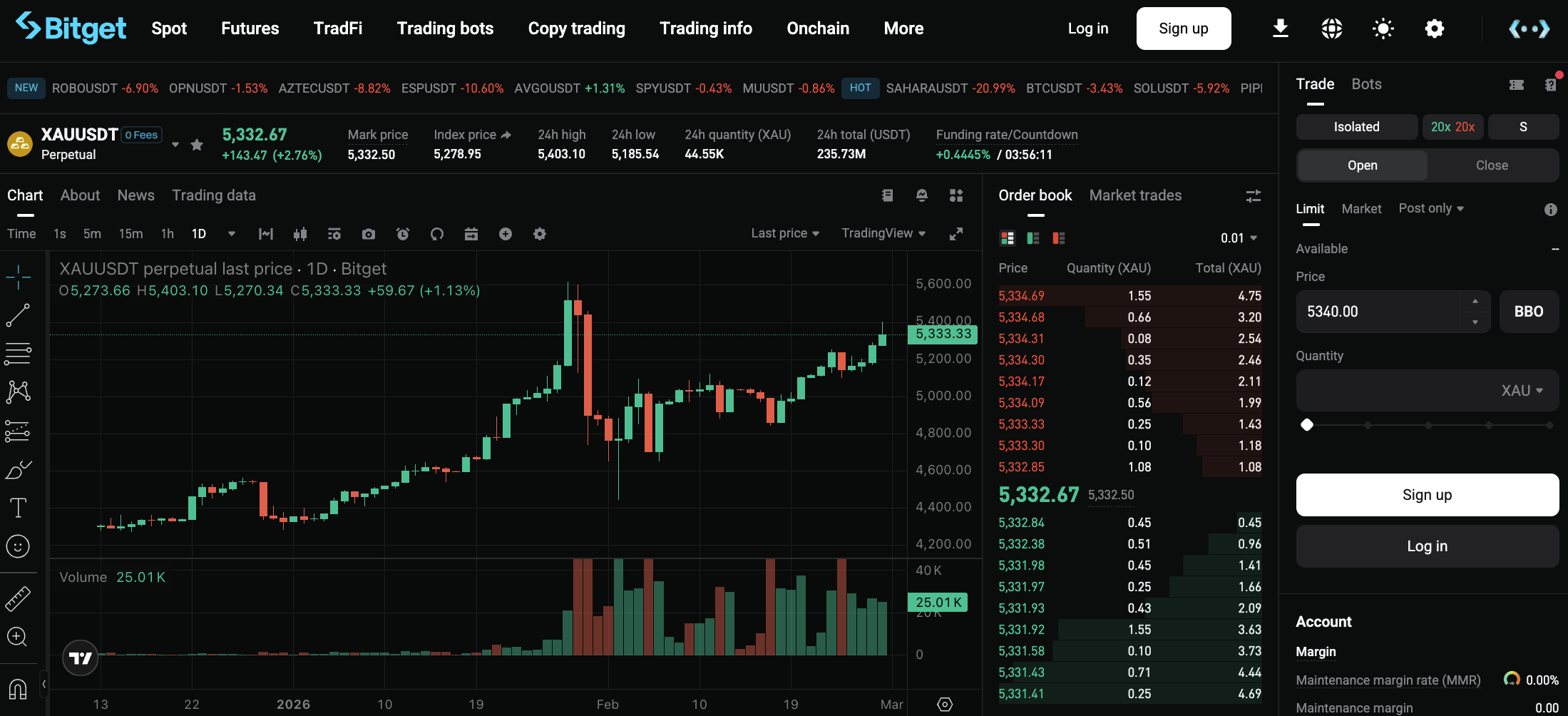
● Bitget offers USDT-margined perpetual futures on gold and silver with flexible leverage ranging from 1x to over 20x, suitable for capturing short-term safe-haven momentum.
● The platform boasts strong liquidity and market depth to maintain execution quality even during extreme volatility.
● Advanced tools such as grid bots and copy trading support multiple trading styles.
Trading ideas (not investment advice, for reference only; trading involves risks):
● Aggressive approach: Consider smaller long exposure near current price levels, targeting $5300+ for gold and $95+ for silver, and applying strict stop-loss controls to address significant market swings.
● Conservative approach: Wait for initial pullbacks during Asian or Western trading sessions before scaling into positions in several batches.
● Key developments to monitor: Watch for official responses from Iran, Israel, and the United States, oil price dynamics, and signs of regional escalation.
Reminder: Geopolitical developments evolve rapidly, and markets may experience sharp volatility in either way. Proper position sizing and disciplined risk management are essential. Track real-time market movements and join community discussions on Bitget to stay informed and capture potential opportunities.
Disclaimer
Cryptocurrency investments carry significant risk. Please make decisions based on your personal financial situation and risk tolerance, and diversify your asset allocation wisely. This content is for reference only and does not constitute investment advice. Exercise strict risk control, as market volatility can be extremely high.


- Table: Impact of major Middle East conflicts on gold, silver, and oil prices
- Short-term impact of the current Israel-Iran conflict on gold and silver
- Is there an opportunity to go long on gold and silver?