
News
Stay up to date on the latest crypto trends with our expert, in-depth coverage.

1Bitget UEX Daily | Trump Does Not Rule Out Sending Troops to Iran; Iran Closes Strait of Hormuz, Oil Prices Soar; Drone and Space Stocks Rise Collectively (2026/03/03)2Bitcoin slide slowing, but bear market still in play: Analysts3Research Report|In-Depth Analysis and Market Cap of Opinion Labs (OPN)
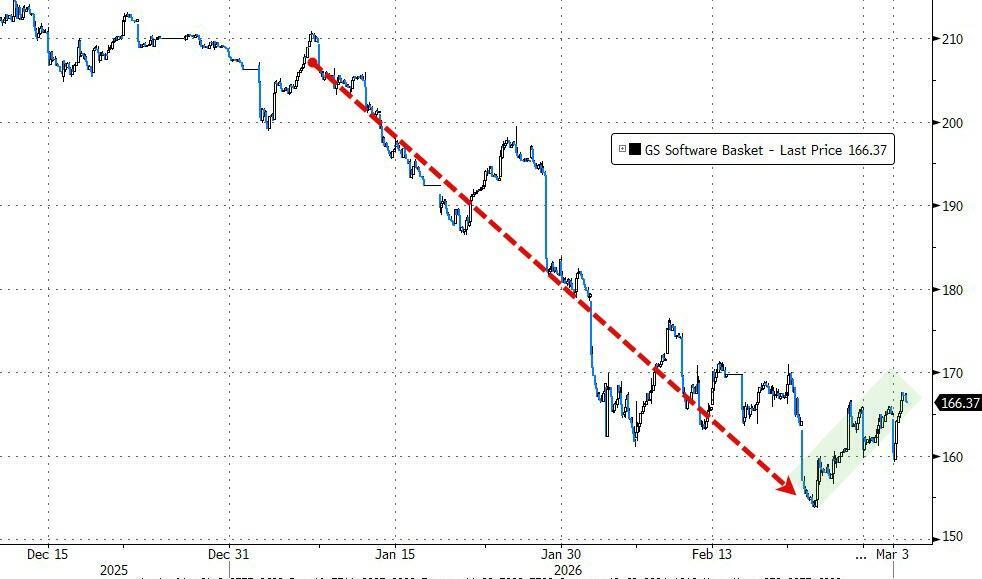

Global funds are scrambling for US dollar safe haven!
美投investing·2026/03/04 02:10
Which AI software stock takes center stage today? An analysis from a trend scout
101 finance·2026/03/04 02:06
Upland Software's Financial Results: A Typical 'Sell the News' Scenario Following Guidance Revision
101 finance·2026/03/04 02:06
Upland Software's Earnings: A Classic 'Sell the News' After a Guidance Reset
101 finance·2026/03/04 02:06
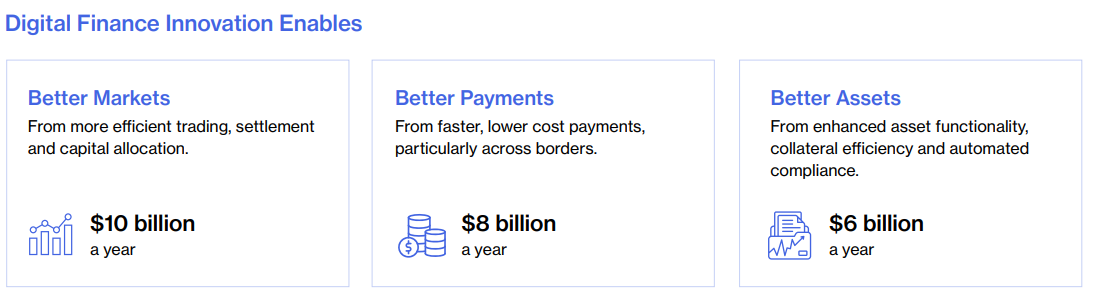
Australia is at risk of missing the $17B crypto boat, researchers say
Cointelegraph·2026/03/04 02:03
Dick's Sporting Goods: Steering Through the Retail Downturn and Establishing an International Platform
101 finance·2026/03/04 01:57
Energy Fuels: Assessing Uranium and Rare Earth Output Trends in Relation to Market Supply and Demand
101 finance·2026/03/04 01:57
'No longer a choice': Bitwise CIO says US-Iran strikes put crypto in primary market role
The Block·2026/03/04 01:48
Flash
02:22
Geopolitical conflicts trigger a safe-haven frenzy: global gold ETFs attract $6.2 billion in a single week(1) As the geopolitical conflict between the US and Iran continues to escalate, global investors are frantically pouring into gold ETFs. The latest data shows that weekly inflows into gold ETFs have reached $6.2 billions, marking the third consecutive week of net inflows. So far this year, the annualized inflow into gold funds has reached $148 billions, far surpassing last year's record of $101 billions. This wave of risk aversion stems from the direct threat that Middle East conflicts pose to global economic stability. By investing in gold ETFs, investors can hedge against inflation and uncertainty without bearing the storage costs of physical gold. Against the backdrop of expanding money supply and US Treasury debt soaring to $38 trillions, gold is seen as the ultimate tool for preserving value.(2) Asia, as the world's largest gold consumption market, is leading this round of risk aversion. Local investors have made gold ETFs their preferred hedging tool. Experts recommend allocating 10%-15% of precious metal ETFs in investment portfolios, with a focus on gold to enhance stability. In the first two months of this year, gold prices have far outperformed the stock market: after surging 64% last year, gold has risen another 18% so far this year, while the S&P 500 index has only gained 1%. Analysts believe gold is effectively hedging against soaring government spending, massive deficits, and economic uncertainty. Compared to physical gold, gold ETFs with high liquidity and low costs have become the top choice for most investors.(3) Legendary hedge fund manager Ray Dalio recommends allocating up to 15% in gold. However, experts also advise maintaining rationality: over the past 30 years, the annualized return of gold has been about 8%, lower than the S&P 500's 10.7%. Diversification remains key, and a 15% allocation to gold can provide protection in the current environment.(4) The head of market analysis at StoneX points out that although multiple factors are supporting gold and silver prices, both metals are currently in an overbought state and may need to correct in the short term. Currently, gold's RSI is close to 70, at the top of its upward channel. She emphasizes that investors should be wary of short-term volatility but not overly panic; unless the conflict escalates further, the market will enter a consolidation phase.
02:19
Saudi oil storage facilities under pressure, Gulf oil-producing countries face storage bottlenecks(1) According to geospatial analytics company Kayrros, Saudi Arabia's main oil storage facilities are rapidly being filled, as the key export channel, the Strait of Hormuz, remains effectively closed to shipping. (2) Kayrros co-founder and chief analyst Antoine Halff revealed that as of March 1, the Ju'aymah terminal on Saudi Arabia's east coast "will soon run out of remaining storage capacity." Meanwhile, at the Ras Tanura refinery, which was shut down following this week's Iranian attack, four out of its six storage tanks have already been filled. (3) Halff also pointed out that due to the closure of the strait, Iraq has begun to cut production at its largest oil field. He emphasized, "Iraq's lower storage capacity is a structural vulnerability. If the Strait of Hormuz continues to be blocked, other countries may soon face similar situations." Data shows that the total onshore oil storage capacity of the five Arab oil-producing countries in the Gulf region is about 350 million barrels. As of March 1, the observed crude oil inventories in these countries were about 175 million barrels. Halff added that actual operational capacity rarely exceeds 80% of nominal storage capacity.
02:19
A whale reduced its ETH and WBTC long positions 4 hours ago and repaid a loan with 12.03 million USDT.PANews March 4th news, according to on-chain analyst Yujin's monitoring, a whale reduced his leveraged long position 4 hours ago: Sold 3,809 ETH at a price of $1,967 (7.49 million USD) (UTC+8); Sold 67.1 WBTC at a price of $67,692 (4.54 million USD) (UTC+8). Then, he used these 12.03 million USDT to repay his leveraged loan on the lending platform.
News