
How Did Greenland Ignite a US-Europe Trade War? Europe in Dire Straits, Safe-Haven Gold Strongly Breaks Through 4800

FX678 News, January 21—— Currently, the geopolitical game between the US and Europe over Greenland has gone beyond a simple dispute, evolving into a "stress test" for the existing international financial and political framework. The core conflict lies in the fact that although Europe holds a massive net creditor position towards the US, any countermeasure involving financial weapons carries the risk of "self-harm," since the US possesses an overwhelming advantage in "financial weaponization" due to dollar hegemony and control over global financial infrastructure. This forces Europe to be more likely to resort to trade measures, sharply increasing the risk of a trade war.
The market is discussing whether Europe will use its massive net creditor position against the US to retaliate over the Greenland issue. However, some Wall Street analysts partly believe this is not a credible threat. The US holds an advantage in weaponizing global finance, largely thanks to the dominance of the dollar.
Therefore, if Europe takes retaliatory action, it is likely to use trade measures. Meanwhile, the risk of a full-scale trade war is now higher than ever, as Europe's stakes are also greater than ever. Although Europeans may ultimately give in, this time they are unlikely to surrender without a fight.
Notably, the Greenland dispute is far from an isolated geopolitical event; it is a stress test for the existing international financial and political framework. The upward momentum of gold prices during volatility is much greater than the momentum for a downward trend. On Wednesday (January 21), during the Asian session, spot gold fluctuated upward, rising about 1.2% intraday and currently trading near $4,820 per ounce. As of 10:10 (UTC+8), it once hit a historic high of $4,843.99 per ounce.
The Greenland event highlights that the market is facing so-called framework uncertainty, not just policy uncertainty:
Meanwhile, the situation in Greenland may still be resolved in some way and may not lead to escalation. A non-escalatory resolution could occur through market reactions, US institutional safeguards (restraints on the president from Senate Republicans and Supreme Court intervention), and negotiations.
A conceivable solution could be for Europe to pay for the US military assets stationed in Greenland, perhaps by transferring some natural resource extraction rights. Another possibility is some form of long-term "lease" (for example, a hundred-year term), in which Denmark and Greenland retain sovereignty but grant the US the right to use Greenland as it wishes.
However, the probability of escalation remains high.
If You Owe the Bank Ten Trillion, the Bank Is in Trouble
A hot topic in the market is whether Europe might use its huge holdings of US assets to counter President Trump over the Greenland issue. But according to some Wall Street analysts,
How to implement it remains unclear. Most of the US assets held by Europe belong to the private sector (with Norway's sovereign wealth fund being a notable exception), making it difficult for national governments to take direct control.
One option is to impose capital controls,
Another option is some form of regulation, either "soft" or "hard". The former could include pressuring European pension funds (especially those related to the public sector) to sell or stop buying US assets; the "hard" approach might involve directly regulating the foreign exchange exposure of banks, insurance companies, and pension funds. These are also quite radical moves. More importantly, pension funds have fiduciary responsibility to their clients.
The mere rumor of Europe dumping US assets would cause significant losses on the assets Europe holds, making it a case of hurting oneself while trying to hurt the enemy.
Although Europe is a net creditor to the US, the total amount of European assets held by the US is also quite large.
If Europe stirs up huge waves in the global financial market, it would be unwise, as it would not only inflict significant losses on its own assets. Given the status of the dollar and the US's control over global financial infrastructure, such a move by Europe would be self-destructive.
A clear example is:
And the only entity capable of creating dollar liquidity to alleviate such shortages is the Federal Reserve. A simple majority vote in both houses of Congress could force the Fed not to provide dollar swap lines. Ensuring mutual destruction is not a wise policy, especially when escalation is controlled by the other side.
A more nuanced argument is
Fight with Their Backs to the Wall
This does not mean that European leaders will retreat without a fight this time; currently, Europe's main bargaining chip is that it has nothing more to lose.
Previously, Europe did not retaliate over mutual tariffs for two direct reasons:
Therefore, European leaders may feel that, since retreat no longer brings benefits, they might as well fight back. They will also realize that "the whole world is watching" and, if they surrender without resistance again, no one will take Europe seriously anymore.
Last but not least, President Trump was already unpopular among most European voters, and the latest developments have made matters worse. In terms of European domestic politics, US government actions have galvanized the political center and may have also harmed the interests of those European allies who support "Make America Great Again." In short: European governments will face greater pressure from domestic public opinion to "stand up" to this US president.
Safe-Haven Gold Likely to Continue to Shine
The current geopolitical struggle between the US and Europe over Greenland, especially its potential to escalate into a full-blown confrontation involving finance and trade,
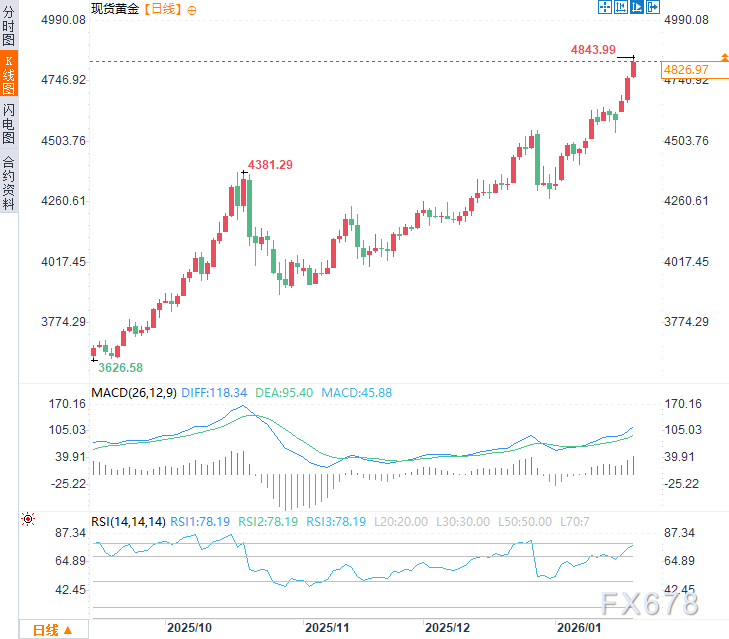
(Spot gold daily chart, source: Easy FX678)
At 10:27 (UTC+8), spot gold is quoted at $4,821.40 per ounce.
Disclaimer: The content of this article solely reflects the author's opinion and does not represent the platform in any capacity. This article is not intended to serve as a reference for making investment decisions.
You may also like
XRP Price Shoots for $1.95 as Institutional Cash Reaches a Fever Pitch
NVIDIA’s Rapid S-Curve Growth: Constructing the Foundation for AI Infrastructure
How Changes in Policy and Global Geopolitical Strains Are Transforming Bitcoin Trading
Trending news
MoreCrypto prices
More





