
Goldman Sachs Latest View: US Photovoltaic 4Q25 Earnings Season, Certainty Is Returning

After more than two years of policy, interest rate, and sentiment fluctuations in the new energy sector, Goldman Sachs gave a relatively clear judgment in its latest report, "Americas Clean Technology: Solar 4Q25 Preview":
Here is their relatively clear assessment:The U.S. solar market, especially utility-scale, is returning to a focus on fundamentals..
(Report release date: January 19, 2026, total 37 pages)
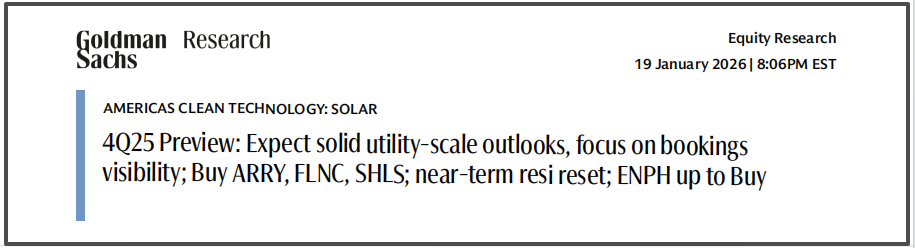
The core of this report is not about the financial performance of a single company, but rather attempts to answer three questions:Is demand still there? Are orders real? Which companies can turn execution into profit?
I. First, the conclusion: The industry is not dead, but the logic is changing
Goldman's overall view for 2026 is constructive:
Covered companies' 2026 revenue expected to grow about 20% year-over-year on average
Market focus is shifting from "Are policies getting worse?" to "orders, execution, and cash flow"
Utility-scale solar has become the most certain main theme
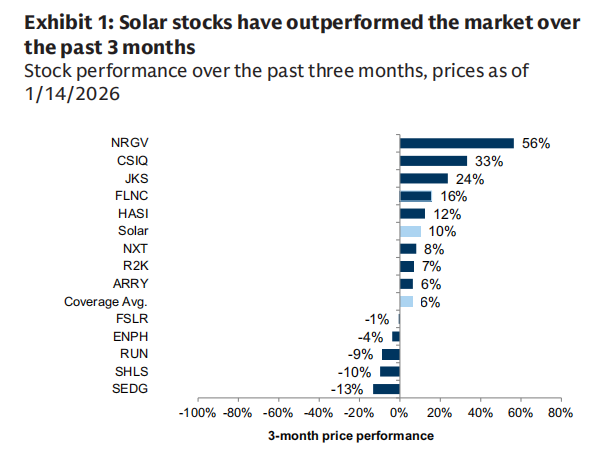
In the past few months, solar stocks have outperformed the broader market, but this rally is not sentiment-driven. Instead, it comes from two more "rigid" variables:
Structural uptrend in U.S. electricity demand (data centers, AI load)
Phased clearing of policy uncertainties (safe harbor rules, subsidy details gradually implemented)
II. The true main line: Utility-scale solar + energy storage
Goldman Sachs repeatedly emphasizes a key point in the report:
Utility-scale is the core engine of U.S. solar for the next few years.
Several key data points are worth noting:
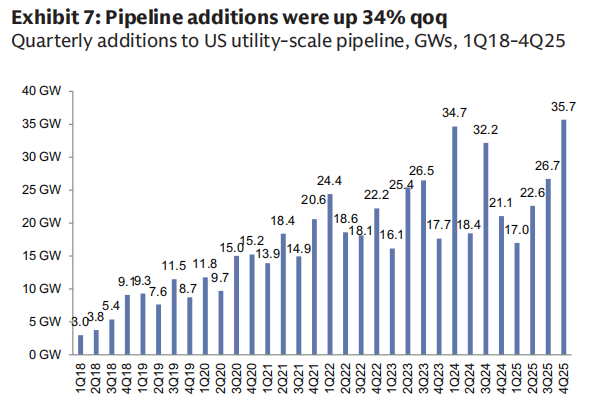
4Q25 U.S. utility-scale solaradded project pipeline about 36GW,
up 34% quarter-over-quarter, up 69% year-over-yearA new historical high for the third consecutive quarter
The industry has basically emerged from the "macro + policy noise period" of the first half of 2025
At the same time,energy storage is becoming the second growth curve for solar companies:
Battery storage orders are strongly tied to power demand from data centers
Companies with energy storage capabilities or related product lines are significantly more favored by institutions
III. What are institutions buying? Not the biggest names, but "mid-sized companies that can deliver"
In this report, Goldman's key recommendations are not the traditional "solar industry leaders," but rathermid- and small-cap companies with stronger execution and order visibility:
Array Technologies (ARRY)
Fluence Energy (FLNC)
Shoals Technologies (SHLS)
Their common traits are clear:
Orders and backlog can be verified
Directly benefit from utility-scale and energy storage demand
Relatively less sensitive to subsidies and short-term policy changes
In addition, in this report Goldman Sachsupgraded Enphase's rating to Buy. The core logic is not "residential solar will rebound soon," but rather:
Market expectations have been suppressed to extremely low levels
Safe harbor orders and product line advances bring the possibility of short-term upside surprises
IV. But risks are also real: Short sellers haven't disappeared
An easily overlooked detail is:
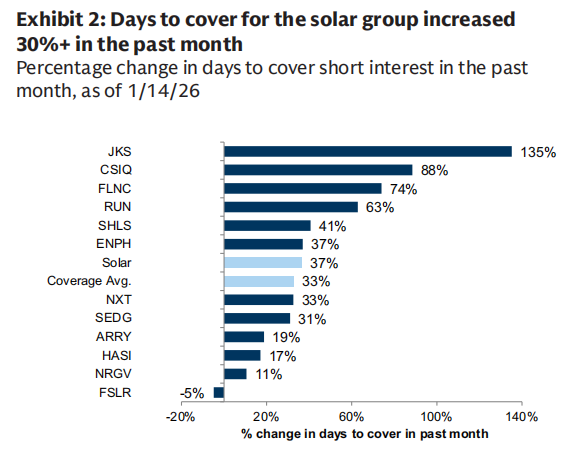
Short positions in the solar sector are rising.
In the past month, covered companies' "days to cover" has generally risen over 30%
Showing that the market still harbors doubts about:
Policy reversals
Overseas supply
Module prices
continuing to be questioned
What does this mean?
This is not a "no-brainer" rally, but one where "differentiation will be very pronounced."
My interpretation:
In one sentence, to summarize this Goldman Sachs report:
The story of solar has shifted from a "policy gamble" back to "industry and electricity demand logic."
In the next two years, the market will truly reward companies that excel in three areas, not those with the loudest slogans:
Whether orders can keep coming in
Whether projects can be delivered on time
How deeply energy storage and electricity demand are integrated
For investors, this also means:
Solar is no longer a "directional" sector, but an "individual company" industry.
Disclaimer: The content of this article solely reflects the author's opinion and does not represent the platform in any capacity. This article is not intended to serve as a reference for making investment decisions.
You may also like
Stocks fall while oil prices rise after Iran warns it may respond to ground offensive
AI Chip Export Regulations: An Overview of Nvidia, AMD, and Cryptocurrency Trends
NFLX on March 5: Upside After Deal Call-Off or Trap?
Meta's Drop on March 5: Examining Loss Aversion and Herd Mentality
Trending news
MoreCrypto prices
More





