
UBS Research Report: Netflix—Why Accelerate Investment at This Point?

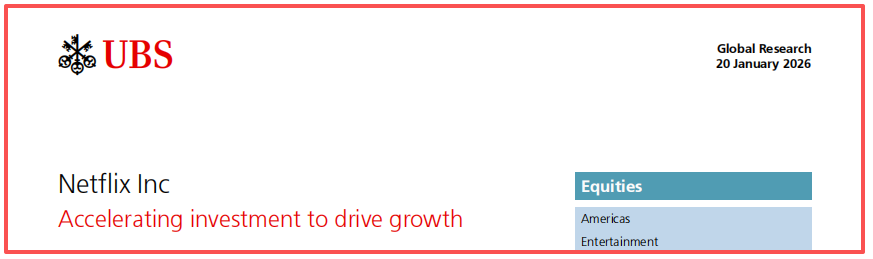
UBS released an analyst report on January 20. Through this report, we will break down three things today:
Netflix’s actual current business status
Why the short-term “noisy” margin isn’t worrying institutions
Where future growth truly comes from
I. The Results Aren’t Bad — The Issue Is with the “Pace,” Not the “Direction”
Looking at the results, Netflix’s business performance is not weak:
Q4 2025 revenue grew 18% year-on-year
Operating profit grew 30% year-on-year
Performance was obviously better than prior guidance
What really caused market divergence is the outlook for 2026:
Revenue guidance of 12–14%, within an acceptable range
But margin expansion is clearly slowing down
UBS’s judgment is clear:
This is not a demand issue, nor a deterioration in the business model, but a phased result of the company proactively accelerating investment.
II. The Core Reason for “Noisy” Margins: Active Expansion, Not Passive Pressure
Breaking down the pressure on the profit side, it mainly comes from three types of investment:
Content investment continues to rise
2026 content budget approaches $20 billion
Covering film/TV, live streaming, licensing, and more
Accelerated advertising business development
Including ad tech, sales system, and content adaptation
Short-term costs are front-loaded, but scale effects are still forming
Regional and compliance costs
Tax and transaction costs are rising in Latin America, EMEA, and other regions
These are structural costs, not a decline in operational efficiency
UBS clearly points out:
The noise in margin comes from the investment pace, not from a weakening fundamental.
III. Where Does Growth Come From? The Answer Is Still Subscriptions + Ads
1️⃣ Subscriptions Remain the “Chassis” of Growth
Expected new subscribers in 2026: around 22 million
ARM (average revenue per member) expected to grow about 5% year-on-year
Management remains restrained about price increases, but hasn’t given up long-term potential
Institutional view:
Netflix’s pricing power has not disappeared, they are just choosing to delay using it.
2️⃣ Ad Business Enters the Second Stage
Advertising is repeatedly emphasized in this report:
2025 ad revenue has already increased significantly
UBS expects ad revenue in 2026 to potentially double again
No longer just “supplemental income,” but an important mid-term growth variable
This means Netflix’s business model is shifting from
“Single-subscription driven”
to
“Dual engine of subscriptions + ads.”
IV. Several Market Concerns — What Do Institutions Think?
Content copyright uncertainty
→ Seen as a short-term disturbance, not affecting long-term competitive landscape
Margin fluctuations
→ Clearly a phased phenomenon, not a trend reversal
Capital return capacity
→ Free cash flow in 2026 is expected to exceed $11 billion
→ Buybacks and capital flexibility remain ample
UBS’s core stance is:
These concerns do not change Netflix's long-term model assumptions.
My Understanding:
What Netflix is doing now is not “betting on growth,” butactively extending the growth curve on the premise that its advantages are still in place.
Short-term profits aren’t pretty — that’s a fact;
But from the perspective of institutional models, this looks more like aproactive shift in pace, not a forced concession.
When content, ads, and user scale are all still rising,
the market’s final discussion won’t be about margins in a particular year,
but about how high Netflix’slong-term ceiling can still be raised.
Disclaimer: The content of this article solely reflects the author's opinion and does not represent the platform in any capacity. This article is not intended to serve as a reference for making investment decisions.
You may also like
DigitalOcean's Agentic Inference Cloud: Creating the Infrastructure for Deploying AI in Production
Indian Rupee falls to an all-time low as USD/INR jumps amid rising oil prices and increased risk aversion
Safe Bulkers at the Capital Link Forum: Steering Dry Bulk Operations Amid Changing Macro Trends
Trending news
MoreCrypto prices
More





