

The risk-adjusted returns of Bitcoin have once again sparked debate within the financial community. According to CryptoQuant data, Bitcoin’s Sharpe Ratio has turned negative, highlighting that the risk-return balance closely watched by fund managers has failed to deliver a satisfactory premium despite significant fluctuations. After reaching over $120,000 at the beginning of October, Bitcoin’s price pulled back to around $90,000, with high volatility further squeezing risk-adjusted performance. While some commentators on social media interpret the negative value as a “bottom signal,” the metric reflects current market conditions rather than future directions.
Bitcoin’s Risk-Reward Dynamics Shift as Sharpe Ratio Turns Negative
By:Cointurk
Bitcoin’s Sharpe Ratio Turns Negative
According to the metric shared by CryptoQuant, Bitcoin’s Sharpe Ratio turning negative indicates that the “additional return” over risk-free yields, such as U.S. Treasury bonds, has been inadequate relative to volatility. The Sharpe Ratio, commonly used in fund management, measures how much reward a given investment provides for the level of volatility assumed; a negative value points to a balance where the risk undertaken is not compensated.
Market behavior aligns with this scenario: sharp intraday swings and unstable recoveries have failed to drive returns permanently higher. Although prices remain significantly below record highs, the continued high volatility keeps putting pressure on risk-adjusted returns.
What Does a Negative Sharpe Indicate?
A negative Sharpe Ratio emerges as a signal during some of the most challenging periods of bear markets. In the past, towards the end of 2018, the metric stayed negative for months, with prices lingering in low ranges. Similarly, in 2022, during a process dominated by leverage-induced sell-offs and forced liquidations, the Sharpe Ratio remained weak, and the “negative condition” persisted even after price declines slowed.
A CryptoQuant analyst emphasized that the Sharpe Ratio does not precisely capture the bottoms; however, the risk-return balance historically resets to levels seen before significant movements. The assessment also stated that while the market exhibits an “oversold” characteristic and the risk-adjusted scenario could appear more favorable for long-term positioning, it doesn’t necessarily imply that the price can’t go lower.
Traders typically focus on whether the metric shows a steady recovery towards the positive region following a prolonged period of weakness. Such a shift could indicate a phase where returns start to surpass volatility, and the risk-return dynamics improve. In the current picture, with Bitcoin hovering around $90,000, it displayed unusual “saw-tooth” movements throughout the week, and a weak performance continued compared to gold, bonds, and global technology stocks.
0
0
Disclaimer: The content of this article solely reflects the author's opinion and does not represent the platform in any capacity. This article is not intended to serve as a reference for making investment decisions.
PoolX: Earn new token airdrops
Lock your assets and earn 10%+ APR
Lock now!
You may also like
Private Credit in the Shadows: Evaluating Claims of Systemic Risk
101 finance•2026/03/06 06:06
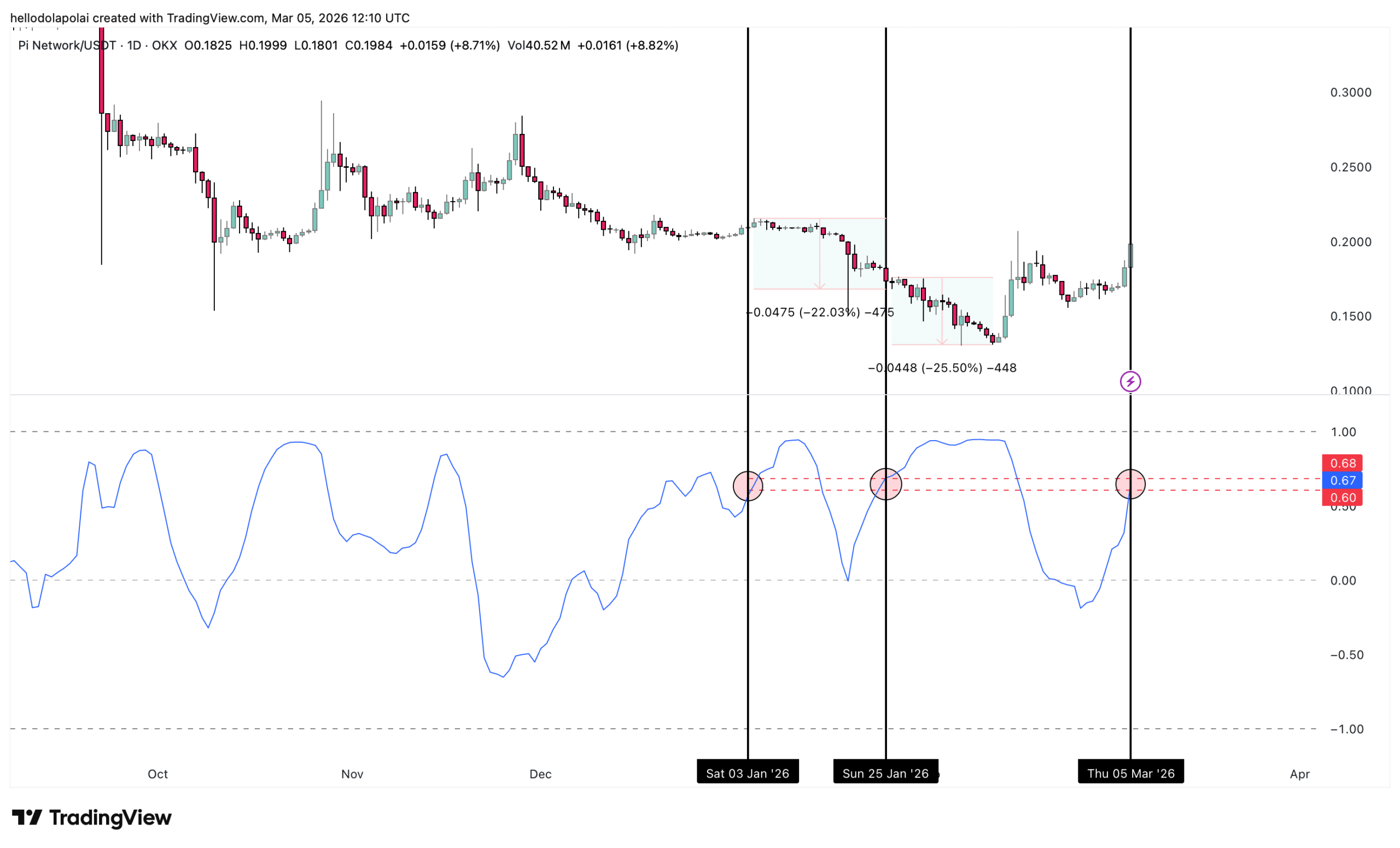
Why PI’s 14% price uptick will face downside risk from its correlation with Bitcoin
AMBCrypto•2026/03/06 06:03
Bitcoin not an 'allowable asset': Vancouver city staff asks council to drop BTC reserve motion
The Block•2026/03/06 06:03
USD/CHF stays muted around 0.7800 while the US Dollar holds firm after its latest advances
101 finance•2026/03/06 06:00
Trending news
MoreCrypto prices
More
Bitcoin
BTC
$70,449.29
-2.71%

Ethereum
ETH
$2,069.41
-2.45%

Tether USDt
USDT
$1.0000
-0.01%

BNB
BNB
$645.04
-1.18%

XRP
XRP
$1.4
-1.31%

USDC
USDC
$0.9999
+0.00%

Solana
SOL
$87.87
-2.81%

TRON
TRX
$0.2859
+0.40%

Dogecoin
DOGE
$0.09353
-2.87%

Cardano
ADA
$0.2685
-1.79%
How to buy BTC
Bitget lists BTC – Buy or sell BTC quickly on Bitget!
Trade now
Become a trader now?A welcome pack worth 6200 USDT for new users!
Sign up now