
Hershey (NYSE:HSY) Announces Strong Fourth Quarter Results for Fiscal Year 2025

Hershey Surpasses Q4 2025 Revenue Forecasts
Hershey (NYSE:HSY), the renowned chocolate maker, released its fourth quarter results for calendar year 2025, outperforming analysts’ revenue projections. The company posted a 7% year-over-year increase in sales, reaching $3.09 billion. Adjusted earnings per share came in at $1.71, exceeding consensus estimates by 21.8%.
Highlights from Hershey’s Q4 2025 Performance
- Total Revenue: $3.09 billion, surpassing analyst expectations of $2.98 billion (7% annual growth, 3.8% above estimates)
- Adjusted EPS: $1.71, beating the projected $1.40 (21.8% above estimates)
- 2026 Adjusted EPS Outlook: Midpoint guidance of $8.36, topping analyst forecasts by 17.9%
- Operating Margin: 14.4%, a decline from 32.5% in the prior year’s comparable quarter
- Organic Revenue: Up 5.7% year over year
- Sales Volume: Decreased by 3% compared to last year (previously down 6%)
- Market Cap: $41.73 billion
Kirk Tanner, President and CEO of The Hershey Company, remarked, “As we move into 2026, we remain highly confident in our business momentum.”
About Hershey
Famous for its classic milk chocolate bars and Hershey’s Kisses, Hershey (NYSE:HSY) stands as a leading name in the chocolate industry.
Examining Revenue Trends
Long-term growth is a key indicator of a company’s strength. While any business can deliver strong results in the short term, sustained expansion over several years is a sign of lasting quality.
With annual revenues totaling $11.69 billion, Hershey is a major player in the consumer staples sector. Its strong brand recognition helps drive sales, but its large market presence also makes it challenging to achieve significant incremental growth. To boost sales further, Hershey may need to adjust pricing strategies, introduce new products, or expand internationally.
Over the past three years, Hershey’s sales have grown at a modest compound annual rate of 3.9%, reflecting a slowdown as consumers purchase fewer of its products. We’ll discuss the implications of this trend in the “Volume Growth” section below.
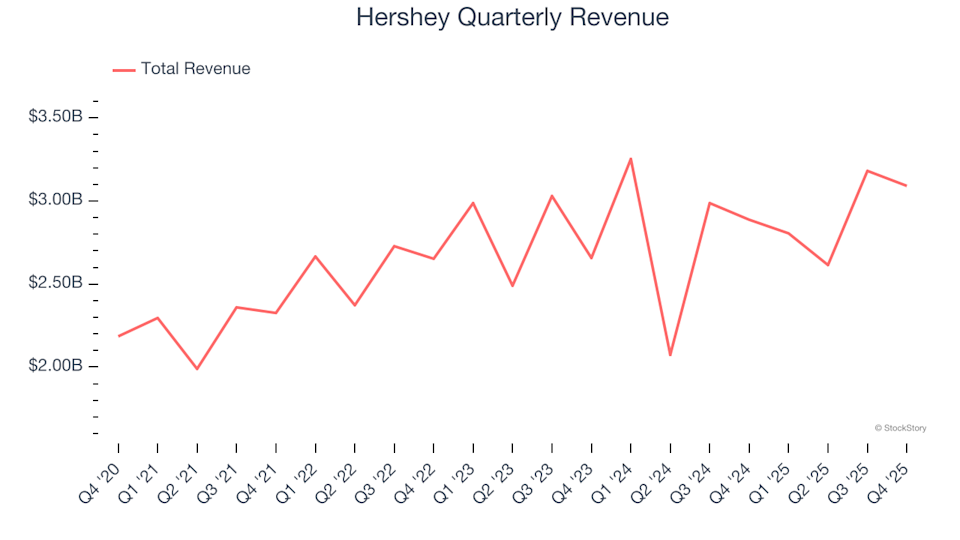
In the latest quarter, Hershey achieved a 7% year-over-year increase in revenue, with its $3.09 billion in sales topping Wall Street’s forecast by 3.8%.
Looking forward, analysts anticipate Hershey’s revenue will rise by 2.6% over the next year, mirroring its recent growth pace. This projection suggests the company may face ongoing demand challenges.
Volume Growth Analysis
Revenue increases can result from higher prices or greater sales volumes. For consumer staples, volume is especially critical, as there’s a limit to how much consumers will pay for everyday products—they can always switch to less expensive alternatives if prices rise too much.
Hershey’s average quarterly sales volume has declined by 1.2% over the past two years, which is concerning since demand for staple goods is usually stable.
During the fourth quarter of 2025, Hershey’s sales volume dropped by 3% year over year, indicating a further slowdown and highlighting challenges in moving product.
Summary of Hershey’s Q4 Results
We were encouraged by Hershey’s robust full-year EPS guidance, which significantly outperformed analyst expectations. The company’s strong organic revenue growth also contributed to its earnings beat, making for a solid quarterly report. Following the announcement, Hershey’s stock price rose 3.5% to $213.
While this quarter’s results were positive, a single earnings report isn’t enough to determine whether Hershey is a buy. Evaluating the company’s long-term quality and valuation is essential for making an informed investment decision.
Disclaimer: The content of this article solely reflects the author's opinion and does not represent the platform in any capacity. This article is not intended to serve as a reference for making investment decisions.
You may also like
BWA or OPLN: Which Is the Better Value Stock Right Now?
BGC or TW: Which Is the Better Value Stock Right Now?
OMRNY vs. VPG: Which Stock Is the Better Value Option?
SONVY vs. IDXX: Which Stock Should Value Investors Buy Now?
Trending news
MoreCrypto prices
More





