
The "False Safe Haven" of Gold That Wall Street Fears Most! What Risks Are Hidden Behind CME's Three Margin Increases in Two Weeks?

Fxstreet, February 6—— On Friday (February 6), the continuous sell-off in global stock markets provided buying support for gold, a traditional safe-haven asset. The Chicago Mercantile Exchange (CME) raised margin requirements for gold and silver futures trading for the third time in less than two weeks, all pointing to a core theme: the market is undergoing a painful structural adjustment, transitioning from ultra-high volatility to a new equilibrium.
On Friday (February 6), the ongoing sell-off in global stock markets provided buying support for gold, a traditional safe-haven asset. Spot gold rebounded from the previous day's sharp swings, with a significant daily gain, once approaching the $4,860 per ounce level during the session. However, this rally should be defined more as a combination of technical correction and heightened risk aversion, rather than a trend reversal. Meanwhile, silver's performance revealed deeper market contradictions: it plunged over 10% during early Asian trading, hitting a six-week low, and although it later rebounded, it still ended the week down more than 12%, extending last week's record-breaking decline. This extreme divergence within precious metals, along with the CME's third margin hike for gold and silver futures in less than two weeks, all point to a core theme: the market is undergoing a painful structural adjustment, transitioning from ultra-high volatility to a new equilibrium.
Fundamental Analysis: A "Fragile" Environment Amidst Mixed Bullish and Bearish Factors
The current market fundamentals cannot be simply summarized as "rising risk aversion," but rather as a "fragile" environment shaped by multiple competing forces. On one hand, there are clear supporting factors: the broad decline in global stock markets, especially the spillover of Wall Street's sell-off into Asian markets, has directly triggered increased allocation to gold as a safe-haven asset. At the same time, geopolitical tensions—particularly the critical talks between the US and Iran in Oman—add uncertainty and provide a potential geopolitical risk premium to gold prices. An analyst from a well-known institution pointed out that some risk-averse capital inflows were indeed observed, but the shadow of last Friday’s epic sell-off still hangs over the market, making buyers more cautious.
On the other hand, strong restrictive and disruptive factors are equally prominent and have even altered market dynamics. The first is the strengthening US dollar. The dollar index hovered near a two-week high after former US President Trump nominated Kevin Warsh as the next Federal Reserve Chair, adding uncertainty to monetary policy prospects and putting direct pressure on dollar-denominated gold. The second is the market infrastructure’s stress response. CME’s consecutive margin hikes—from January 30, February 2, to this Thursday (February 5)—have occurred at a frequency rarely seen in recent years. While this move is ostensibly a standard operation by the exchange to control market volatility risk, its deeper impact is the systematic cleansing of high-leverage speculative positions. Raising margins increases the holding cost for short-term traders and forces some capital out of the market, which itself is one of the reasons for sharp price swings, forming a feedback loop of "volatility triggers margin hikes, margin hikes intensify volatility." Analyst Ole Hansen’s view hits the mark: before volatility subsides and price discovery improves, gold—especially silver—is likely to continue to trade with sharp two-way swings.
Lastly, there are conflicting signals on the physical demand side. With the Chinese Lunar New Year approaching, some analysts believe the price pullback may stimulate physical buying in consumer countries. However, another major gold consumption market, India, presents a different picture: the local gold premium has fallen by more than half from a ten-year high this week, and the high and volatile prices have clearly dampened buyer interest. This reveals the suppressive effect of high price zones on physical demand and the divergence in demand logic across regions.
Technical Analysis: Corrective Rally Faces Key Resistance
According to the four-hour chart technical indicators provided, gold is currently at a critical stage of correction and decision-making. Prices are hovering near the middle Bollinger Band (around $4,853), which serves as a reference point for short-term bullish or bearish positioning. The Bollinger Band itself is extremely wide, with the upper band at $5,160 and the lower at $4,546, visually reflecting the exceptionally volatile market range in recent days. After the previous plunge, prices have rebounded toward the middle band, testing its validity.
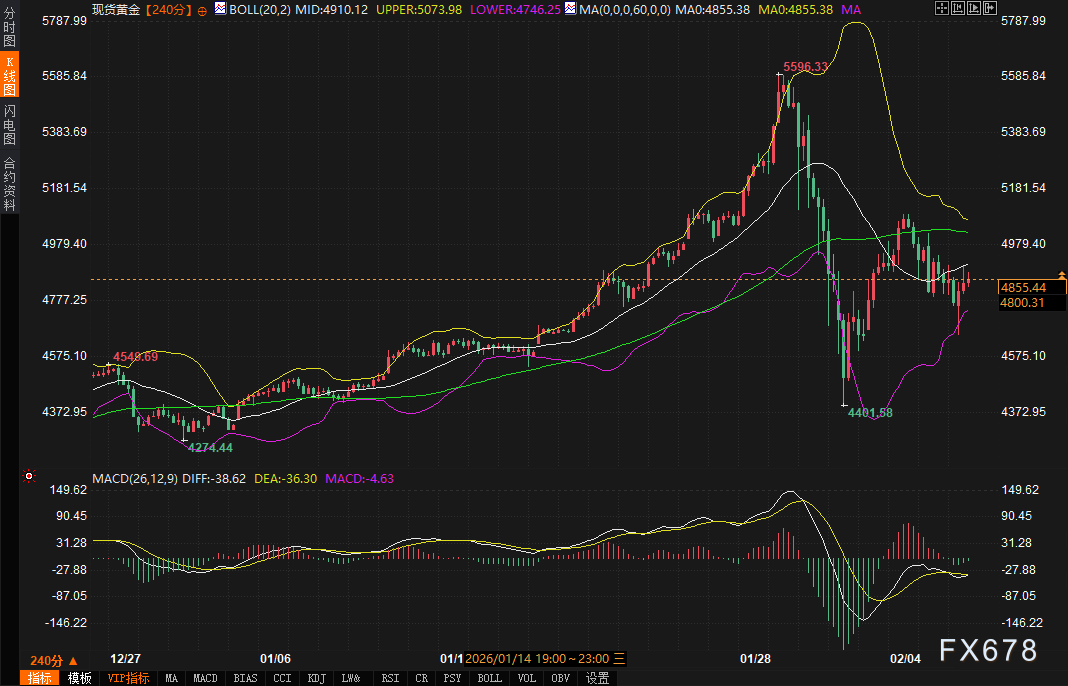
The MACD indicator is still below the zero line, indicating that the bearish trend has not fully reversed, but the negative value gap between the DIFF line (-23.23) and the DEA line (-32.62) has narrowed, suggesting that downward momentum is easing and a short-term corrective rebound is underway. Market analyst Kelvin Wang has identified key short-term resistance at $5,169 and critical support at $4,400, forming the upper and lower bounds of the current wide trading range. Unless gold can effectively break and hold above the middle band and higher resistance, the current rally can only be defined as a rebound within a downward trend.
IV. Outlook for Future Trends
Looking ahead, the short-term direction of the gold market will depend on the outcome of competition at several levels:
1.
2.
3.
4.
Overall, the gold market is in a chaotic period where the old trend has been broken, and a new equilibrium has yet to be established. Its fundamental safe-haven attributes provide a value floor, especially amid geopolitical tensions and stock market corrections. However, the deleveraging process triggered by exchange intervention, and the resulting ultra-high volatility, is currently suppressing and distorting its price discovery function. In the coming period, the market is likely to remain in a wide-ranging oscillation pattern until one of the aforementioned bullish or bearish factors gains decisive advantage, or the market structure completes its self-cleansing. Investors should prioritize managing volatility risk over simply judging direction.
Disclaimer: The content of this article solely reflects the author's opinion and does not represent the platform in any capacity. This article is not intended to serve as a reference for making investment decisions.
You may also like
Top Analyst: Cardano (ADA) is Building Foundation for Major Rally
CenterPoint Energy Rises 0.48% Driven by Earnings and Capital Investments, Ranking 502nd in Trading Volume
Trending news
MoreCrypto prices
More





