(Kitco News) – While silver prices are establishing a higher floor in 2026, the ceiling remains unclear, with burgeoning global demand creating upside and downside risks to price forecasts, according to analysts at J.P. Morgan Global Research.
In a note published Tuesday, the analysts said silver is attempting to step out of gold’s shadow in 2026, but whether it can or not remains unclear.
“Like Robin to gold’s Batman, silver has been known to play eternal sidekick in the world of precious metals — often overlooked by its more illustrious counterpart,” they wrote. “Despite silver’s practical applications in industrial processes and outputs, including as a paste used on solar panels and arrays to collect and transport electricity, the price ratio of gold to silver has at times eclipsed 100/1.
“At present, however, the ratio is as close as it’s been in 15 years,” they added, “as both gold and silver prices undergo extreme volatility to start 2026 — including a stretch where, at least by net appreciation in value, silver’s rise began to eclipse gold’s.”
J.P. Morgan sees a big part of those gains coming as a result of U.S. tariff policy. “For months, the U.S. Commerce Department underwent a review of critical minerals under Section 232, a specific provision of the U.S. Trade Expansion Act of 1962 that allows the President to impose tariffs or other trade restrictions on imports if they are deemed to threaten national security,” the analysts wrote. “That period of uncertainty ended in mid-January, with President Trump holding off on imposing new tariffs on imports of critical minerals, including silver, and instead seeking bilateral agreements with trading partners to secure adequate supply. Silver’s price dipped then rebounded after that executive order.”
The next proximate cause in silver’s decline came on January 30, when the president announced the nomination of Kevin Warsh as the next Fed chair. “Silver crashed 27%, alongside a 10% drop in gold prices,” they noted.
And while Warsh’s nomination, together with a near-term strengthening of the U.S. dollar, seem to have slowed the outsized demand for precious metals, the analysts said specific structural drivers remain that are likely to continue constraining silver’s supply.
“One is that, by and large, silver is mined as a byproduct of other metals, meaning production is somewhat less elastic to higher silver prices,” they noted. “Another is silver’s role in industrial processes, such as the manufacture of solar panels.”
Gregory Shearer, head of Base and Precious Metals Strategy at J.P. Morgan, sees a scenario in which high silver prices could compel solar manufacturers top switch to silver-free technologies to restrain costs, while also finding ways to reduce the amount of silver needed for each solar panel.
“Long term, the largest risk we see for silver comes from more widespread adoption of silver-free technology, such as the cadmium telluride thin-film technology,” Shearer said, referring to one such silver-free technology. “While a precious metal at its core, silver is still a very industrial metal, with industrial applications accounting for about 60% of total demand (excluding ETF flows). From a fundamental perspective, we believe the surge higher in silver has likely already set in motion a meaningful acceleration in substitution and thrifting trends, which will leave scar tissue on silver balances over the coming quarters.”
Shearer acknowledged, however, that these changes may take years. In the near term, he still sees fluctuations in investment demand as the main price driver.
J.P. Morgan Global Research sees higher floor being established for silver prices — but an unclear ceiling.
“One reason gold enjoys more dependable demand than silver is that its buyer base is wider and includes global central banks, which purchase gold as diversification from USD reserve holdings, as well as for its virtues as an inflation hedge and liquid asset with no counterparty risk,” the report noted. “Silver doesn’t enjoy that same baseline demand — which is part of the reason why a fair silver price may be harder to ascertain.”
“Without central banks as structural dip buyers as in gold, we do think there remains the risk for a further move back higher in the gold to silver ratio,” Shearer said, but added that global demand – particularly in China and India – will play a crucial role in determining where silver prices find support after recent pullbacks.
“With amplified Chinese investment demand significantly influencing price formation across the metals complex, we believe this remains another catalyst to watch in silver over the coming weeks,” Shearer said. “Ultimately, we are more cautious on re-engaging in silver in the near term until it becomes clearer that some of the recent froth in prices has been fully shaken out.”
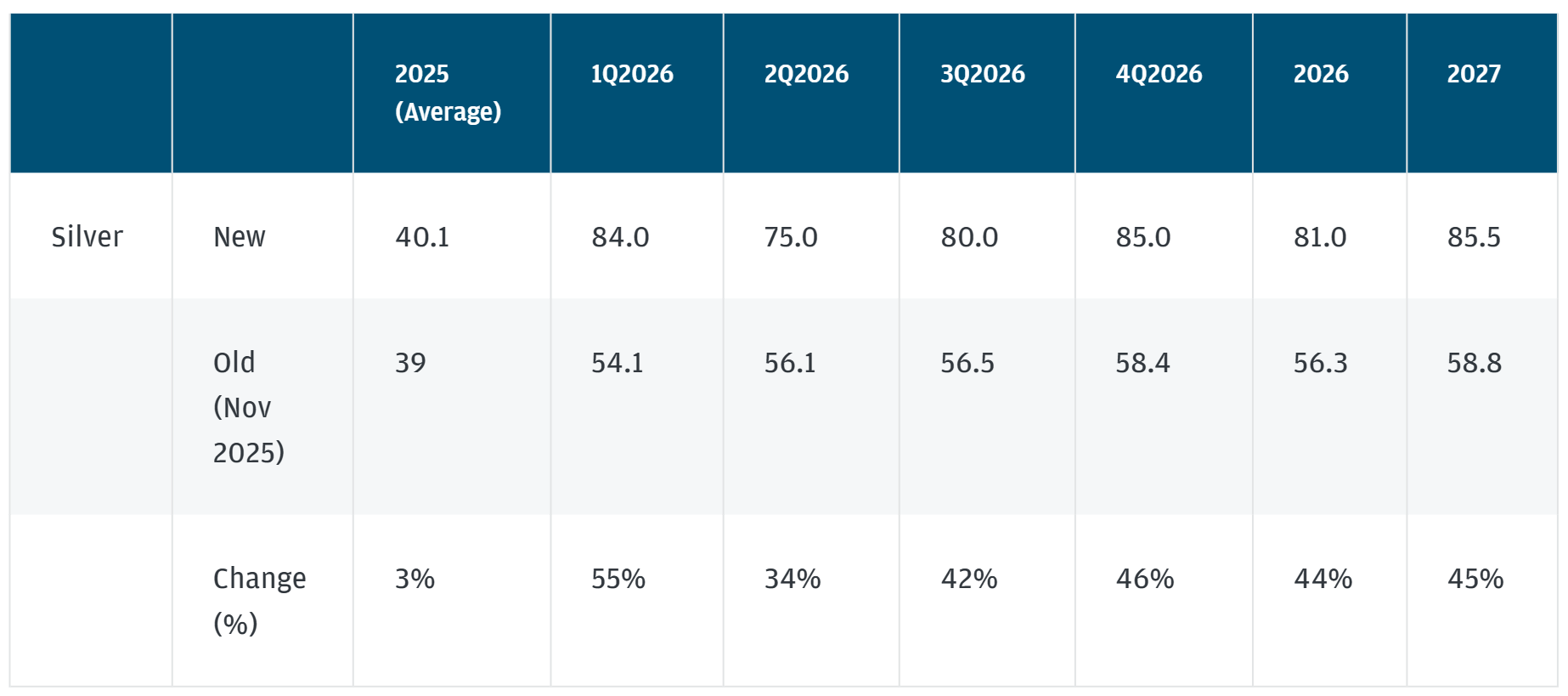
J.P. Morgan Global Research sees silver prices averaging $81 per ounce in 2026, with Q4 predicted to have the highest average price of $85, while they forecast the gray metal to average $85 in 2027.