
Top Economist Says America's Winning Trade War Despite $70.3 Billion In Deficit: US Runs Enormous 'Stuff Surplus'

In a provocative challenge to traditional economic anxieties, top economist Justin Wolfers is reframing the widening U.S. trade gap not as a fiscal failure, but as an enormous physical “surplus” that signals a historic boom in American material wealth.
The ‘Stuff’ Surplus
While the U.S. Census Bureau announced a sharp rise in the goods and services deficit to $70.3 billion for December 2025, Wolfers argues that the public is looking at the ledger backward.
“The U.S. has an enormous trade surplus with the rest of the world,” Wolfers stated in a recent viral analysis. “It has a trade surplus in stuff.”
Wolfers explains that what is technically labeled a deficit is simply a massive influx of physical goods—cars, electronics, and industrial supplies—exchanged for “pieces of paper,” or U.S. dollars.
“We retained more stuff from the rest of the world than we sent to the rest of the world,” he noted, adding rhetorically, “doesn't stuff make you just as happy as pieces of paper?”
Imma blow your mind…
— Justin Wolfers (@JustinWolfers) February 22, 2026
While the U.S. has a trade DEFICIT in $, we also have a trade SURPLUS in stuff.
They're the same: We buy more stuff from abroad than we sell, so more money leaves than comes in, but more stuff comes in, than leaves.
So is this a deficit, or a surplus?
Data Driven Consumption
The latest data supports this “stuff” influx. December imports surged to $357.6 billion, driven by a $10.2 billion increase in physical goods.
Significant gains were observed in high-value consumption and capital categories, including a $3.4 billion increase in computer accessories and a $1.3 billion rise in telecommunications equipment.
The Capital Counterpoint
Echoing this sentiment, ARK Invest CEO Cathie Wood recently noted that “the other side of a trade deficit is a capital surplus.”
Wood argues that the current trade environment, recently characterized by the Supreme Court striking down sweeping tariffs, could actually accelerate growth by acting as a “tax cut” for consumers.
Despite the monthly spike, the total 2025 deficit actually decreased slightly by $2.1 billion from 2024, ending the year at $901.5 billion. For Wolfers, this gap represents the ultimate consumer win: a country so wealthy it can trade its currency for a mountain of global products.
Blue Chips Gain As Tech Lags In 2026
As of Friday’s close, the Dow Jones index rose 2.57% year-to-date, whereas the S&P 500 was 0.74% higher and the Nasdaq Composite index was down 1.50% in 2026.
The SPDR S&P 500 ETF Trust (NYSE:SPY) and Invesco QQQ Trust ETF (NASDAQ:QQQ), which track the S&P 500 index and Nasdaq 100 index, respectively, closed higher on Friday. The SPY was up 0.72% at $689.43, while the QQQ advanced 0.88% to $608.81.
Image via Shutterstock
Disclaimer: The content of this article solely reflects the author's opinion and does not represent the platform in any capacity. This article is not intended to serve as a reference for making investment decisions.
You may also like
General Mills Outlook Clouded By Soft Consumer Spending, Pet Segment Struggles, Analysts Say
Chinese Analyst Sets Critical Level: “Bitcoin Below This Point Would Mean a Deep Bear Market”
Cardano Whales Dump $30 Million Before Breakdown — Is Retail Buying the Wrong Dip
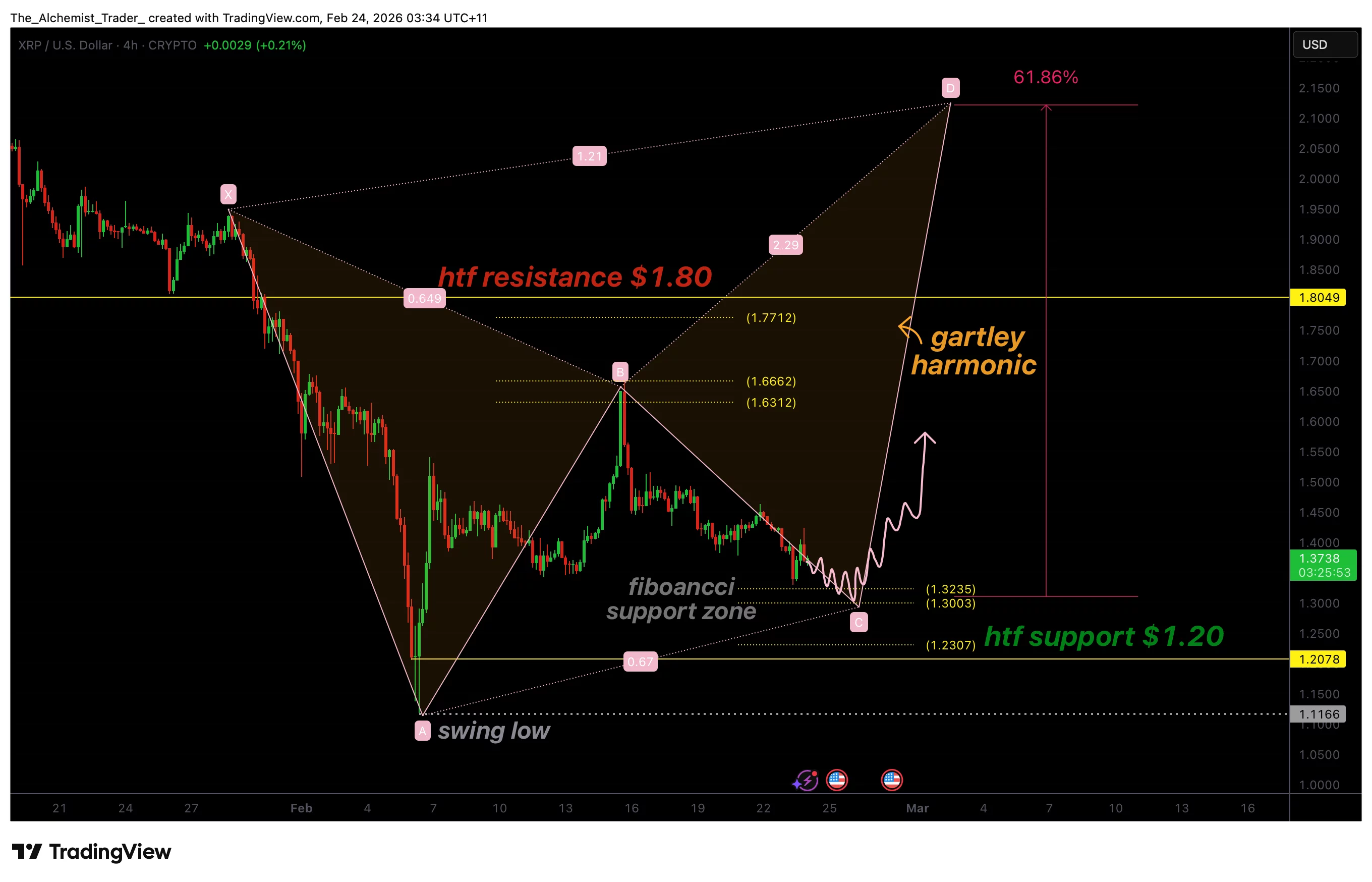
XRP price forms gartley pattern at $1.30: Bullish bottom developing?
Trending news
MoreCrypto prices
More





