
Should You Buy, Sell or Hold Opendoor Stock Post Q4 Earnings?

Opendoor Technologies Inc. OPEN reported fourth-quarter 2025 results, reflecting tangible progress under its revamped “Opendoor 2.0” operating model. While near-term financial performance remained pressured by legacy inventory and a softer housing backdrop, management highlighted improving unit economics, faster resale velocity and a clearer path toward profitability.
During the quarter, the company reported revenues of $736 million, topping estimates but declining 32.1% year over year. It posted an adjusted loss per share of 7 cents, narrower than the Zacks Consensus Estimate of a loss of 8 cents. GAAP gross profit totaled $57 million, with gross margin expanding 50 basis points sequentially to 7.7%. For more details, read: Opendoor Q4 Loss Narrower Than Expected, Revenues Down Y/Y.
Management stated faster inventory turns, a decline in homes held for more than 120 days, and continued expansion of its capital-light Cash Plus offering. The company stated that it is advancing its previously articulated four-pronged transformation strategy targeting breakeven Adjusted Net Income on a forward 12-month basis by 2026-end, alongside enhancements in unit economics, accelerated transaction velocity, direct-to-consumer engagement and product expansion.
As of Friday, Opendoor stock is trading 54% below its 52-week high of $10.87 (attained on Sept. 17, 2025). So, should investors pour more capital into OPEN now? Let us take a closer look.
Key Drivers of Opendoor’s Q4 Performance
Opendoor continues to advance its Opendoor 2.0 framework, with underwriting refinement and pricing precision serving as central pillars of its operating model. Management highlighted measurable improvement in newer acquisition cohorts, reflecting tighter buy-box standards and enhanced analytics. The updated approach is designed to align acquisition pricing more closely with real-time market conditions, supporting improved contribution margins and more consistent resale outcomes.
Resale velocity has emerged as another important operational lever. The company reported a meaningful reduction in aged inventory, supported by more targeted pricing adjustments and improved listing strategies. Faster inventory turnover reduces the duration of market exposure and supports more predictable performance across varying housing conditions. Management emphasized that newer cohorts are turning at a materially quicker pace compared with prior periods.
Opendoor’s capital-light initiatives are also gaining traction. The Cash Plus offering has expanded as a share of contracts, providing sellers with alternative transaction structures while reducing balance-sheet intensity for the company. This mix shift supports capital efficiency and diversifies revenue streams, reflecting a broader effort to balance growth with risk management.
OPEN’s Challenges: Housing Volatility & Margin Risks
Despite measurable operational progress under its Opendoor 2.0 framework, Opendoor continues to navigate meaningful transitional pressures. Management acknowledged that recent performance has been influenced by the clearing of legacy inventory acquired under its prior operating strategy, which has weighed on near-term contribution margins. While newer acquisition cohorts are demonstrating improved pricing precision and resale velocity, the overall margin profile remains sensitive to the mix of older versus refreshed inventory. Until the portfolio fully transitions to homes purchased under the updated underwriting model, variability in contribution performance may persist.
Additionally, Opendoor remains exposed to fluctuations in home prices. Management noted that a 5%-10% decline in home values would impact margins, underscoring that the business is not insulated from broader housing movements. Although initiatives such as faster inventory turns, broader spread dispersion and the capital-light Cash Plus offering are designed to mitigate risk, the model continues to involve direct inventory ownership. At the same time, the company is scaling acquisitions, expanding geographic reach and introducing adjacent services such as mortgage offerings. Sustaining improved unit economics while executing these growth initiatives will be critical as Opendoor works toward its profitability targets.
Opendoor’s Price Performance & Valuation Insights
Opendoor stock has steadily gained momentum alongside improving fundamentals. Shares of Opendoor have soared 254.6% in the past year against the industry’s fall of 14.7%. Meanwhile, industry peers, such as Zillow Group, Inc. Z and Offerpad Solutions Inc. OPAD, have declined 39.5% and 62.8%, respectively, over the same time frame.
OPEN’s One-Year Price Performance
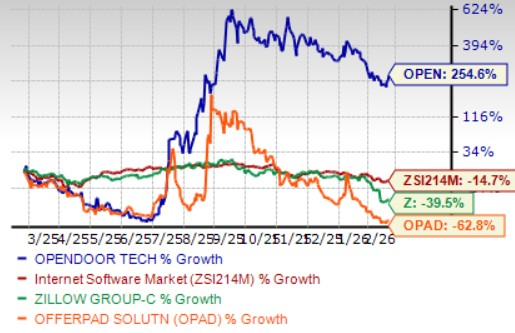
Image Source: Zacks Investment Research
From a valuation standpoint, OPEN trades at a forward price-to-sales (P/S) multiple of 0.77, significantly below the industry’s average of 3.89. Conversely, industry players, such as Zillow Group and Offerpad, have P/S multiples of 3.6 and 0.05, respectively.
OPEN’s P/S Ratio (Forward 12-Month) vs. Industry
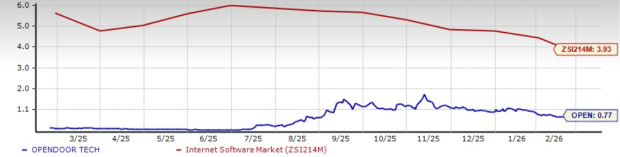
Image Source: Zacks Investment Research
OPEN’s Investment Verdict: Hold for Now
Opendoor is steadily advancing its Opendoor 2.0 transformation, supported by improved underwriting discipline, faster resale velocity and growing traction in capital-light offerings such as Cash Plus. The company’s focus on pricing precision, tighter acquisition standards and operational efficiency provides a clearer framework for long-term stabilization. Continued progress in newer acquisition cohorts and expanding product capabilities lay the groundwork for a more durable earnings profile over time.
However, transitional pressures from legacy inventory, ongoing exposure to home price fluctuations and the inherent balance-sheet intensity of holding homes could weigh on near-term margin performance. The path to sustained profitability remains execution-dependent, particularly as the company scales acquisitions and introduces adjacent services.
While Opendoor’s operational improvements and discounted valuation may appeal to long-term investors, housing market sensitivity and margin variability warrant careful consideration before initiating new positions. For existing shareholders, retaining this Zacks Rank #3 (Hold) stock appears reasonable as management works toward consistent profitability.
You can see the complete list of today’s Zacks #1 Rank (Strong Buy) stocks here.
Disclaimer: The content of this article solely reflects the author's opinion and does not represent the platform in any capacity. This article is not intended to serve as a reference for making investment decisions.
You may also like
Tesla Sues California DMV, Seeks to Overturn Ruling on False Advertising of FSD
Crypto Exchange Backpack Plans to Offer Company Equity to Token Stakers
Dragonfly’s Qureshi says crypto built for AI
Anthony Pompliano's Bitcoin Treasury ProCap Buys Back Stock Amid 85% Price Plunge
Trending news
MoreCrypto prices
More





