
Something Rare Is Happening In Emerging Markets - And You Are Still Missing It

While U.S. software stocks wobble under the weight of AI disruption and the S&P 500 grinds sideways, something quite rare is unfolding beneath the surface of global markets.
Emerging markets are quietly having a moment we haven't seen in decades.
The iShares MSCI Emerging Markets ETF (NYSE:EEM) has just posted nine consecutive weekly gains — its longest winning streak since 2005, the peak of the last major emerging market leadership cycle.
A 10-week winning streak — which could be achieved by the end of this week — would mark the first such run in the fund's more than 20-year history.
That alone would be notable.
But the relative performance tells the real story.
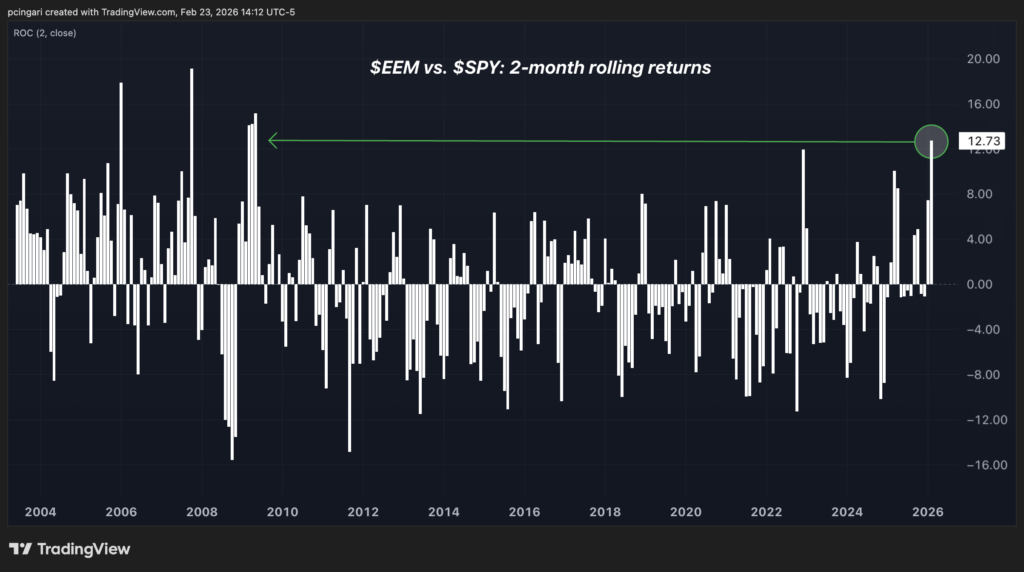
Over the past two months, EEM has outperformed the SPDR S&P 500 ETF Trust (NYSE:SPY) by 13 percentage points — the strongest relative surge since 2008. Over the past 12 months, emerging markets have beaten the S&P 500 by 25 percentage points, marking the widest performance gap since January 2010.
This isn't a small rotation. It's a structural shift — at least so far.
Chart: EM Beat US Stocks By 13 Percentage Points In Two Months — Largest Gap Since 2008
A Quiet Repricing Is Underway
What makes this episode particularly intriguing is the macro backdrop.
AI enthusiasm has dominated headlines for over a year. Yet now, parts of U.S. software and long-duration growth are starting to feel the pressure of that same disruption.
Meanwhile, the S&P 500 and the Invesco QQQ Trust (NASDAQ:QQQ) have traded in flat pattern.
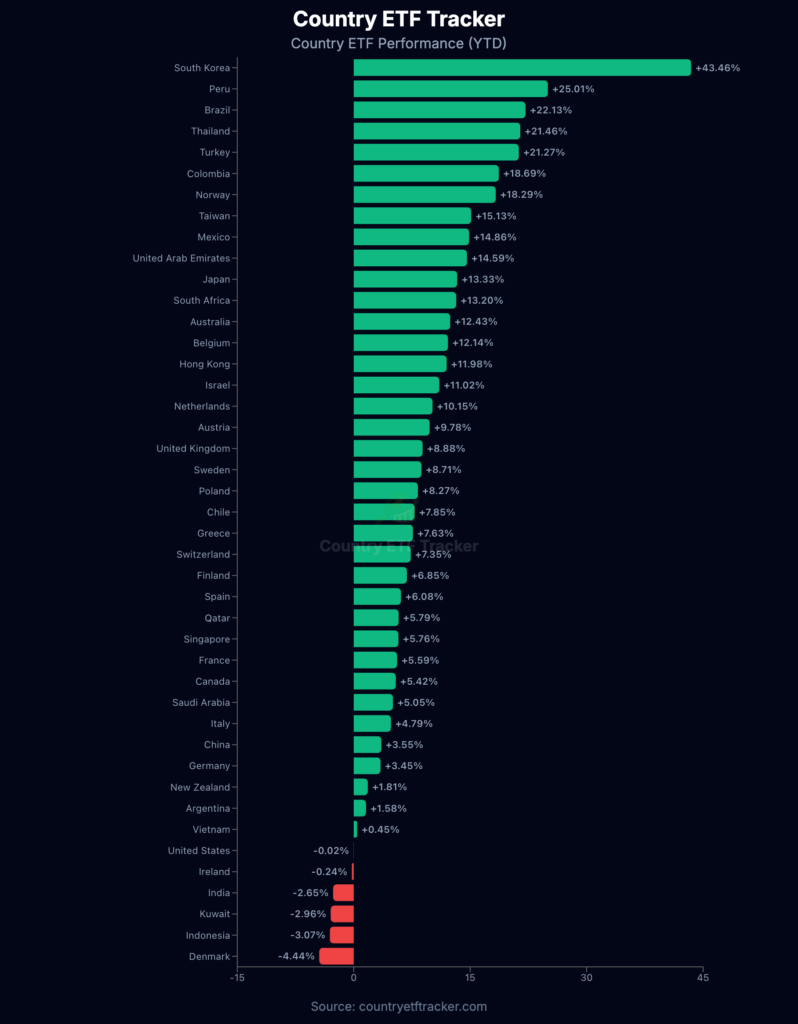
According to data, the top-performing U.S.-listed country ETFs year-to-date are: iShares MSCI South Korea ETF (NYSE:EWY), up 43.8%, iShares MSCI Peru ETF (NYSE:EPU), up 25.1%, iShares MSCI Brazil ETF (NYSE:EWZ), up 22.4%, iShares MSCI Thailand ETF (NYSE:THD), up 21.5%, and iShares MSCI Turkey ETF (NYSE:TUR), up 21.5%.
Several forces appear to be converging at once. Investors are rotating out of crowded U.S. technology trades just as commodities and cyclical sectors begin to regain leadership.
After a decade of relative underperformance, emerging markets also offer far more attractive valuations, creating a compelling contrast to stretched U.S. multiples.
At the same time, early signs of geographic capital reallocation are emerging, with flows gradually shifting outside the United States.
Layer on top a weakening U.S. dollar, and the macro backdrop increasingly tilts in favor of emerging markets.
“Emerging markets continue to benefit from a weaker US dollar, as well as a diversification trade out of the US to other markets that are more levered to commodities, materials and the industrial AI trade,” said Jeff Jacobson, analyst at 22V Research.
According to the expert, if the dollar resumes its broader downtrend — particularly after recent policy developments, including the Supreme Court's tariff decision — that could act as another tailwind for emerging markets.
Tactical Bounce Or Structural Rotation?
The big question now is simple — Are we witnessing the early stages of a multi-quarter — even multi-year — shift away from U.S. mega-cap dominance toward emerging market leadership?
The last time EEM strung together a run like this, it marked the beginning of a powerful cycle.
History doesn't repeat perfectly. But sometimes, it rhymes loudly enough that investors should pay attention.
Right now, emerging markets are speaking — and many investors still aren't listening.
Image created using artificial intelligence via Midjourney.
Disclaimer: The content of this article solely reflects the author's opinion and does not represent the platform in any capacity. This article is not intended to serve as a reference for making investment decisions.
You may also like
OPNUSDT now launched for pre-market futures trading
Join the BGB holders group—unlock Spring Festival Mystery Boxes to win up to 8888 USDT and merch from Morph
Trading Club Championship (Margin)—Trade to share 58,000 USDT, with up to 3000 USDT per user!
CandyBomb x XAUT: Trade futures to share 5 XAUT!
Trending news
MoreCrypto prices
More





