
2 Reasons to Appreciate PG and 1 Reason for Caution

Procter & Gamble: Recent Performance and Investment Outlook
Over the past half-year, Procter & Gamble's stock has mirrored the S&P 500's upward movement, increasing by 5.9% to reach $165.39 per share, while the index itself advanced 6.2% during the same period.
Is this a favorable moment to invest in PG?
What Fuels the Conversation Around Procter & Gamble?
Established by William Procter, a candle maker, and James Gamble, a soap maker, Procter & Gamble (NYSE:PG) has grown into a powerhouse in the consumer goods sector. Its extensive lineup includes products ranging from tissues and detergents to personal care and grooming essentials.
Key Strengths of Procter & Gamble
1. Strong Operating Margins Indicate Effective Management
Operating margin serves as a crucial indicator of a company's profitability, reflecting earnings before taxes and interest—factors less tied to core operations.
Over the past two years, Procter & Gamble has maintained an average operating margin of 25.4%, with only minor fluctuations in the last twelve months. This high level of profitability, uncommon in the consumer staples industry, is a testament to the company’s streamlined cost management and large-scale operations. Its robust gross margin provides a solid foundation for these results.
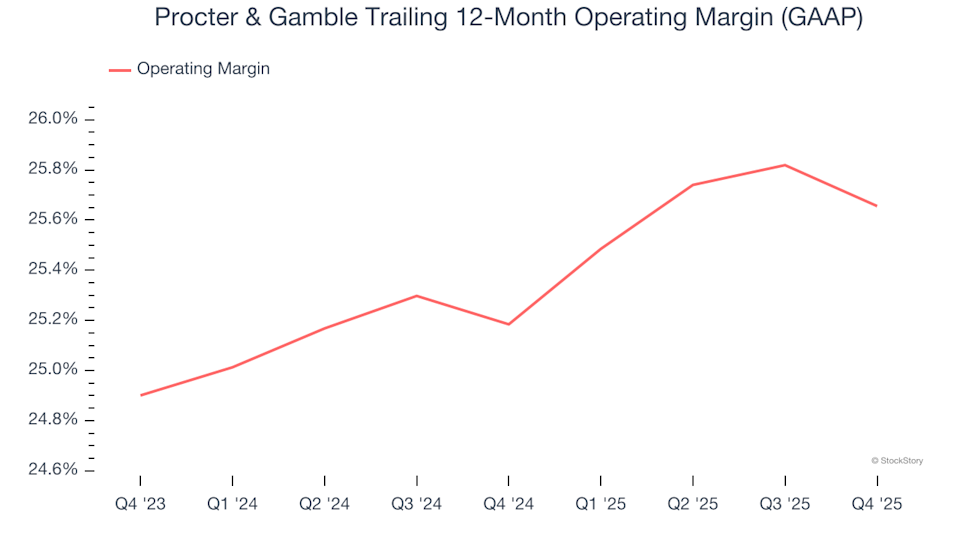
Procter & Gamble Trailing 12-Month Operating Margin (GAAP)
2. Impressive Free Cash Flow Margin Enhances Growth Opportunities
While free cash flow may not always be highlighted in financial reports, it offers valuable insight as it accounts for all operational and capital expenditures, making it a reliable measure of financial health.
Procter & Gamble consistently generates strong cash flow, thanks to a business model that supports reinvestment, shareholder returns, and competitive positioning. The company’s free cash flow margin has averaged 18.3% over the past two years, placing it among the leaders in its sector.
Procter & Gamble Trailing 12-Month Free Cash Flow Margin
A Cautionary Note
Sluggish Organic Growth May Signal Slowing Core Demand
When assessing revenue expansion, organic growth is the most telling metric, as it excludes the effects of acquisitions, divestitures, and currency changes, focusing solely on the company’s underlying performance.
Although demand for Procter & Gamble’s offerings has remained steady over the last eight quarters, its organic revenue growth has lagged behind industry peers, averaging just 1.8% year-over-year.
Procter & Gamble Year-On-Year Organic Revenue Growth
Conclusion
While Procter & Gamble’s strengths outweigh its challenges, investors may wonder if the current price of $165.39 per share (23.2× forward P/E) presents a good entry point.
Discover Even More Promising Stocks
Building a successful portfolio means looking beyond yesterday’s winners. The risks associated with crowded trades are increasing every day.
Our Top 5 Growth Stocks for this month features a handpicked selection of high-quality companies that have delivered a remarkable 244% return over the past five years (as of June 30, 2025).
This list includes well-known names like Nvidia, which soared 1,326% from June 2020 to June 2025, as well as lesser-known success stories such as Tecnoglass, which achieved a 1,754% five-year return.
Disclaimer: The content of this article solely reflects the author's opinion and does not represent the platform in any capacity. This article is not intended to serve as a reference for making investment decisions.
You may also like
Soligenix's EMA Designation: A Near-Term Catalyst for a High-Risk Biotech
Analyst: XRP Can Easily Hit $100, But $10,000 Is Impossible
Why Crypto Is Not Pointless: A Third Worlder's Perspective

XRP Breaks $1.37 – Buyers Are Going CRAZY!
Trending news
MoreCrypto prices
More





