
Goldman versus Citigroup: Which company's turnaround narrative is more persuasive?

Wall Street’s Evolving Giants: Goldman Sachs vs. Citigroup
Major players on Wall Street are redefining their strategies for sustainable expansion. Goldman Sachs Group, Inc. (GS) is shifting from its traditional deal-centric approach to a more diversified financial services model. Meanwhile, Citigroup Inc. (C) is simplifying its structure to sharpen its competitive position.
As both financial institutions chart new courses, investors are left to consider: which company’s transformation offers greater long-term promise? Let’s examine the prospects for each.
Goldman Sachs: Strategic Refocus and Growth
Goldman Sachs has long been a leader in mergers and acquisitions, trading, and capital markets. Under CEO David Solomon, the firm is intentionally moving away from non-essential consumer banking to concentrate on areas where it holds a distinct advantage: investment banking, trading, and asset and wealth management.
Recent moves include transferring the Apple Card program to JPMorgan in January 2026, acquiring Innovator Capital Management in December 2025 to enhance its active ETF offerings, and selling its Polish asset management arm, TFI, to ING Bank Slaski. The company also completed the sale of GreenSky, its home improvement lending platform, in 2024, and transitioned the General Motors credit card program in the third quarter of 2025.
These strategic changes are reflected in the numbers: in 2025, investment banking revenues climbed 21% year-over-year, while asset and wealth management saw an 11.9% increase in net revenues, driven by higher fee income and robust private credit performance. Goldman aims for high-teen returns in its asset and wealth management division and targets around 5% annual growth in long-term fee-based net inflows over the medium term.
Looking ahead, Goldman plans to boost lending to private equity and asset managers, and expand internationally. The asset management division is set to grow its private credit portfolio to $300 billion by 2029, with expansion plans for Europe, the UK, and Asia. In January 2026, Goldman acquired Industry Ventures, strengthening its foothold in the innovation economy and the global alternatives market.
Citigroup: Streamlining for Efficiency
Citigroup’s overhaul is more extensive. Under CEO Jane Fraser, the bank is executing a multi-year plan to simplify operations and focus on core strengths. Since April 2021, Citigroup has exited consumer banking in nine out of 14 targeted markets across Asia and EMEA.
In February 2026, Citigroup completed the sale of its Russian subsidiary, AO Citibank, to Renaissance Capital, enhancing its capital position and simplifying its balance sheet. This transaction is expected to add approximately $4 billion to Citigroup’s Common Equity Tier 1 capital in the first quarter of 2026.
Additionally, Citigroup sold a combined 49% equity stake in Grupo Financiero Banamex, S.A. to various investors and is winding down its Korean consumer banking operations, exiting Russia, and preparing for an IPO of its Mexican consumer and business banking units. These actions are freeing up capital for investments in wealth management in key markets such as Singapore, Hong Kong, the UAE, and London.
To support its leaner structure, Citigroup has revamped its leadership and operating model, reducing bureaucracy and increasing efficiency. In January 2024, the company announced plans to cut 20,000 jobs by 2026, having already reduced its workforce by over 10,000 employees.
With these initiatives, Citigroup anticipates a 4-5% compound annual revenue growth rate by the end of 2026 and expects to achieve $2-2.5 billion in annualized cost savings. The bank is also targeting a 10-11% return on tangible common equity in 2026.
Citigroup is also expanding its presence in private markets and wealth management through strategic partnerships. In September 2025, it launched an $80 billion customized portfolio with BlackRock, offering clients tailored exposure to public and private markets. Collaborations with Carlyle Group and Apollo Global Management have further strengthened its private credit and direct lending platforms.
Comparing Performance, Valuation, and Shareholder Returns
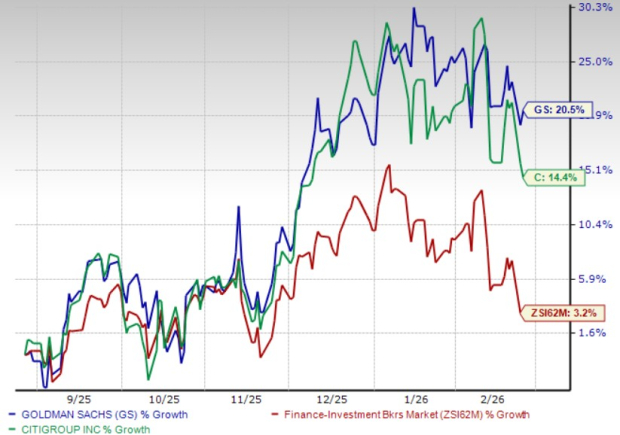
In the past six months, Goldman Sachs shares have advanced 20.5%, while Citigroup’s stock has gained 14.4%, both outperforming the industry average growth of 3.2%.
Recent Price Performance
Source: Zacks Investment Research
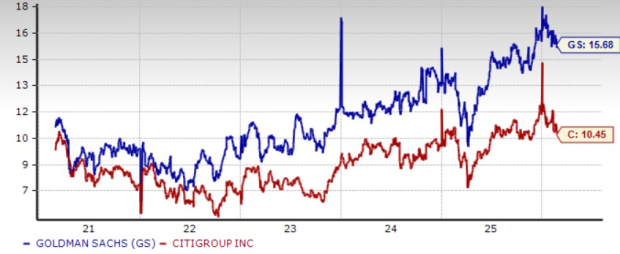
Goldman Sachs currently trades at a 12-month forward price-to-earnings (P/E) ratio of 15.68, while Citigroup’s forward P/E stands at 10.45.
Forward P/E Comparison
Source: Zacks Investment Research
Citigroup’s valuation is below the industry average of 13.64, whereas Goldman Sachs trades at a premium. Both companies have a strong track record of returning value to shareholders. In January 2026, Goldman Sachs increased its dividend by 12.5% to $4.50 per share, marking its sixth increase in five years. In July 2025, the dividend was raised by 33.3% to $4 per share, with three increases over the past five years.
Analyst Estimates: GS vs. C
Analyst consensus for Goldman Sachs projects revenue growth of 8.6% in 2026 and 3.2% in 2027, with earnings expected to rise 10.3% and 10.7% in those years, respectively. Both years have seen upward earnings revisions recently.
Goldman Sachs Estimate Trends

Source: Zacks Investment Research
For Citigroup, consensus estimates call for revenue increases of 5.4% in 2026 and 4.3% in 2027, with earnings growth of 27.9% and 18.4% in those years. Recent weeks have also brought upward revisions for Citigroup’s earnings estimates.
Citigroup Estimate Trends

Source: Zacks Investment Research
Which Stock Offers Greater Potential?
Goldman Sachs is not just reducing risk but is actively reallocating resources toward higher-return, structurally attractive businesses. By strengthening its leadership in advisory, trading, and alternative investments, and scaling up private credit and wealth management, Goldman is creating a business model that combines cyclical growth with steady fee-based income. This approach provides the company with greater flexibility during market upswings and resilience through its asset and wealth management divisions. Its expansion in private credit and alternatives aligns with long-term institutional demand.
Citigroup, on the other hand, is focused on restructuring and efficiency. While its lower valuation and robust near-term earnings growth may attract value investors, the path to sustained double-digit returns on equity depends heavily on flawless execution and ongoing operational improvements.
Overall, Goldman Sachs presents a more compelling growth story, supported by solid fundamentals, positive earnings revisions, and a strategic emphasis on high-margin, scalable businesses. Its premium valuation reflects its higher-quality earnings and stronger return prospects. For investors seeking a blend of earnings stability, strategic clarity, and long-term growth, Goldman Sachs stands out as the more attractive choice at this time.
Currently, Goldman Sachs holds a Zacks Rank of 2 (Buy), while Citigroup is rated 3 (Hold).
Spotlight: Top Semiconductor Stock
There’s a lesser-known semiconductor company that stands apart from industry giants like NVIDIA. Positioned to capitalize on the next wave of market growth, this firm is just beginning to attract attention—an ideal time for investors.
With impressive earnings momentum and a growing customer base, the company is well-placed to benefit from surging demand in Artificial Intelligence, Machine Learning, and the Internet of Things. Global semiconductor manufacturing is forecast to soar from $452 billion in 2021 to $971 billion by 2028.
Get More Investment Insights
Disclaimer: The content of this article solely reflects the author's opinion and does not represent the platform in any capacity. This article is not intended to serve as a reference for making investment decisions.
You may also like
1 Tech Stock Flying Under the Radar That Wedbush Recommends Owning During Middle East Tensions
In the United States, prediction markets spark debate after bets on Iran

We Asked Google Gemini Where XRP Will Trade On March 31, 2026, Here’s What It Said
Bitcoin – How ceasefire hopes, oil prices are driving crypto market’s volatility
Trending news
MoreCrypto prices
More





