
US and China Question Modi’s ‘Make in India’ Manufacturing Incentive Program

India's Manufacturing Push Faces Global Criticism Over Subsidies
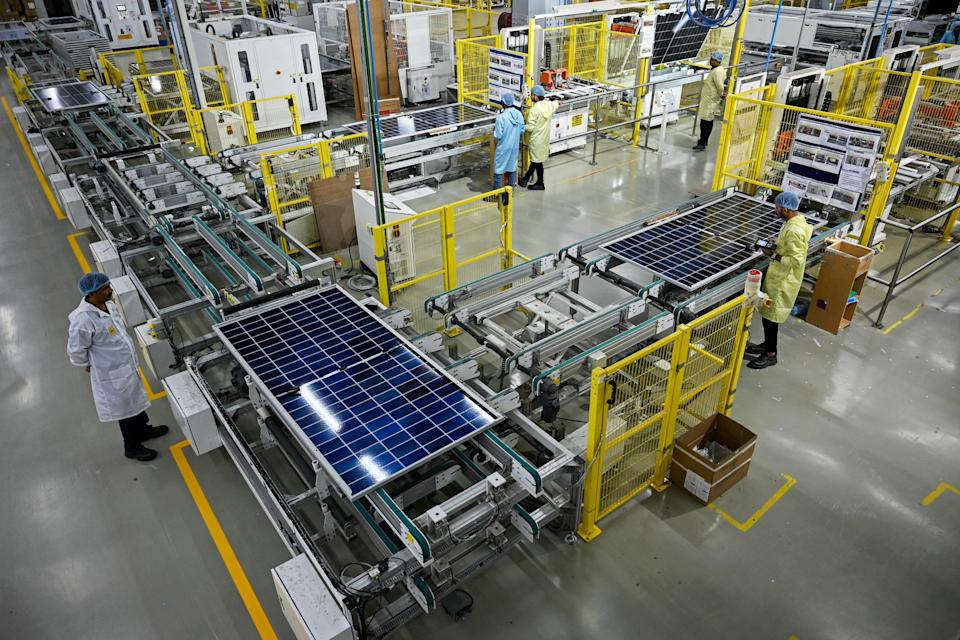
Photographer: Shammi Mehra/AFP/Getty Images
Prime Minister Narendra Modi’s drive to position India as a leading manufacturing hub is encountering resistance from major global economies, who argue that his administration’s subsidy policies violate international trade agreements.
This week, the United States announced provisional tariffs of 126% on solar products imported from India, citing unfair government support for Indian manufacturers. Experts believe these steep duties will largely block Indian solar panel producers from accessing the US market.
Top Stories from Bloomberg
This development follows the World Trade Organization’s decision to form a panel to investigate China’s claims that India’s incentive programs for the automotive and renewable energy sectors unfairly benefit local manufacturers, putting foreign competitors at a disadvantage. The WTO panel was established after talks between India and China failed to resolve the dispute over these targeted subsidies.
Central to these controversies is India’s production-linked incentive (PLI) initiative, introduced in 2020 to strengthen domestic industry. Covering 14 sectors—including electronics, pharmaceuticals, solar modules, and medical equipment—the program is backed by a budget of 1.91 trillion rupees (about $21 billion).
Critics argue that these incentives give Indian companies an unfair edge. In the solar industry, firms such as Waaree Energies Ltd., Adani Enterprises Ltd., and Reliance Industries Ltd. have all benefited from these government measures, which include both direct incentives and non-tariff barriers.
These disputes arise as India seeks to improve its relationships with both the US and China. New Delhi and Washington recently reached an agreement to ease trade tensions that had resulted in some of the highest US tariffs in the region. At the same time, India is working to restore ties with Beijing after a sharp downturn following border clashes in 2020.
It’s worth noting that both the US and China have also faced criticism for their own subsidy practices. In 2024, China objected to aspects of the US Inflation Reduction Act, claiming it discriminates against Chinese goods. Meanwhile, European officials have accused China of using heavy subsidies to boost its electric vehicle and solar industries.
India’s Response and Economic Implications
India’s Ministry of Commerce and Industry did not issue a statement in response to these developments. However, unnamed officials in New Delhi indicated that India plans to vigorously defend its incentive schemes, maintaining that they are consistent with WTO regulations.
These programs are a key part of India’s strategy to increase manufacturing’s share of the national economy to around 25%. Currently, manufacturing accounts for roughly 17% of GDP, and growing pressure from major trading partners could complicate New Delhi’s plans.
“Reviving manufacturing without initiatives like the PLI scheme would be challenging,” said Biswajit Dhar, an independent trade economist based in New Delhi. He also suggested that India should consider additional strategies to support industry, such as investing in technology and innovation.
Reporting contributed by Rajesh Kumar Singh.
Most Read from Bloomberg Businessweek
©2026 Bloomberg L.P.
Disclaimer: The content of this article solely reflects the author's opinion and does not represent the platform in any capacity. This article is not intended to serve as a reference for making investment decisions.
You may also like
Is Celestica Inc. (CLS) A Good Stock To Buy Now?

BJ's Wholesale Club CEO Flags 'Dynamic Environment' Of Tariffs, Cautious Consumers
What actions taken by Iran led to the Dow dropping by 750 points
Ethereum Faces Key Supertrend Resistance
Trending news
MoreCrypto prices
More





