
Nvidia Shareholders Respond Tepidly to Positive Outlook

Nvidia’s Latest Forecast Leaves Investors Unconvinced Despite Strong Results
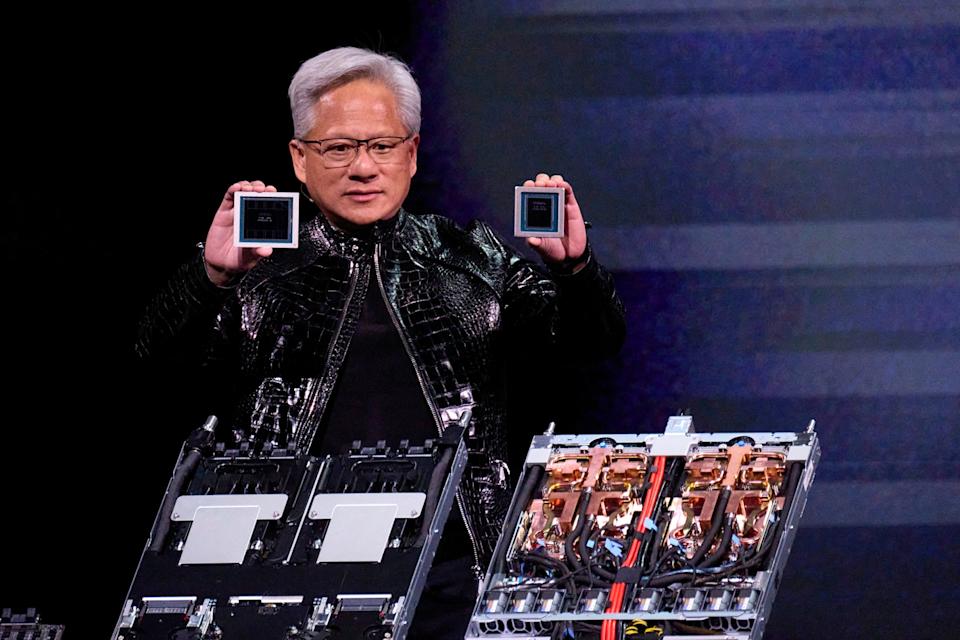
Photographer: Bridget Bennett/Bloomberg
(Bloomberg) Nvidia Corp., the leading producer of AI chips, did not fully satisfy investors with its recent sales outlook, highlighting ongoing doubts about the sustainability of the AI boom and its impact on the company’s future.
Although Nvidia reported a remarkable 73% increase in fourth-quarter revenue and issued a first-quarter forecast that surpassed Wall Street’s consensus, the company’s shares dropped by up to 1.5% during its analyst call. In premarket trading on Thursday, the stock saw a modest gain of less than 1%.
Top Stories from Bloomberg
This reaction underscores the current skepticism facing Nvidia. After a period of explosive growth that made it the most valuable company globally, investors are now demanding stronger proof that the AI-driven sales surge will persist.
“Nvidia’s performance was robust by most standards,” JPMorgan Chase & Co. analysts commented after the earnings release. “However, the market’s response indicates that expectations were even higher.”
Leadership Responds to Investor Concerns
During the earnings call, CEO Jensen Huang addressed these worries, emphasizing that customers are already generating returns from their investments in Nvidia’s technology. He expressed confidence that this would drive continued high levels of spending.
“Expanding computing capacity directly fuels growth and revenue,” Huang stated. “I’m certain our clients’ cash flows are on the rise.”
Chief Financial Officer Colette Kress also sought to reassure analysts, particularly regarding potential supply shortages. She noted that Nvidia has secured enough components to keep up with increasing demand, though producing sufficient quantities of the company’s most advanced chips remains a challenge. Kress highlighted that both the current Blackwell series and the upcoming Rubin lineup are expected to outperform previous sales targets, with Nvidia previously forecasting $500 billion in chip sales by the end of 2026.
“We are confident in our inventory and supply agreements to support future demand, including shipments into 2027,” Kress added.
Challenges in the Chinese Market
Nvidia continues to face uncertainty in China, its largest chip market. The US government has issued limited licenses for H200 processor shipments to Chinese customers, but approval from Chinese authorities remains unclear. For now, Nvidia is excluding Chinese data center revenue from its forecasts.
Additional Insights
The limited license from the US requires chips to pass inspection before export and subjects them to a 25% tariff upon entry. Nvidia dominates the market for accelerator chips, which are essential for processing the massive datasets required for AI model training and inference. The company, based in Santa Clara, California, has also expanded into general-purpose processors, networking, and complete computing systems, strengthening its customer relationships.
Financial Highlights
- First-quarter revenue is projected at approximately $78 billion, exceeding the $72.8 billion average estimate, though some analysts anticipated nearly $80 billion.
- Fourth-quarter revenue reached $68.1 billion, a 73% increase, with adjusted earnings at $1.62 per share—both surpassing analyst expectations.
- Adjusted gross margin was 75.2%, slightly above forecasts.
“We’re not sure what more investors are looking for, but we’re pleased with the results,” wrote Bernstein analyst Stacy Rasgon.
Performance by Business Segment
Nvidia’s data center division, which includes its leading AI accelerator and networking products, generated $62.3 billion in revenue, outpacing the $60.4 billion average estimate. The gaming segment, once Nvidia’s primary revenue source, brought in $3.73 billion, falling short of the $4.01 billion forecast. Automotive sales reached $604 million, below the expected $643 million.
Industry Headwinds and Partnerships
The tech sector is grappling with a shortage of memory chips, a critical component for Nvidia’s products. This supply constraint has driven up prices and limited device shipments, particularly impacting the gaming division. Kress noted uncertainty about whether the situation will improve enough this year to boost gaming sales.
Despite these challenges, AI data center chips have become Nvidia’s main growth driver. Earlier this month, Meta Platforms Inc. committed to deploying millions of Nvidia processors over the coming years, further strengthening their partnership. Nvidia’s main competitor, Advanced Micro Devices Inc., also announced a significant long-term deal with Meta, valued at tens of billions of dollars.
These large-scale agreements are presented as evidence of a robust AI market. However, the close relationships between suppliers and customers—sometimes involving mutual financial stakes—have raised concerns about artificially inflated demand.
More Top Reads from Bloomberg Businessweek
©2026 Bloomberg L.P.
Disclaimer: The content of this article solely reflects the author's opinion and does not represent the platform in any capacity. This article is not intended to serve as a reference for making investment decisions.
You may also like
Ethereum: Sharplink’s losses cross $1B as ETH falls below $2K
Mortgage and refinance rates as of March 4, 2026: Increasing, yet remain under 6%

US dollar surge since start of war on Iran unlikely to last, say FX strategists: Reuters poll
Trending news
MoreCrypto prices
More





