Bitcoin’s recent surge has reignited debate over the alleged “10 a.m. dump” pattern. For months, traders anticipated routine intraday selling that repeatedly capped upside momentum.
Now, the disruption of this expectation has prompted a reassessment of the short-term market structure.
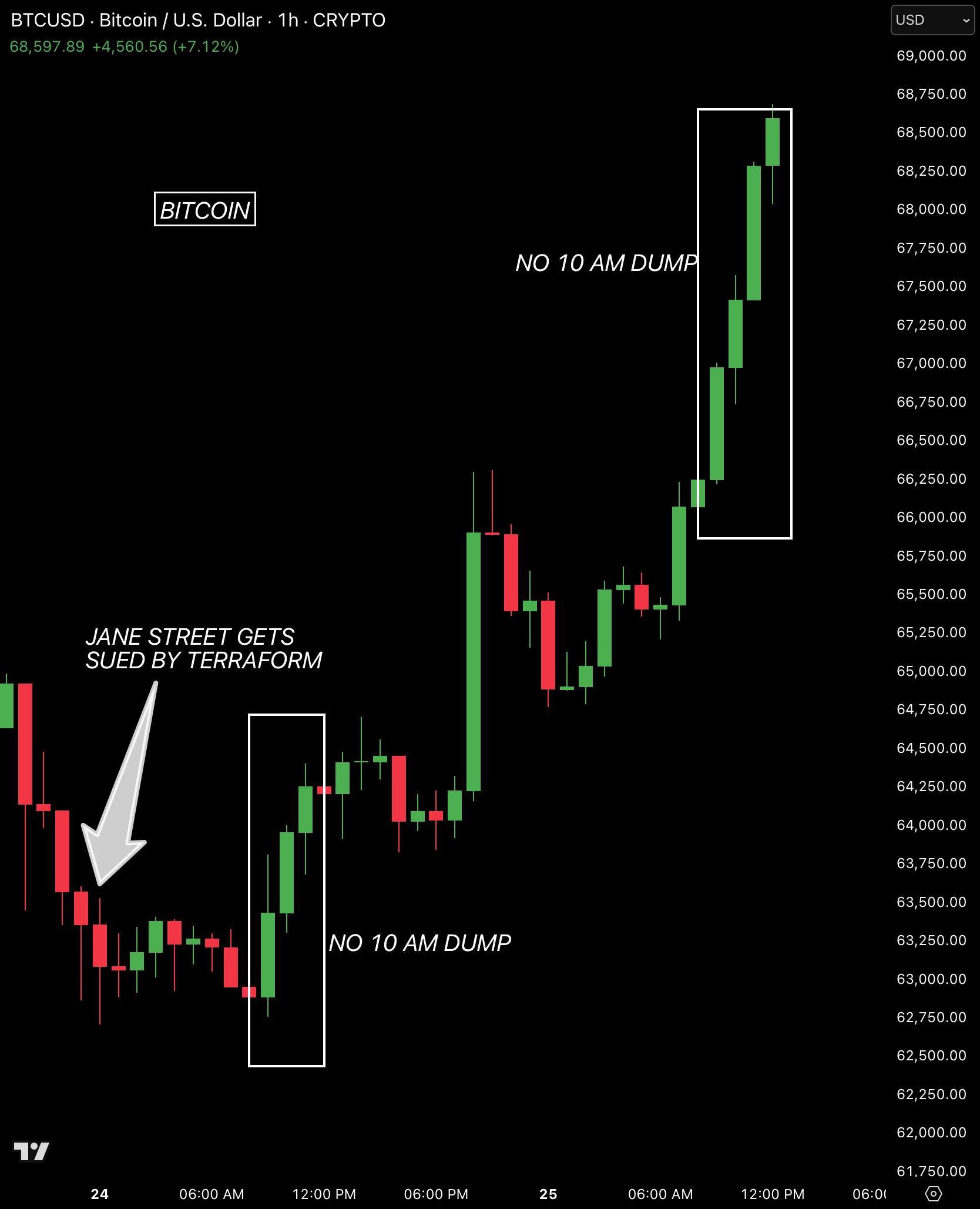
Previously, price weakness clustered around the 10 a.m. window, often reversing early advances. In this sequence, however, at the time of writing, Bitcoin [BTC] traded near $68,500, gaining over 7.12%. Instead of fading, momentum persisted through the same hour.
Source: X
Earlier, the price had compressed near $63,000 amid visible selling pressure. Gradually, buyers rebuilt the structure above $64,000 and extended toward $65,500. Importantly, the anticipated liquidity flush did not occur; instead, green candles expanded cleanly above $66,000 and accelerated toward $68,750.
Meanwhile, Terraform’s lawsuit against Jane Street intensified speculation about a systematic seller. As that narrative spread, intraday continuation replaced rejection. The weekly candle turned green after five red weeks, adding $120 billion to Bitcoin’s valuation.
Still, the key question remains whether this shift reflects a permanent microstructure change or merely a temporary relief within broader bearish conditions.
Positioning-driven bounce or true demand expansion?
Bitcoin’s rebound unfolded alongside a sharp derivatives reset, framing the key debate around organic price discovery versus positioning distortion.
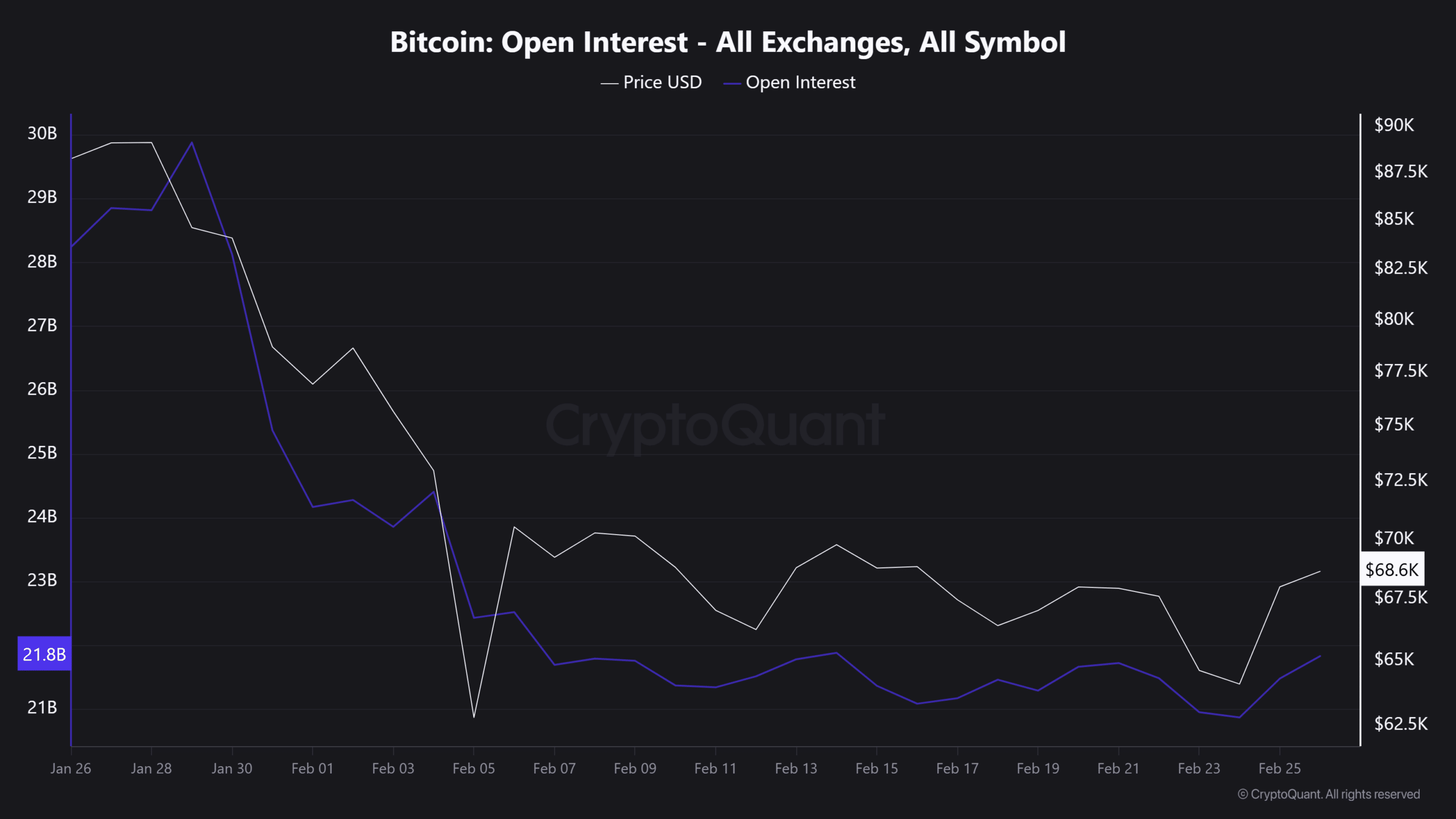
Open Interest trended downward from roughly $30 billion to near $21.8 billion, reflecting aggressive deleveraging. As leverage flushed, forced liquidations accelerated downside exhaustion.
Price simultaneously bottomed near $62,000 before rebounding toward $68,600, adding over $120 billion in market capitalization.
Source: CryptoQuant
As liquidations cleared, suppressed positioning created squeeze conditions. Short exposure unwound mechanically, fueling upside momentum rather than fresh spot demand. This dynamic explains the speed of the recovery phase.
Meanwhile, the Fund Flow Ratio hovered near 0.05, at press time, with Binance flows closer to 0.012. Low exchange inflows signaled muted panic selling, yet also weak structural accumulation.
Through this lens, the rally appears relief-driven. Deleveraging stabilized the structure first, and then short liquidations extended the price higher. Sustained upside now depends on renewed inflows, not positioning vacuums alone.
U.S. Spot demand returns as whale distribution cools
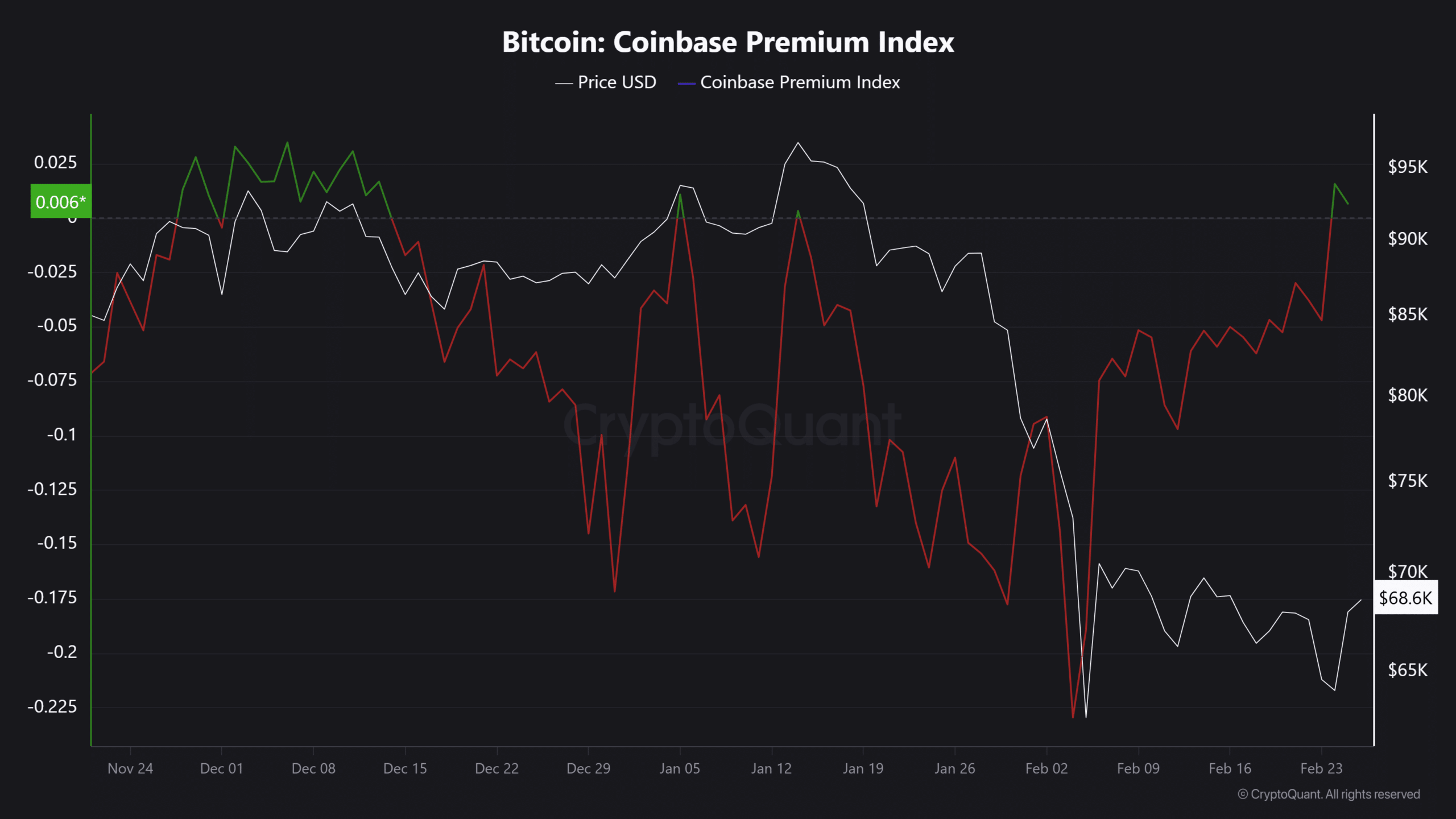
U.S. demand shows early signs of structural rebuilding, as the Coinbase Premium Index turned positive near 0.006. This shift signals renewed spot buying interest. As the premium recovered, the price stabilized around $68,600, reinforcing near-term support.
Source: CryptoQuant
Meanwhile, the Exchange Whale Ratio declined from the prior 0.7–0.8 distribution zones toward 0.5. This drop indicates reduced large-holder exchange inflows. As whale transfers eased, sell-side pressure softened.
At the same time, the absence of ratio spikes suggests whales paused distribution rather than accelerated exits. This restraint tightens the circulating supply.
Together, improving U.S. flows and muted whale selling form a constructive base, from which stabilization can extend into gradual upside attempts.
Final Summary
- Bitcoin [BTC] rebound reflects liquidation-driven expansion, where deleveraging and short squeezes powered the $120 billion surge more than organic demand.
- Bitcoin stabilization now depends on sustained U.S. inflows and continued whale absorption as distribution pressure fades.