
Hiltzik: Reasons international markets surpassed U.S. stocks in performance during Trump’s initial year

Global Markets Outperform U.S. Stocks During Trump’s First Year
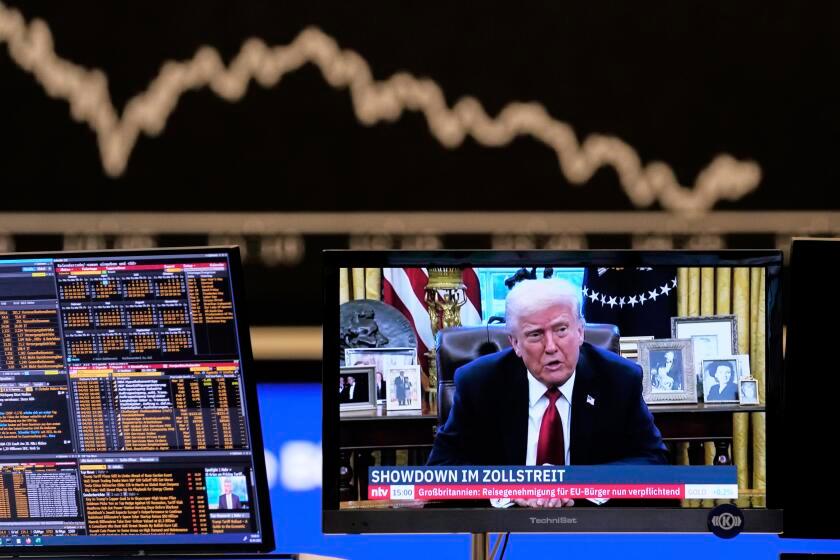
Traders closely followed the U.S. stock market’s reaction as President Trump announced sweeping tariffs on April 2, causing significant market volatility. (Michael Probst / Associated Press)
Strong U.S. Returns, But Global Markets Surge Ahead
Many American investors may be pleased with how their portfolios performed during President Trump’s first year, as all major U.S. indices posted impressive gains. The S&P 500, for example, climbed 17.9% over the year.
However, those who compare their returns internationally might feel differently. In 2025, stock markets outside the U.S. significantly outpaced American equities. The MSCI World ex-USA index, which tracks developed markets excluding the U.S., soared by more than 32%—almost double the U.S. market’s growth.
A Shift in Market Leadership
This marks a notable change from recent years. Since 2013, the U.S. market had typically outperformed its global peers, except in 2017 and 2022. For instance, in 2024, the U.S. index rose 24.6%, while non-U.S. markets managed just 4.7%.
The Trump trade is dead. Long live the anti-Trump trade.
Katie Martin, Financial Times
How Countries Ranked in 2025
Looking at individual countries, the U.S. ranked 21st out of 23 developed markets in 2025, ahead of only New Zealand and Denmark. Austria and Spain led with remarkable 86% gains, while Finland, Ireland, and Hong Kong each saw increases of 50% or more. The Netherlands, Norway, the UK, and Japan also posted gains above 40%.
Why Did U.S. Stocks Lag?
- U.S. stocks have become expensive by historical standards, trading at about 23 times expected earnings in 2025, compared to a long-term average of 18.
- Market gains in the U.S. have been heavily concentrated in the technology sector, particularly among companies focused on artificial intelligence, raising concerns about a potential bubble.
- Many analysts point to Donald Trump’s policies as a key factor influencing the divergence between U.S. and international markets.
Trump’s Influence on Market Sentiment
At the start of 2025, investors were optimistic about Trump’s approach, expecting deregulation and a focus on maintaining America’s global dominance to boost markets. That optimism faded as the year progressed.
Global Investors Turn Cautious
As Katie Martin of the Financial Times observed, “Wherever you look in financial markets, you see signs that global investors are going out of their way to avoid Donald Trump’s America.”
Key Policy Moves Impacting Markets
- Trump’s unpredictable tariff policies have made it difficult for investors to gauge international trade flows. The Supreme Court’s decision to strike down most tariffs, followed by Trump’s swift introduction of new ones and threats of further increases, has only heightened uncertainty.
- Trump’s push for lower interest rates has weakened the dollar, making U.S. assets less attractive to foreign investors.
According to Sam Burns of Mill Street Research, “The current uncertainty is entirely man-made (largely by one orange-hued man in particular) but could well continue at least until the US mid-term elections in November.”
Fact-Checking Trump’s Market Claims
President Trump has frequently highlighted stock market records as evidence of his policy success, claiming, for example, that the average 401(k) balance increased by at least $30,000 since he took office. However, data from Bank of America shows the average increase was closer to $13,000 in 2025.
Stock Market Records and Reality
While officials like Attorney General Pam Bondi have pointed to the Dow surpassing 50,000 as proof of economic strength, the index soon dipped below that milestone. For example, if you had invested $48,488 in the Dow when Trump took office, your investment would have grown to $50,000 by February 6—a 3.2% gain. The same investment in global markets outside the U.S. would have reached nearly $60,000, a 24% increase.
Comparing Broader Market Indices
From January 17, 2025, just before Trump’s inauguration, through the latest close, the MSCI U.S. index rose 16.3%. In contrast, the global index excluding the U.S. jumped nearly 42%.
This trend has continued into the current year: the S&P 500 is up just 0.74% so far, while the MSCI World ex-USA index has gained 8.9%. According to Morningstar, this is the strongest start for global stocks relative to the S&P 500 since at least 1996.
Looking Ahead
It’s possible that the gap between U.S. and international markets could narrow or even reverse as the year goes on, as has happened in the past. Market dynamics shift with economic conditions, but one constant is that Trump is expected to remain in office until January 20, 2029. Investors should plan accordingly.
Further Reading
Stay Updated
Get the latest commentary on economics and more from Pulitzer Prize winner Michael Hiltzik.
This article was first published in the Los Angeles Times.
Disclaimer: The content of this article solely reflects the author's opinion and does not represent the platform in any capacity. This article is not intended to serve as a reference for making investment decisions.
You may also like
Sandisk has more legs left to run
Bitcoin Holds Steady as Geopolitical Tensions Rattle Crypto Markets
Altcoin Rotation Builds: 5 Projects Eye 3×–10× Moves as Weekend Liquidity Nears
Trending news
MoreCrypto prices
More





