
QUBT vs. IONQ: Which Quantum Computing Stock Has More Potential for Growth?

Quantum Computing: Comparing QCi and IonQ Technologies
As quantum computing shifts from theoretical research to practical application, various foundational technologies are vying for dominance. On one side, Quantum Computing Inc. (QCi) utilizes photonic quantum technology, while IonQ employs a trapped-ion approach. Photonic systems use particles of light as qubits, whereas trapped-ion platforms manipulate atomic ions with lasers to perform computations.
How IonQ's Trapped-Ion Technology Works
IonQ's system confines ions within a linear trap using approximately 100 miniature electrodes that generate electromagnetic fields, keeping the ions suspended in three dimensions and shielded from external interference. These traps use rapidly changing voltages to maintain stable conditions, allowing for chains of up to 79 ions for single-qubit operations.
The ions are housed in an ultra-high vacuum chamber to prevent decoherence from stray particles. This setup provides long coherence times and allows for flexible reconfiguration without hardware modifications, positioning IonQ as a leader in scalable quantum computing.
QCi's Photonic Quantum Computing Approach
QCi's technology leverages photons as qubits, encoding information through properties such as polarization, path, or time-bin. Operating at room temperature, this method reduces complexity and costs, making it suitable for commercial, defense, and research applications. Photonic qubits offer extended coherence times, minimal interaction with the environment, and compatibility with existing telecom infrastructure, supporting the development of distributed quantum networks.
Stock Performance Over the Past Year
In the last twelve months, QCi's stock has climbed 49.1%, while IonQ's shares have soared by 66.4%.
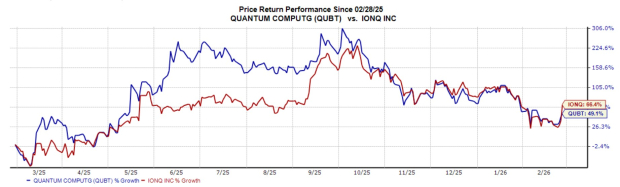
Image Source: Zacks Investment Research
QCi: Recent Achievements and Outlook
- QCi secured a subcontract worth up to $406,478 to assist NASA’s Langley Research Center, using its Dirac-3 quantum computer to enhance space-based LIDAR data by filtering out solar noise—a challenge for reliable atmospheric sensing.
- The company also landed a contract with the National Institute of Standards and Technology (NIST) to design and build TFLN photonic integrated circuits.
- QCi made its first U.S. commercial sale of quantum cybersecurity solutions to a top five U.S. bank, marking progress in its quantum AI and security offerings.
- Completion of a quantum photonic chip foundry in Tempe, Arizona, positions QCi to meet customer demand and expand production for various markets.
- As of the third quarter, QCi reported $352 million in cash and equivalents, plus $461 million in investments, providing a solid financial base for growth.
Despite these advances, QCi faces short-term risks due to its modest revenue relative to expenses, ongoing reliance on external funding, and uncertain prospects for large-scale commercial adoption compared to more established competitors.
IonQ: Strategic Progress and Milestones
- IonQ has expanded its global presence through partnerships, acquisitions, and technical breakthroughs in 2025, including a strengthened alliance with Korea’s KISTI and the delivery of a 100-qubit Tempo system.
- The company broadened its agreement with QuantumBasel and secured future deployments of its quantum systems.
- IonQ signed an agreement with the U.S. Department of Energy to advance quantum technologies in space and formed a strategic partnership with Emergence Quantum, enhancing its footprint in the Asia-Pacific region.
- Recent acquisitions include Oxford Ionics, Vector Atomic, Lightsynq, and Capella, accelerating IonQ’s full-stack quantum platform.
- IonQ achieved a record 99.99% two-qubit gate fidelity, paving the way toward millions of physical qubits and tens of thousands of logical qubits by 2030. This progress reduces error-correction needs and strengthens IonQ’s commercial prospects.
- Collaborations with AstraZeneca, Amazon Web Services, and NVIDIA resulted in a 20-fold acceleration in quantum-powered drug discovery.
- By the end of the fourth quarter, IonQ held $3.3 billion in cash, equivalents, and investments, ensuring strong liquidity for future initiatives.
However, IonQ continues to operate at a loss, and the commercial viability of large-scale, fault-tolerant quantum computers remains unproven. The company faces ongoing execution risks, unpredictable customer adoption, and the lengthy development cycles typical of emerging quantum technologies.
Analyst Price Targets
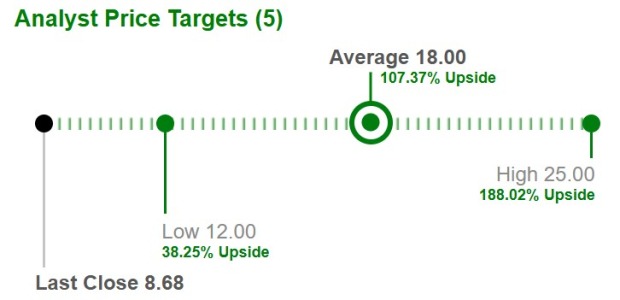
According to five analysts, QCi’s average short-term price target is $18.00, suggesting a potential upside of 107.4% from its latest closing price.
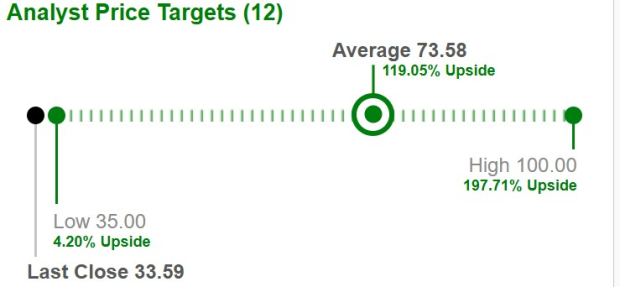
For IonQ, twelve analysts set an average short-term price target of $73.58, indicating a possible 119.1% increase from its most recent close.
Valuation Comparison
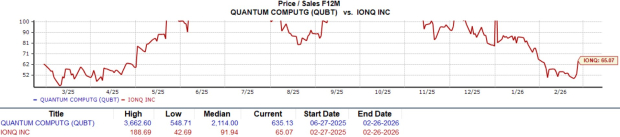
QCi trades at a forward 12-month price-to-sales (P/S) ratio of 635.13, which is below its one-year median of 2114.00. IonQ’s forward P/S ratio stands at 65.07, also under its median of 91.94, making IonQ comparatively less expensive than QCi.
Summary and Investment Perspective
IonQ appears to be better positioned for long-term leadership, thanks to its strategic acquisitions, comprehensive technology roadmap aiming for millions of qubits by 2030, and collaborations with major industry players like Amazon Web Services, NVIDIA, and AstraZeneca. QCi has also demonstrated significant technical and commercial progress, securing government contracts and making early sales in quantum cybersecurity.
Both companies maintain strong balance sheets, supporting their ability to navigate the lengthy commercialization process. Currently, both QCi and IonQ hold a Zacks Rank #3 (Hold). Based on recent performance, valuation, and analyst targets, QUBT stock may be less attractive to investors compared to IONQ.
Disclaimer: The content of this article solely reflects the author's opinion and does not represent the platform in any capacity. This article is not intended to serve as a reference for making investment decisions.
You may also like
US Treasury yields move up as oil prices climb and concerns about inflation increase
Hyperliquid's Token Rises as Weekend Iran Shock Finds Few Open Markets
72 Hours of Life and Death! Decisive Factors That Will Determine the Market's Next Move
AUD/JPY trades above 111.00 after paring recent losses
Trending news
MoreCrypto prices
More





