
ARM's Self-Reinforcing Ecosystem Strengthens Its Industry Dominance

Arm Holdings plc’s ARM competitive strength is rooted in a powerful two-sided network effect that closely connects software developers and hardware manufacturers within a mutually reinforcing ecosystem.
ARM’s architecture has evolved into the preferred industry standard for device makers, largely because it supports a vast and mature library of applications across major operating systems, including Android, iOS, Windows and Linux. This broad compatibility gives hardware manufacturers confidence that ARM-based chips will integrate smoothly with widely used tools, services, and platforms worldwide, making Arm Holdings a reliable and strategically sound choice.
At the same time, developers are naturally drawn to ARM because applications built on its architecture can immediately reach an enormous and continuously growing global installed base. Every new hardware partner expands Arm Holdings’ footprint, increasing the platform’s attractiveness to developers and encouraging further innovation and commitment.
This reinforcing cycle, in which growing developer support attracts more hardware partners and expanding hardware adoption draws in even more developers, has strengthened ARM’s ecosystem over time. The result is a durable, competitive moat that reinforces its leadership position and makes it exceptionally challenging for competitors to disrupt its dominance.
This network-driven strength has produced a remarkable outcome: ARM effectively dominates mobile CPU architecture. With its intellectual property embedded in nearly every smartphone globally, the company benefits from unmatched scale, making its leadership in mobile computing exceptionally hard for competitors to challenge.
In comparison, NVIDIA NVDA competes with ARM in edge computing and AI-focused device workloads, supported by its own ecosystem strengths. However, NVIDIA lacks Arm Holdings’ extensive presence in mobile devices. Even as NVIDIA moves into low-power processors, the widespread compatibility and entrenched standards surrounding ARM significantly constrain NVIDIA’s ability to displace it. Qualcomm QCOM occupies a unique position as both a key partner and a peer, as its mobile processors are built on ARM cores. Qualcomm’s reliance on ARM architecture means its success in smartphones further reinforces ARM’s dominance. While Qualcomm continues to invest in custom designs to diversify its strategy, ARM’s scale and ecosystem strength keep Qualcomm closely aligned with the platform.
ARM’s Price Performance, Valuation, Estimates
The stock has declined 9% over the past six months against the industry’s 23% growth.
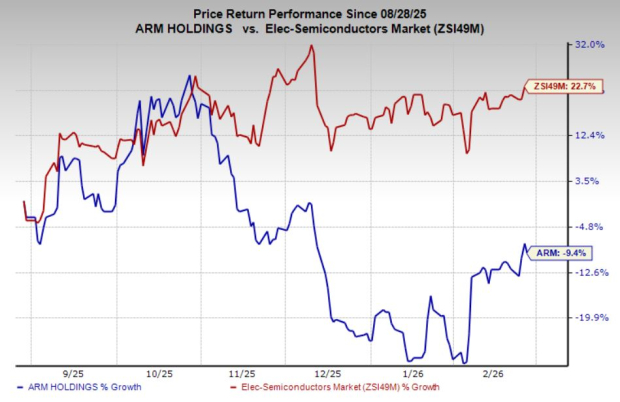
From a valuation standpoint, ARM trades at a forward price-to-sales ratio of 23.5x, well above the industry’s 8.5x. It carries a Value Score of F.
The Zacks Consensus Estimate for ARM’s fiscal 2026 earnings has been on the rise over the past 30 days.

ARM currently carries a Zacks Rank #4 (Sell).
Disclaimer: The content of this article solely reflects the author's opinion and does not represent the platform in any capacity. This article is not intended to serve as a reference for making investment decisions.
You may also like
Breakout Pushes $0.09656 DOGE Above Converging Trendlines as Price Trades Between Key Levels
XRP Price Crash to $1 Likely as Middle East Conflict Escalates

Evaluating Newmont’s 2026: A Year of Transition in the Gold Market Cycle
Jim Cramer on Applied Digital: "You Should Own the Stock"

Trending news
MoreCrypto prices
More





