
Vitalik Buterin floats simulated transactions to enhance crypto security

Ethereum co-founder Vitalik Buterin has suggested using “transaction simulations” and other similar features to improve the user experience and security of Ethereum wallets and smart contracts.
In a post to X on Sunday, Buterin argued that security and user experience are not separate fields, as both revolve around user intent — ensuring protocols are doing what users intend them to do.
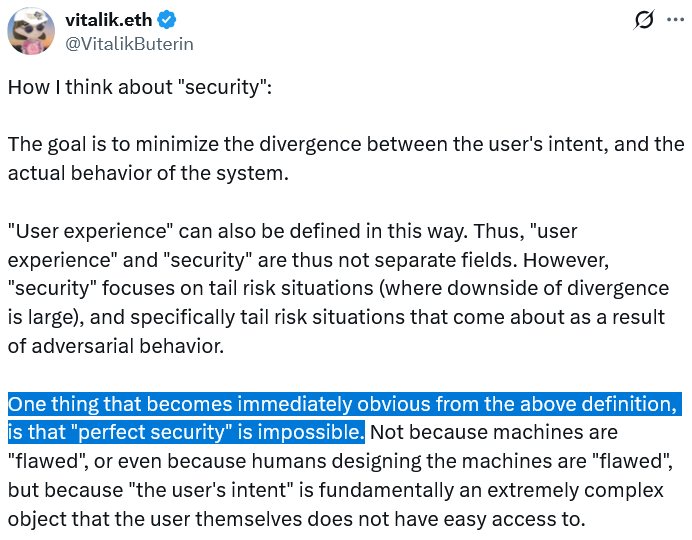 Source: Vitalik Buterin
Buterin said an intent-based security approach could involve designing systems that double-check user actions and could apply to Ethereum wallets and smart contracts, as well as more broadly to operating systems and hardware.
“The user specifies first what action they want to take, and then clicks ‘OK’ or ‘Cancel’ after seeing a simulation of the onchain consequences of that action,” he said.
Other ways could include spending limits and multisig approvals, so execution only happens when the user’s intent, expected outcome, and risk limits all align, he said.
The result is that it should be easier to do low-risk things and harder to do dangerous things, Buterin said.
User intent is difficult to define
However, Buterin noted that defining user intent is “extremely complex” and part of the reason why there is no such thing as a “perfect security” solution:
“[It’s not] because machines are ‘flawed’, or even because humans designing the machines are ‘flawed’, but because ‘the user's intent’ is fundamentally an extremely complex object that the user themselves does not have easy access to.”
“I would argue that the common trait of a good solution is: the user is specifying their intention in multiple, overlapping ways, and the system only acts when these specifications are aligned with each other,” he said.
Security is one of three components of the blockchain trilemma, along with decentralization and scalability.
The concept, coined by Buterin, theorizes that blockchains can optimize two of these aspects but must compromise on the other.
Decentralization and scalability have arguably been bigger focuses in the Ethereum ecosystem in recent years, particularly the latter, given that Ethereum’s mainnet has lagged behind some of its biggest layer 1 competitors in scalability.
Disclaimer: The content of this article solely reflects the author's opinion and does not represent the platform in any capacity. This article is not intended to serve as a reference for making investment decisions.
You may also like
Solana [SOL] stalls at range highs as market panic overrides capital inflows
![Solana [SOL] stalls at range highs as market panic overrides capital inflows](https://img.bgstatic.com/spider-data/864083153c8d2118fd81ea1a2ebacf611772326992214.png)
美国10月PPI超预期上涨,PCE或将面临压力,美联储降息步伐会受影响吗?

Iridium’s 9604: Wagering on the Hybrid IoT S-Curve Foundation Layer
Here’s why Stellar’s (XLM) price action may be at the risk of a 28% drop
Trending news
MoreCrypto prices
More





