
Wall Street’s traditional quant strategies are being disrupted as artificial intelligence reshapes the market

AI Reshapes Wall Street's Investment Strategies
The recent upheaval in Wall Street's approach to investing was sparked not by disappointing earnings or unexpected moves from the Federal Reserve, but by a provocative scenario posted on Substack. A report from Citrini, a lesser-known research group, envisioned a near future where artificial intelligence rapidly eliminates white-collar jobs, leaving the economy unable to absorb the shock.
This unsettling outlook triggered significant market reactions: International Business Machines Corp. experienced its steepest decline in a quarter-century, software stocks dropped to new lows, and Nassim Taleb cautioned about looming bankruptcies. By week's end, anxiety had spread further, fueled by concerns over private credit, higher-than-anticipated inflation, and tensions in the Middle East, resulting in the S&P 500's worst monthly performance since March.
Top Stories from Bloomberg
- LA’s Bankrupt ‘Graffiti Towers’ Finds Buyer for $470 Million
- An Insurance Expert Appraises the Safety Record of Self-Driving Cars
- Minneapolis Braces for Rent Crisis As ICE Surge Winds Down
- It’s a Tough Time To Be a Black Real Estate Developer
- New Tax Proposal Takes Aim at Thailand’s Salty Food Obsession
The ripple effects of AI's disruption reach far beyond a few headline-grabbing declines. As artificial intelligence redraws the boundaries between industry winners and losers, it is fundamentally altering the tools professional investors use to construct portfolios. Long-standing beliefs about which stocks are secure, undervalued, or worth pursuing are being challenged, and even the quantitative frameworks guiding trillions in investments are undergoing revision.
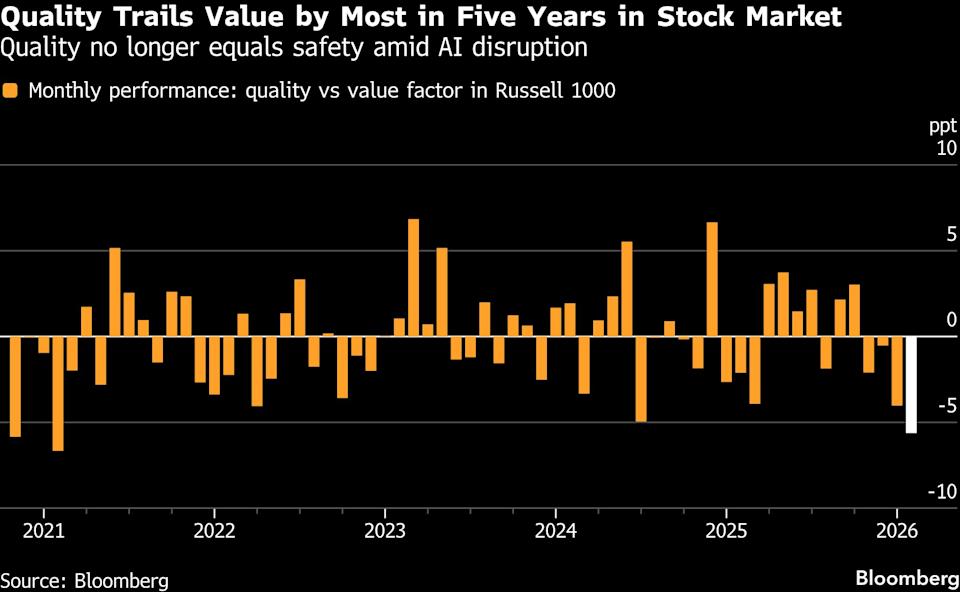
Traditionally, "quality" stocks—those with robust profits and consistent earnings—have been seen as safe bets. Companies like Microsoft and AppLovin, which offer client management and business solutions with high margins due to their complex, automated services, are now facing setbacks. Firms with strong competitive advantages and high valuations are losing favor, as AI threatens the very barriers that once protected them. Meanwhile, value stocks, previously overlooked due to fears of investing in struggling businesses, are regaining attention. Momentum strategies, which rely on riding the success of market leaders, are displaying unusual contradictions.
The notion of safety is being redefined. With uncertainty surrounding future cash flows caused by AI's rapid changes, investors are gravitating toward companies with solid current fundamentals and attractive prices, such as AngloGold Ashanti, Coca-Cola Co., and Acadia Healthcare Co.
AI Forces a Shift in Investment Factors
Nick Niziolek, co-chief investment officer at Calamos Investments, notes that AI is transforming the behavior of traditional equity factors used in portfolio construction, causing the makeup and nature of these factor baskets to evolve in real time.
For years, investors have been willing to pay premiums for companies expected to deliver future earnings—think software firms, pharmaceutical companies, and social media platforms that thrive in the knowledge economy. Now, with AI disrupting new sectors almost daily, few are willing to bet on cash flows that may not materialize in the coming years.
AI's permanence is clear, and the businesses poised to benefit are those providing essential infrastructure: utilities, semiconductor manufacturers, and producers of grids and pipelines. According to Goldman Sachs strategists, these companies possess "heavy assets, low obsolescence" (HALO), making them the new favorites among investors. Once considered dull or sensitive to economic cycles, these stocks are now in high demand.
Travis Prentice, chief investment officer at Informed Momentum Company, explains that AI requires broader participation to succeed, rewarding industries with significant physical capital and cyclical characteristics—traits often found in value-oriented strategies.
In February, quality stocks in the Russell 1000 lagged behind value stocks by over five percentage points, marking their worst performance since 2021 and reversing a three-year trend where quality led the market.
Alexander Altmann, global head of equities tactical strategies at Barclays Plc, suggests that hedge funds heavily invested in quality stocks may have intensified the recent downturn as they adjust their portfolios.
He describes the current environment as a confusing period for quantitative strategies, where disruptive technology collides with years of crowded trades—a powerful mix.
Despite these changes, factor regimes have historically been tested and often revert to traditional patterns. If AI's impact proves less widespread, or if economic conditions favor a return to quality, old investment strategies could quickly regain prominence.
Broader market risk appetite has diminished, influenced by geopolitical tensions and challenges in the software sector. The S&P 500 experienced its worst month since last year's tariff-driven selloff, high-yield credit declined, and safe-haven assets like Treasuries and gold saw gains.
Momentum and AI: A New Dynamic
The momentum factor is also undergoing transformation. Over the past decade, rising stocks tended to accelerate further, supported by analysts' frequent upgrades due to strong earnings. Now, however, the fastest-rising stocks show little connection to improving fundamentals, according to Man Group's analysis. Instead, any link to AI—even a tenuous one—can drive share prices higher.
Ziang Fang, senior portfolio manager at Man Group, observes that what appears to be a momentum portfolio is, in reality, an AI-focused portfolio. He emphasizes the importance of understanding the source and implications of this exposure from a risk standpoint.
With AI creating uncertainty for many companies, investors are less willing to wait for clarity. Immediate cash returns are highly sought after. Exchange-traded funds tracking firms with strong dividends and buybacks have attracted $7 billion in new investments this month, second only to value-focused funds among smart-beta ETFs, according to Bloomberg data.
A group of stocks prioritizing higher cash payouts has risen about 7% this quarter, based on research from 22V.
Dennis DeBusschere, co-founder at 22V, describes AI as a unique force reshaping factor relationships and expects the breakdown of traditional patterns to persist throughout the year.
Most Read from Bloomberg Businessweek
- How Covid Quietly Rewires the Brain
- Claude Code and the Great Productivity Panic of 2026
- The Buyers Behind Gold’s $5,000 Breakthrough
- Indian Desserts Are Ready for Their Matcha Moment
- America’s Love of Ube Is Straining Supplies in the Philippines
©2026 Bloomberg L.P.
Disclaimer: The content of this article solely reflects the author's opinion and does not represent the platform in any capacity. This article is not intended to serve as a reference for making investment decisions.
You may also like
Citi Raises Price Target on DT Midstream, Inc. (DTM)

Kinetik Holdings Inc. (KNTK) to Benefit From 2H26 Tailwinds

Here is Why Cheniere Energy, Inc. (LNG) is Still Highly Favored by Hedge Funds

Product Tanker Rates Offer Near-Term Momentum to Scorpio Tankers Inc. (STNG)

Trending news
MoreCrypto prices
More





