
Credo's AI Partnership Can't Lift Slumping Stock as Shares Slide 2.73% to 206th in $820M Trading Volume Amid Valuation Concerns

Market Snapshot
Credo Technology (CRDO) closed 2.73% lower on February 27, 2026, with a trading volume of $0.82 billion, ranking 206th in market activity. The stock’s 1.93% decline added to a 30-day price drop of 9.26%, despite a consensus analyst price target of $205.82—41% above the current price of $120.83. The company’s shares trade at a price-to-earnings (P/E) ratio of 103, significantly higher than the semiconductor industry average of 43.
Key Drivers
Credo’s recent partnership with TensorWave to deploy its ZeroFlap Active Electrical Cables (AECs) and Optics in next-generation AI clusters represents a strategic pivot toward AI-centric infrastructure. The collaboration positions Credo’s high-reliability interconnect solutions at the core of TensorWave’s AMD-based AI cloud, a market expected to expand as demand for scalable, power-efficient data center connectivity grows. TensorWave’s focus on “faster time to first token” and “production-grade reliability” aligns with Credo’s value proposition of 100 million hours of mean time between failures (MTBF) and advanced telemetry management. This partnership underscores Credo’s transition from traditional networking applications to AI-specific use cases, a shift analysts view as critical for long-term growth.
However, the stock’s recent underperformance suggests skepticism about the partnership’s immediate impact. While the deal expands Credo’s addressable market, analysts highlight risks including high customer concentration and overvaluation. Shares trade 52.6% above Simply Wall St’s fair value estimate, and the company’s high P/E ratio indicates investors are paying a premium for future growth rather than current earnings. Recent revenue from AI-related customers remains unquantified, leaving uncertainty about how quickly the partnership will translate into measurable revenue. Additionally, the stock’s volatility—exacerbated by short-term momentum—raises questions about whether the market is overestimating the partnership’s near-term potential.
The broader AI infrastructure sector’s dynamics further complicate Credo’s outlook. While AI cluster adoption is accelerating, competition from established players and the capital intensity of scaling AI hardware could pressure margins. Credo’s success hinges on its ability to secure follow-on contracts with TensorWave and other AI cloud providers, as well as demonstrate consistent revenue growth from AI-focused deployments. The company’s recent product launches, such as the Blue Heron 224G AI scale-up retimer, may bolster its offerings, but their adoption rates remain unproven.
Investor sentiment is also influenced by macroeconomic factors. The semiconductor sector has faced headwinds from slowing global demand, and Credo’s reliance on hyperscale customers amplifies its exposure to spending cycles. While the partnership with TensorWave is a positive catalyst, it does not mitigate the risk of revenue volatility if key clients delay or scale back AI infrastructure investments. Analysts urge closer scrutiny of Credo’s upcoming earnings reports to assess the pace of AI-related revenue growth and whether the company’s valuation aligns with its execution capabilities.
In summary, Credo’s stock reflects a tug-of-war between bullish AI infrastructure tailwinds and valuation concerns. The TensorWave deal strengthens its positioning in a high-growth niche but must be balanced against execution risks and market skepticism. Investors will likely remain cautious until the company provides clearer evidence of scalable AI revenue and improved profitability metrics.
Disclaimer: The content of this article solely reflects the author's opinion and does not represent the platform in any capacity. This article is not intended to serve as a reference for making investment decisions.
You may also like
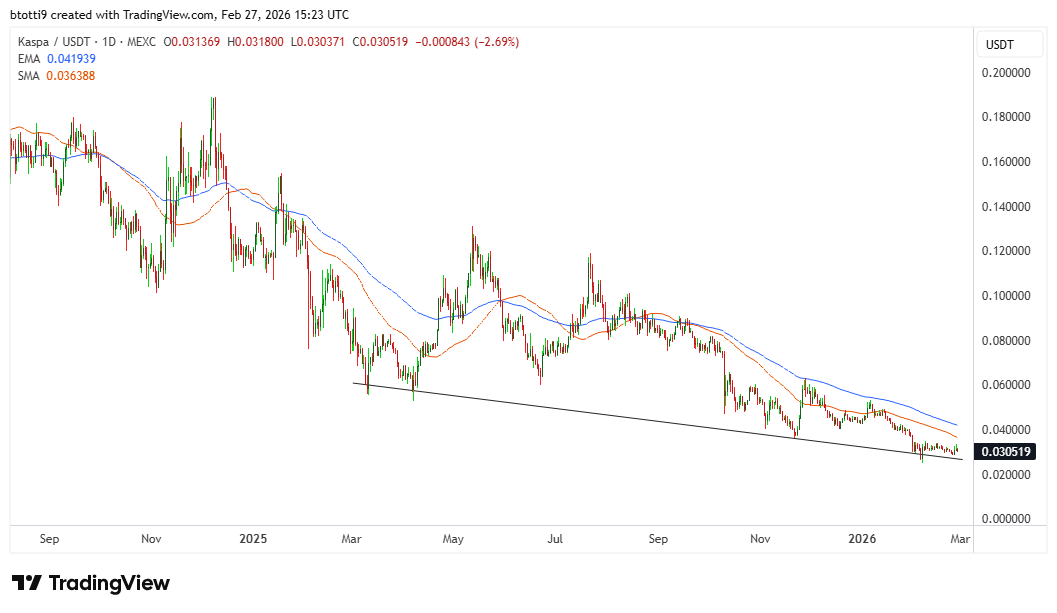
Kaspa (KAS) price forecast: why $0.03 is pivotal for bulls
Italian manufacturing industry shows signs of recovery for the first time in three months
French manufacturing output keeps expanding in February, yet demand remains weak
Trending news
MoreCrypto prices
More





