
Bitcoin Acts as a Geopolitical "Barometer": Will Market Opening on Monday Signal a Return of Risk Appetite?

Bitcoin's V-shaped reversal following the sharp escalation in the Middle East is being interpreted by some market participants as a positive signal for the opening of global risk assets on Monday.
Academy Securities strategist Peter Tchir stated in a report that, as the only risk asset tradable over the weekend, Bitcoin has historically been a barometer of market sentiment. Its rebound suggests that risk appetite is recovering. Meanwhile, oil prices have already priced in part of the geopolitical risk in advance, providing further support for a risk-on opening in the market on Monday.
As the US-Iran situation evolved, Bitcoin reversed from a "sharp decline" to a "sharp rise". After news broke of Israel's airstrike on Iran, digital assets plummeted. However, as Iranian state media confirmed the assassination of Khamenei, the market quickly reversed and surged. Bitcoin not only recovered its losses but also rose above the level before the conflict broke out.
According to China Central Television (CCTV) News, Iran's Supreme Leader Khamenei was assassinated on the morning of February 28. Israeli sources said that Khamenei and his senior aides, including Ali Shamkhani, Secretary of Iran's Defense Council, and Mohammad Pakpour, Commander-in-Chief of the Islamic Revolutionary Guard Corps, were all killed in the airstrike.
The report stated that he is optimistic about the market opening in a "risk-on" mode on Monday. He pointed out that oil prices have risen from about $60/barrel at the end of last year to $72 last Friday, and part of the conflict risk premium has already been priced in by the market. In addition, after the heavy blow to Iran's leadership, its strategic game logic has been broken—"now is the time to seek a dignified end."
Bitcoin's Role as a "Barometer"
The report stated that this is the third time in recent years that Bitcoin has served as a real-time barometer of market sentiment during a major Middle East conflict over the weekend. Each time, the initial response was a sharp drop, but this time, the strength of the rebound was entirely different.
On April 13, 2024, Iran launched a large number of suicide drones at Israel, with the conflict also occurring in the early hours of Saturday while global markets were closed. Bitcoin's initial response at that time was a sharp decline.
From June 21 to 22, 2025, "Operation Midnight Hammer" saw B-2 bombers carrying massive bunker-buster bombs destroy three nuclear facilities in Fordow, Natanz, and Isfahan. The event again occurred on a Saturday morning, and Bitcoin once more experienced a knee-jerk plunge.
The key difference in this conflict compared to the previous two is that Bitcoin saw a significant rebound after the sharp drop, and ultimately traded above its pre-event level. In the report, this price movement is interpreted as a "risk-on" signal.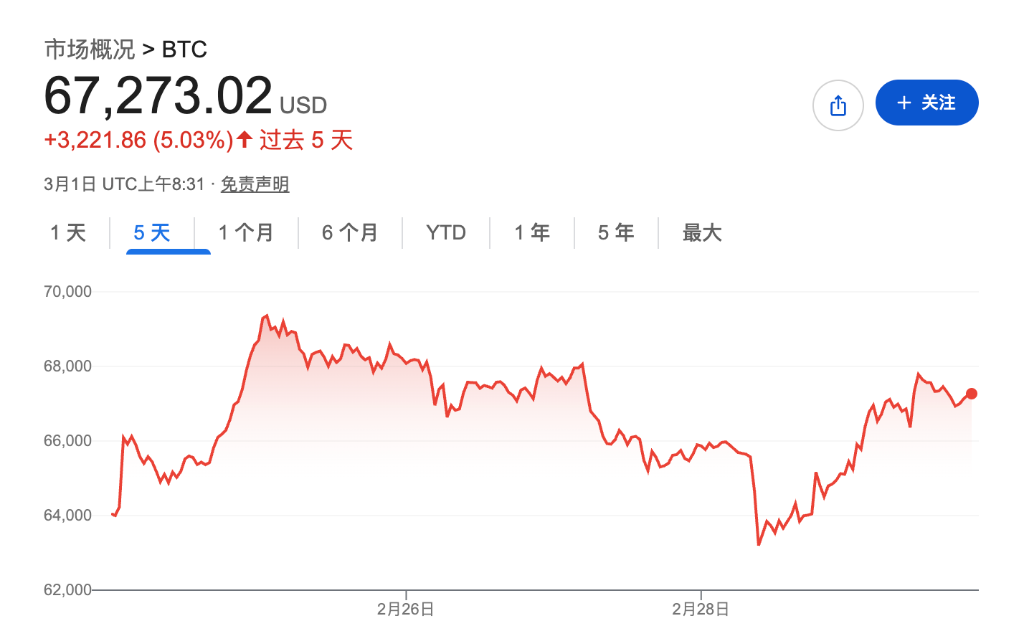
Oil Prices Have Priced in Part of Conflict Risk
The energy market is the core variable in assessing the impact of this round of conflict on the macroeconomy. Academy Securities strategist Peter Tchir outlined several logics behind oil prices in the report:
First, risks are partially priced in. Brent crude oil has risen from about $60/barrel at the end of last year to $72/barrel last Friday. This increase is driven by both US winter energy demand and a certain degree of conflict risk premium. This means that after the market opens on Monday, a lot of the "bad news" for oil prices has already been anticipated.
Second, supply routes have not been blocked. Tchir pointed out that there are currently no signs that the Strait of Hormuz or other key oil transport routes have been shut down. He said: If there is an opportunity for de-escalation and passage is not affected, this is the core premise for oil prices remaining under control.
Lastly, buffer inventories provide a safety cushion. Major oil-consuming countries around the globe have ample crude reserves, and US inventory levels are also high. Therefore, short-term supply disruptions of about a week are expected to have limited impact. Based on these assessments, Tchir expects spot contracts may test $80, but does not expect significant volatility in the forward curve.
Disclaimer: The content of this article solely reflects the author's opinion and does not represent the platform in any capacity. This article is not intended to serve as a reference for making investment decisions.
You may also like
Up 37% Over the Last 6 Months, Does This Popular Networking Stock Still Have Room to Grow?
Ripple CEO Stuns XRP Army With Bombshell Statement for Banks
dogwifhat at $0.20: Reversal or further drop, what’s next for WIF?
"A sharp divide": Wall Street assesses the gains and losses as AI-fueled tech stocks tumble
Trending news
MoreCrypto prices
More





