
Iran Tensions Pose Greatest Risk of Gas Market Upheaval Since 2022

Escalating Middle East Tensions Threaten Global Gas Supplies
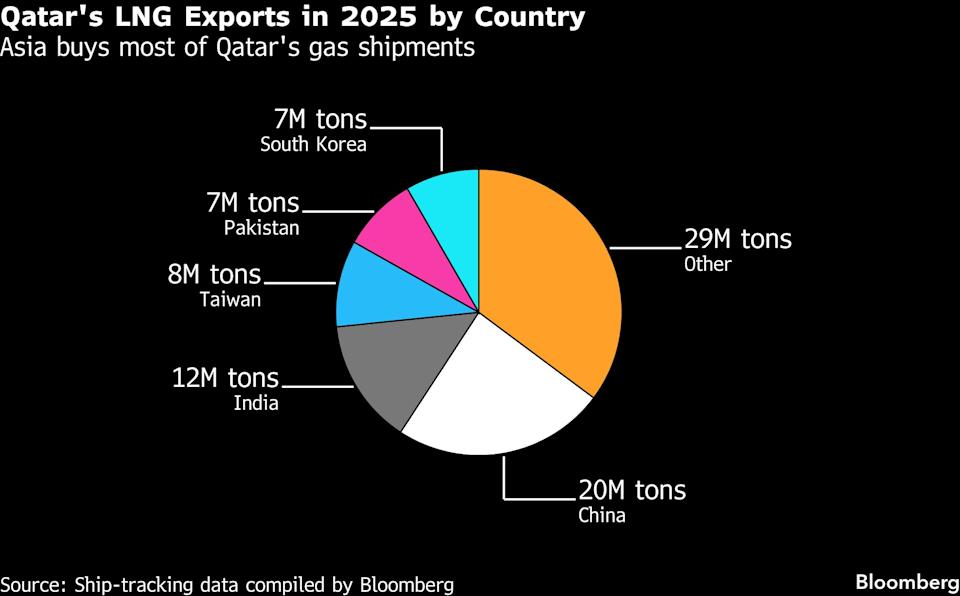
Data from ship-tracking sources indicates that the growing unrest in the Middle East is poised to cause the most severe disruption to natural gas markets since the shockwaves from Russia’s 2022 invasion of Ukraine.
Key energy producers such as Qatar, situated near Iran, play a crucial role in the global gas market. The region also serves as a major transit route, with approximately one-fifth of the world’s liquefied natural gas (LNG) exports passing through the strategically vital Strait of Hormuz.
Top Stories from Bloomberg
Currently, LNG shipments through the Strait of Hormuz have nearly come to a standstill. Asian importers, who source about 25% of their LNG from Qatar—the world’s second-largest supplier—are urgently contacting vendors to secure alternative deliveries. Meanwhile, Egypt is seeking to expedite its shipments after Israel halted production at some of its fields.
Tom Marzec-Manser, who oversees European LNG and gas analysis at Wood Mackenzie, commented, “Any naval operations in the Strait of Hormuz or changes in Qatari LNG output could significantly drive up prices.”
The 2022 conflict in Ukraine caused massive upheaval in the global gas market, severing Russia’s access to its main customers, increasing volatility, and sending European gas prices to record highs.
Asia remains especially susceptible to similar market shocks from the Middle East. Last year, over 80% of Qatar’s LNG exports were sent to Asian countries, with China being the largest recipient, followed by India.
Both Asian and European deliveries must transit the Strait of Hormuz. At least eleven LNG tankers traveling to or from Qatar have paused their journeys to avoid the area, according to recent shipping data. The United Arab Emirates, another smaller LNG exporter, also relies on this route for its shipments.
Anne-Sophie Corbeau, a researcher at Columbia University’s Center on Global Energy Policy, noted, “There’s no substitute for these supplies. The question is whether prices will surge more in Asia or Europe. Europe is less exposed but has limited storage, and the impact will depend on how much supply is redirected to Asia.”
In 2025, Qatar shipped 82.2 million tons of LNG. One of the production lines at the Ras Laffan facility was undergoing scheduled maintenance last week, which is expected to reduce output temporarily, according to traders who requested anonymity due to company policies.
Shipping Companies Adjust Routes Amid Rising Risks
Major Japanese LNG shipping firms are taking precautions. Nippon Yusen has instructed its fleet to steer clear of the Strait of Hormuz, while Mitsui OSK Lines is keeping its vessels in safer waters. Kawasaki Kisen Kaisha has also ordered its ships in the Persian Gulf to remain on standby.
If the conflict persists and shipping interruptions continue, the risk of LNG production cuts will increase, as steady exports are essential to keep facilities running efficiently.
Chinese importers are among those urgently seeking alternative supplies in case Iranian restrictions on shipping remain in place, though QatarEnergy has not delayed any deliveries. The company has not commented outside of regular business hours.
Traders in India, Japan, and other regions are preparing for rising prices, ending a period of relative stability. Not only are spot prices affected, but long-term LNG contracts, which are often tied to crude oil benchmarks, will also become more expensive if Brent prices climb.
Jera Co., Japan’s largest LNG buyer, stated, “Should Middle East tensions escalate or persist, restrictions on tanker movement and other factors could impact Japan’s supply. We are committed to securing flexible fuel procurement through our trading operations.”
Broader Implications for Global Energy Markets
Turkey, which receives pipeline gas from Iran, could also face challenges. If pipeline flows are disrupted, Turkey—like Egypt—may need to increase LNG imports, further driving up prices for seaborne gas.
Iran supplies Turkey under a contract for 9.6 billion cubic meters per year, though actual deliveries have recently fallen short, according to Columbia’s Center on Global Energy Policy. In 2024, Iranian gas accounted for less than 15% of Turkey’s imports, based on Oxford Institute for Energy Studies data.
Reporting assistance by Hideki Suzuki, Natsuko Katsuki, Tsuyoshi Inajima, and Shoko Oda.
(Updated with Jera’s statement.)
Most Read from Bloomberg Businessweek
©2026 Bloomberg L.P.
Disclaimer: The content of this article solely reflects the author's opinion and does not represent the platform in any capacity. This article is not intended to serve as a reference for making investment decisions.
You may also like
BitMine stock slumped for five straight months: will it rebound in March?
Realty Income’s Decade-Long Dividend Performance: A Technical Review of Its Income Generation Mechanism
B. Riley Cuts Target Price on Go Daddy (GDDY) to $215

Trending news
MoreCrypto prices
More





