
What are the benefits of Amazon, Nvidia, and SoftBank investing 110 billion in OpenAI?

On February 27, OpenAI announced the completion of a new funding round of approximately $110 billion, with a pre-money valuation reaching $730 billion.
Following last year’s $41 billion raise, this marks another record-breaking fundraising for OpenAI, making it the largest private financing ever in a technology company.
This round was led by strategic investors, with Amazon contributing $50 billion, SoftBank and Nvidia each investing $30 billion.
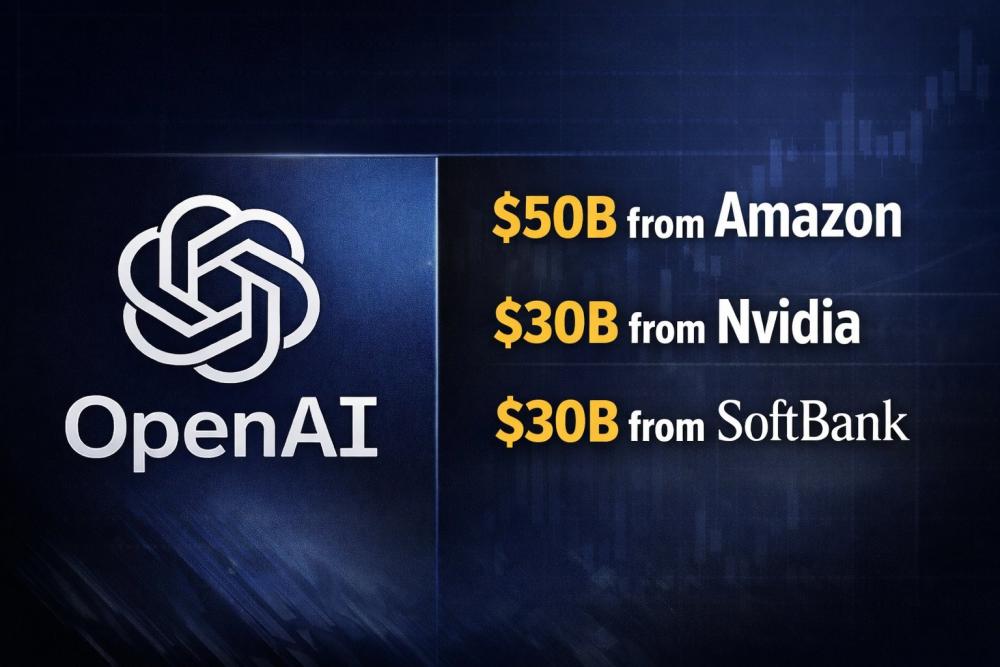
After the completion of this round, OpenAI’s cash reserves rose to about $150 billion. OpenAI stated that the funds will mainly be used to expand computing infrastructure to meet rapidly growing user demand.
01 Amazon Invests $50 Billion in Installments
As the most generous investor in this round, Amazon’s $50 billion commitment will be delivered in two stages: an initial $15 billion has already been allocated, with the remaining $35 billion coming when OpenAI completes an IPO or achieves AGI.
As a result, Sam Altman quickly commented that he’s open to going public at an appropriate time.
Regarding AGI, as defined in the previous contract between OpenAI and Microsoft, AGI refers to "highly autonomous systems that surpass humans at economically valuable work." OpenAI’s charter includes a special clause: once AGI is achieved, Microsoft will lose access to the technology.
But Amazon isn’t just bringing capital; the two parties signed a comprehensive technical partnership—Amazon will use its chips and cloud services in exchange for OpenAI’s models and technology.
The core of their cooperation is the computing power procurement.
OpenAI will pay AWS another $100 billion in computing power costs over the next eight years, on top of an existing $38 billion contract, a significant portion of which will be spent on Amazon’s self-developed Trainium chips. OpenAI has committed to buying around 2 gigawatts of Trainium computing power, including the upcoming Trainium3 and Trainium4, which is set for 2027.
Amazon CEO Andy Jassy specifically noted that the Trainium chips have a 30%-40% cost-performance advantage over comparable GPUs: “Now, both leading AI labs are using them.”
The other lab, of course, is Anthropic, which has been making waves with the US government recently.
Another collaboration between OpenAI and Amazon is at the product level, where both parties will jointly develop a "Stateful Runtime Environment" to operate on Amazon Bedrock. This environment allows developers to use OpenAI models while maintaining context, remembering previous tasks, and collaborating across tools.
AWS has also secured exclusive third-party distribution rights for OpenAI’s enterprise platform Frontier.
There’s an even more direct partnership: Amazon will use OpenAI’s models to optimize its own consumer-facing applications. The two companies will co-develop custom models for Amazon’s internal teams, spanning products from e-commerce to smart hardware.
02 Nvidia $30 Billion: Shareholder + Supplier
The cooperation between Nvidia and OpenAI was once rumored to be off, especially after Jensen Huang commented that investing $100 billion in OpenAI was “never a commitment.”
Nonetheless, the investment has been finalized, though at $30 billion paid over three installments—much less than the rumored $100 billion.
According to the announcement, the two sides reached a new computing power agreement: Nvidia will provide OpenAI with 3GW of dedicated inference computing power and 2GW of compute for training the Vera Rubin system—in addition to the Hopper and Blackwell systems already running on Microsoft, Oracle Cloud, and CoreWeave.
In terms of computing power, 1GW is equivalent to $50 billion, so the value of Nvidia’s support for OpenAI far exceeds the rumored $100 billion.
Thus, Nvidia is not only a shareholder but also OpenAI’s largest chip supplier, essentially “using its own funds” to help OpenAI buy its own chips—even as much of the $30 billion investment will flow back to Nvidia as computing procurement.
In short, this is yet another round of the familiar “circular financing” narrative.
03 SoftBank $30 Billion: IPO Is Paramount
Similar to Nvidia, SoftBank’s $30 billion investment commitment will also be delivered in three stages.
Masayoshi Son’s approach is straightforward: OpenAI is currently the most likely AI company to go public, and SoftBank needs an IPO to boost Vision Fund performance.
Insiders say this round of funding is seen as a major step ahead of an OpenAI IPO, with the company possibly starting the process as soon as the end of this year.
Compared to the other investors, SoftBank also acts as a connector.
Sources say OpenAI will likely secure another $10 billion in primary equity funding, with commitments finalized within a month and investors including sovereign wealth funds and investment firms. It is speculated that many of these investors will be introduced via SoftBank.
04 Microsoft: No New Funds This Round, Position Unchanged
Responding to Amazon’s participation, Microsoft and OpenAI issued a joint statement today, emphasizing that their partnership remains unaffected.
The statement confirms that Microsoft is still the exclusive cloud provider for OpenAI’s stateless model APIs—all stateless (context-free) calls to OpenAI models are hosted on Azure. This remains the mainstream way of accessing OpenAI models.
At the same time, OpenAI’s proprietary products (including the newly launched Frontier) will continue to be hosted on Azure. Frontier is OpenAI’s new enterprise platform that allows organizations to deploy AI agents themselves.
Arrangements for intellectual property authorization and revenue sharing between Microsoft and OpenAI remain unchanged. However, OpenAI retains the right to source compute elsewhere, including for massive infrastructure projects like "Stargate."
05 Copying the "Circular Financing" Narrative
Looking at the input and output for all four parties, as mentioned earlier, it’s once again the “circular financing” cycle:
-
Amazon invests $50 billion, receiving model technology licensing from OpenAI and a $100 billion cloud service order in return
-
Nvidia invests $30 billion, getting OpenAI’s chip procurement commitment
-
SoftBank invests $30 billion, betting on the chance to exit via IPO
-
Microsoft doesn’t contribute new funds this round but keeps exclusive API rights, earning a share of every OpenAI API sale in the future
After this round, OpenAI’s cash grows by $110 billion, while giving it access to the computing resources of three tech giants, at the cost of locking in future technology licensing and cloud procurement for its shareholders in advance.
Moreover, for Amazon and SoftBank, OpenAI’s IPO is a key condition for fulfilling their investment commitments.
With this, OpenAI’s shareholder list features Microsoft, Amazon, Nvidia, and SoftBank—four giants whose businesses both overlap and conflict. How to balance the interests of these shareholders will be Sam Altman’s next major challenge.
06 ChatGPT's Weekly Active Users Surpass 900 Million
Back to the business side, OpenAI clearly needs these funds right now.
OpenAI previously held about $40 billion in cash. With this fundraising, its available capital has risen to approximately $150 billion. The company estimates it will only achieve positive free cash flow for the first time in 2030. Until then, most of the capital will go into data center operations, chip procurement, and cloud expenses.
According to financial data cited by the Financial Times, revenue is about $13 billion in 2025, expected to hit $30 billion this year, with a 2027 target of over $60 billion and 2030 goal exceeding $280 billion. The growth curve is steep, but costs are rising even faster.
As for user data: according to OpenAI’s official data, ChatGPT’s weekly active users already exceed 900 million, with over 50 million consumer subscribers and over 9 million paying business users. This year’s coding tool Codex saw weekly active users triple since the beginning of the year, reaching 1.6 million.
The growth figures are impressive, but competitors aren’t standing still.
Google’s Gemini is aggressively pushing into the consumer market, while Anthropic has already led in the enterprise sector. According to OpenAI executives, by the end of this year, half of OpenAI’s revenue should come from enterprise clients—up from 40% now. This means that in the coming quarters, OpenAI must compete directly with Anthropic to capture another 10% share.
Another notable detail is the change in the equity structure.
After this round, the value of the for-profit shares held by the nonprofit "OpenAI Foundation," spun off from OpenAI in 2025, has risen above $180 billion. Sources say if investor demand is strong, the Foundation may sell up to $10 billion in stock to fund its charity programs and hiring.
In other words, after this $110 billion raise, there may be another opportunity to buy OpenAI stock on the private secondary market.
Source: Tencent Technology
Disclaimer: The content of this article solely reflects the author's opinion and does not represent the platform in any capacity. This article is not intended to serve as a reference for making investment decisions.
You may also like
Factbox-Rising conflicts draw attention to major tech firms' AI investments in the Middle East
DocGo's Q4 2025: What's Priced In After a Year of Misses?
Altcoins Outperform Bitcoin With Double-Digit Weekly Gains
Trending news
MoreCrypto prices
More





