
The Ultimate Trump Card Behind the Trading Frenzy of Gold HALO

Huitong Finance March 2 reports—— In 2026, geopolitical risks are continuously escalating, the trend of de-globalization is intensifying, the HALO investment style is being highly sought after, and the importance of gold as a strategically neutral reserve asset has significantly increased.
On Monday (March 2), Iranian military sources reported that three UK-US oil tankers were attacked in the Persian Gulf and Strait of Hormuz. The US Consulate General in Erbil, Iraq, has been destroyed, and the US military base in Bahrain has also been destroyed.
In 2026, geopolitical risks are continuously escalating, the trend of de-globalization is intensifying, the HALO investment style is being highly sought after, and the importance of gold as a strategically neutral reserve asset has significantly increased.
Analysts predict that although gold prices have reached record highs, under the backdrop of an international monetary system reset (“Bretton Woods III”), its role as a neutral anchor for cross-bloc trade will be even more critical.
In the macro context of early 2026, a direct military conflict between the US and Iran will become the ultimate stress test and explosion point for the HALO trading logic.
This war is not only a geopolitical earthquake but also a complete shattering of the global “light asset, virtualization, globalization” illusion, forcing all capital to flee to physical entities and energy fortresses.
Gold: The "Zero-Obsolescence Asset" of HALO Trading
Gold is the ultimate in the “Low Obsolescence (LO)” concept of HALO.
Physical moat: AI can generate infinite codes, central banks can print unlimited digital currencies, but gold reserves in the physical world are constrained by geophysics.
This “heavy asset (HA) with extremely high mining costs” attribute makes it the ultimate defense against algorithmic inflation and currency devaluation.
Geopolitics’ “honest money”: With de-globalization weaponizing the US dollar system, global central banks are increasing their physical gold holdings, essentially engaging in a national-level HALO trade.
They no longer trust digital claims, but turn toward the physical credit that can be “seen, touched, and cannot be taken away.”
Oil: The “Power Core” of the HALO System (The Heavy Energy Asset)
In 2026, despite ongoing green energy transitions, oil’s HALO attributes in geopolitics are further strengthened.
Liquidity of heavy assets: Oil exploration, drilling, refining, and long-distance pipeline transport are typical high CapEx industries.
Against the backdrop of de-globalization, countries that control these “heavy asset infrastructures” control the breathing room of the global supply chain.
AI’s “physical supply line”: Investors realize that the surge in AI computing power creates a power gap that, in the short term, still requires fossil fuel base-load electricity to support.
Oil is not only energy, but also the base material for chemical products. This “physical irreplaceability” keeps its risk of obsolescence extremely low even in an era of technological explosion.
Traditional Gold Purchase Motives Support HALO Trading Logic
Resource-rich countries use gold, rare earths, uranium, copper, silver and other resources as bargaining chips to enhance negotiating power. Mining stocks and commodity ETFs benefit from rising demand in defense, technology, and energy sectors.
De-globalization accelerates de-dollarization and gold, as a globally recognized neutral reserve asset, strengthens its ability to hedge systemic risk and geopolitical uncertainty.
Analyst Paul Wong believes that even if the world splits into multiple power blocs, gold could still maintain a single reference price, as it is a "neutral value anchor" for cross-group trade.
The Shanghai gold premium could fluctuate, but extreme divergence like the 30% price difference in copper between the LME and COMEX is unlikely to appear in the gold market.
Traditional transparent trading mechanisms like LME and CME are rendered ineffective by tariff barriers and resource nationalism, impeding the free flow of metals.
The rise of resource nationalism leads to increased risks of supply chain disruption, though specific impacts remain unclear.
The post-pandemic policy of debt expansion has entrenched a “fiscal dominance” system, where central banks prioritize debt sustainability over inflation control, speeding up the devaluation of fiat currency purchasing power.
Shifting investor allocations from fiat-denominated assets to hard assets such as gold is now a long-term trend, expected to accelerate in 2026.
Although mainstream investors are aware of the devaluation trend, allocation adjustments are slow. The rapid surge in Japanese government bond yields and the yen’s collapse suggest developed markets may follow in emerging markets’ footsteps.
Central banks have become net gold buyers (for example, sovereign purchases by China), while investment institutions are generally underweight, resulting in a scarcity of sellers in the market. The correction in the summer of 2025 lasted only four months, after which gold prices soared from $3,500 to above $4,800.
The Russia-Ukraine war, US freeze on Russia’s foreign exchange reserves, and other events have intensified central banks’ hedging demand for gold.
Geopolitical conflicts, trade wars, yield curve steepening, and devaluation trades resonate together, with continued buying offsetting any corrective pressure on gold.
“High-temperature operation” policies (expansionary fiscal + loose monetary policy) make inflation a tool for governments to absorb debt, leaving traditional anti-inflation measures ineffective.
The bond market has already priced in the expectation, with surging short-end issuance causing liquidity pressures (e.g., the autumn 2025 repo crisis), forcing the Federal Reserve to restart QE under the guise of “reserve management purchases.”
In a climate of confrontation among monetary blocs, gold is the only reserve asset recognized across groups. Though technicals show overbought signals, institutional allocation remains insufficient.
Analysts predict that the new round of international monetary reset (“Bretton Woods III”) will inevitably include gold, and its weighting will be higher than in the current system.
Summary and Technical Analysis:
The crisis of 2026 is the ultimate stress test for HALO trading. It marks a paradigm shift for global investors from “chasing growth” to “defending against devaluation,” with gold and oil at the center of this physical-world defense battle.
Technically, spot gold has broken out and gapped above the midline of its channel and is currently pulling back, with support at around 5,320 (UTC+8) and resistance at 5,450 (UTC+8).
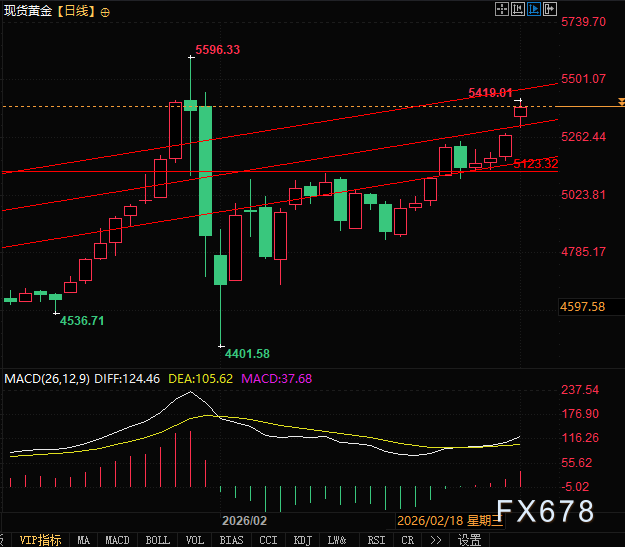
(Spot gold daily chart, source: EasyHuitong)
At 20:26 UTC+8, spot gold was reported at $4,392 per ounce.
Disclaimer: The content of this article solely reflects the author's opinion and does not represent the platform in any capacity. This article is not intended to serve as a reference for making investment decisions.
You may also like
A Review of Q4 Earnings for HR Software Stocks: Comparing Paycom (NYSE:PAYC) with Its Competitors
Wedbush's Sector Split: The Expectation Arbitrage in AppLovin, Unity, and Playtika
Q4 Financial Results: Comparing Baxter (NYSE:BAX) With Other Diversified Medical Devices & Supplies Stocks
Trending news
MoreCrypto prices
More





