
GBP/USD bounces off eleven-week lows as 1.34 holds on Iran sell-off

GBP/USD fell around one-half of one percent on Monday, briefly sliding to an eleven-week low around 1.3310 in early trade before staging a mid-session recovery to settle close to the 1.3400 handle. The drop was driven almost entirely by broad US Dollar strength as the Iran conflict triggered a rush into safe-haven assets, though Sterling's recovery from the lows left a long lower wick on the daily candle, suggesting buyers stepped in near the 200-day Exponential Moving Average (EMA). Over the past week, Sterling was one of the weaker G10 currencies, losing ground to the US Dollar, Australian Dollar, Canadian Dollar, and New Zealand Dollar, while holding roughly flat against the Swiss Franc and gaining only against the Euro and Japanese Yen.
The Bank of England (BoE) held rates at 3.75% in February by a narrow 5-4 vote, with Governor Andrew Bailey casting the deciding vote to hold. Testifying before Parliament's Treasury Committee last week, Bailey described the March 19 decision as "a genuinely open question," noting that services price inflation came in at 4.4% in January, well above the BoE's 4.1% forecast. Chief Economist Huw Pill echoed the caution, warning against being "beguiled" by headline inflation falling toward the 2% target. UK labour market data have softened, with unemployment rising to 5.2% and wage growth moderating to 4.2%, which is keeping markets leaning toward a March cut despite the mixed signals from policymakers.
Domestic political uncertainty is also weighing on Sterling. The Green Party's convincing victory in last week's Gorton and Denton by-election, where Labour slipped to third place after holding the seat with a sizeable majority in 2024, has reignited questions about Prime Minister Starmer's leadership ahead of May's local elections. Chancellor Reeves's Spring Statement later this week will be watched closely for updated fiscal projections from the Office for Budget Responsibility (OBR), with any downgrade to the UK's growth outlook likely to compound the currency's recent weakness. On the US side, escalating Middle East tensions, hotter-than-expected January Producer Price Index (PPI) data, and the Federal Reserve's (Fed) reluctance to cut rates before July continue to support the Greenback.
GBP/USD daily chart
Technical Analysis
In the daily chart, GBP/USD trades at 1.3409. The near-term bias is mildly bearish as spot has slipped below the 50-day exponential moving average, while the 200-day average at 1.3425 now hovers just above price and acts as dynamic resistance. The recent failure to sustain gains above the mid-1.36s has transitioned into a sequence of lower closes, and daily stochastic holding in the lower half of its range signals persistent downside pressure rather than capitulation selling.
Initial resistance is located at the 200-day EMA near 1.3425, followed by the 1.3520 area where the 50-day EMA previously guided the advance. A daily close back above 1.3520 would be needed to ease the current downside bias and open the way toward 1.3695. On the downside, immediate support sits around 1.3350, ahead of a lower band of demand near 1.3250, where a loss would confirm a deeper corrective phase toward 1.3150.
In the weekly chart, GBP/USD trades at 1.3409. The near-term bias is mildly bullish as price holds a clear series of higher weekly closes above the rising 200-week exponential moving average near 1.30, confirming an underlying uptrend structure. The Stochastic oscillator remains in positive territory after retreating from overbought readings, indicating easing but still positive momentum rather than a full bearish reversal, which favors consolidation above recent lows rather than a sustained downside break.
Initial resistance stands at the recent swing area around 1.3650, where prior advances stalled, followed by a stronger barrier near 1.37 that guards any extension toward last quarter’s highs. On the downside, immediate support emerges at 1.3350, with a deeper floor at 1.3250 that aligns the latest reaction low with proximity to the 200-week EMA zone near 1.30. A weekly close below 1.3250 would weaken the bullish bias and expose the 1.31–1.30 band, while sustained trading above 1.3350 would keep focus on a potential retest of 1.3650.
(The technical analysis of this story was written with the help of an AI tool.)
Disclaimer: The content of this article solely reflects the author's opinion and does not represent the platform in any capacity. This article is not intended to serve as a reference for making investment decisions.
You may also like
Marvell: Cramer's "Buy the Dip" Alpha vs. The "Lost Deal" Noise
Lumentum’s OFC Catalyst: A Strategic Move Riding the Wave of AI Infrastructure Growth
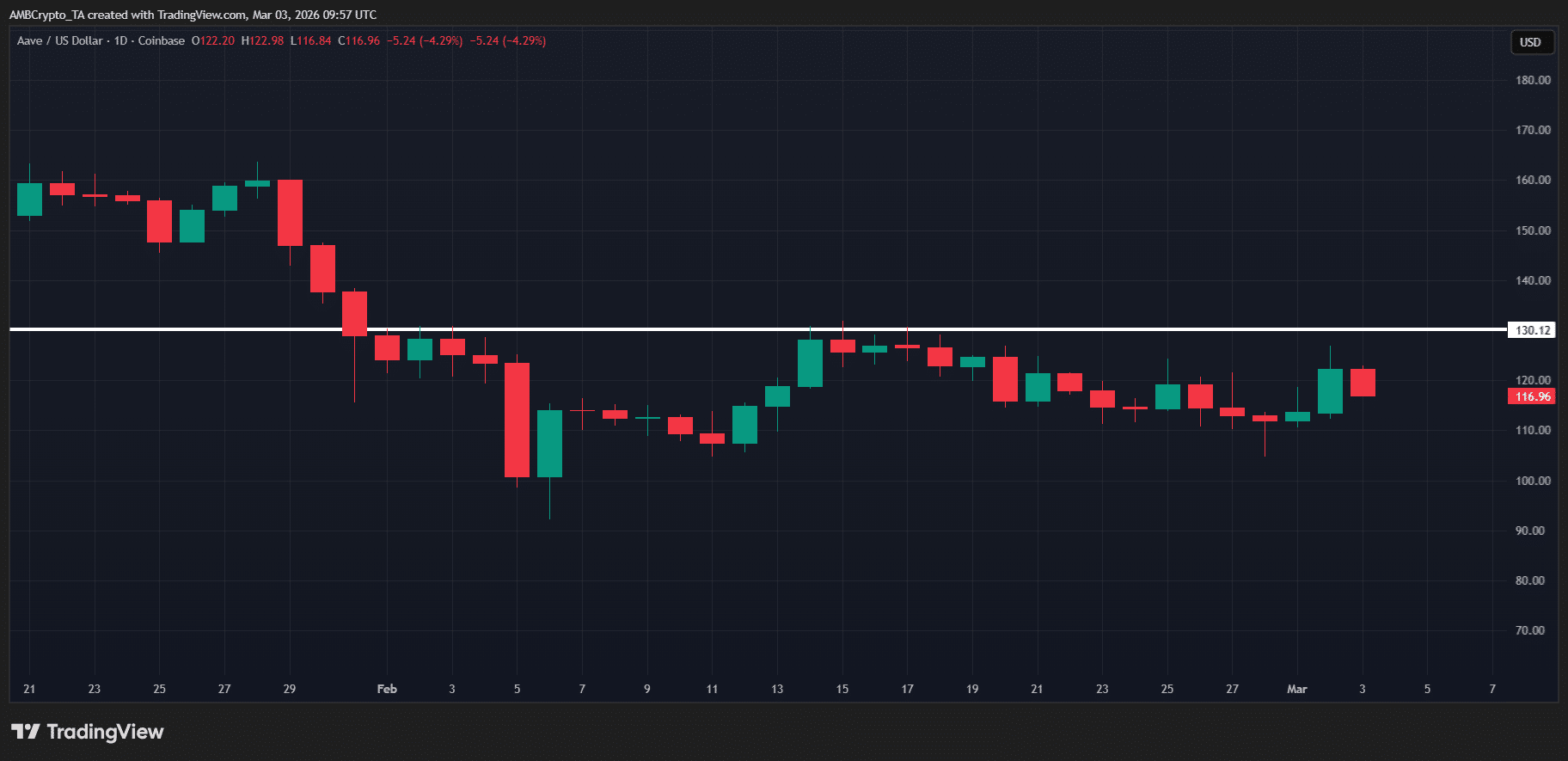
AAVE jumps 7% on $42.5 mln governance boost – Can it break $130?
Trump’s ex-crypto advisor: US government must go beyond 'liking Bitcoin'

Trending news
MoreCrypto prices
More





