
Consolidated Edison's 0.41% Drop as Trading Volume Plunges 49.23% to 449th Largest Amid Strong Earnings Institutional Bets and Cautious Analysts

Market Snapshot
Consolidated Edison (ED) closed March 2, 2026, with a 0.41% decline, marking a modest pullback in its stock price. Trading volume for the day totaled $0.30 billion, a 49.23% drop compared to the previous day, placing it at the 449th largest volume on the market. While the stock’s decline was relatively small in percentage terms, the sharp drop in trading volume suggests reduced investor activity, potentially reflecting a lack of immediate catalysts or uncertainty ahead of the April 30 earnings report.
Key Drivers
The recent performance of Consolidated EdisonED-0.41% appears influenced by a mix of earnings momentum, institutional investment, and analyst sentiment. For the quarter ending December 2025, the company reported earnings of $0.89 per share, exceeding the $0.85 estimate by 4.71%, and revenue of $3.99 billion, surpassing the $3.71 billion forecast by 7.82%. These results, combined with a 6.20 EPS guidance range for FY 2026, highlight operational strength. However, the stock’s modest decline on March 2 may signal investor caution ahead of the April 30 earnings date, where the company faces elevated expectations for its full-year performance.
A significant development came from institutional investors. Clean Energy Transition LLP increased its stake in EDED-0.41% by 35.2% during Q3 2025, elevating its position to 764,387 shares valued at $76.84 million. This move reflects confidence in the utility’s long-term prospects, particularly as the firm now holds 5.6% of its portfolio in ED. Other investors, including Salomon & Ludwin LLC and Webster Bank N.A., also bolstered their holdings, albeit on a smaller scale. Institutional buying often signals a vote of confidence, yet the stock’s muted performance suggests broader market dynamics, such as sector rotation or macroeconomic concerns, may be tempering enthusiasm.
Analyst activity further shaped the stock’s narrative. Scotiabank raised its FY 2026 EPS estimate for ED to $6.15 from $5.92, while Mizuho and TD Cowen adjusted price targets upward. Despite these upgrades, the consensus analyst rating remains “Reduce,” with an average target price of $107.07. This divergence in sentiment underscores a cautious outlook, as some analysts—such as those at Bank of America and Morgan Stanley—maintain “underperform” or “underweight” ratings. The mixed guidance may reflect uncertainty about the company’s ability to sustain its recent earnings momentum, particularly in a regulatory-heavy industry sensitive to policy shifts.
Another critical factor is the company’s dividend strategy. Consolidated Edison increased its quarterly dividend to $0.8875 per share, translating to a 3.2% yield and an annual payout of $3.55. This raise, coupled with a dividend payout ratio (DPR) of 62.8%, signals a balance between rewarding shareholders and preserving financial flexibility. While the yield is attractive in a low-interest-rate environment, the DPR leaves room for further increases, which could appeal to income-focused investors. However, the stock’s price action suggests that dividend growth alone may not be sufficient to drive aggressive buying in the near term.
Finally, the broader market context for utilities stocks appears to be a moderating factor. While ED’s Q4 results and guidance are robust, the sector’s low beta and defensive positioning may limit volatility. With a beta of 0.38 and a P/E ratio of 19.91, the stock is valued for stability rather than growth, which could dampen investor interest in a market environment favoring high-growth sectors. Additionally, the company’s recent insider sales, including a 5.56% reduction in shares by Director John F. Killian, may have contributed to a slightly bearish sentiment among retail investors.
In summary, Consolidated Edison’s stock performance reflects a tug-of-war between strong fundamentals, institutional backing, and cautious analyst sentiment. While the company’s earnings beat and dividend growth provide a solid foundation, broader market dynamics and regulatory risks appear to cap near-term upside. Investors will likely watch the April 30 earnings report and subsequent guidance closely to gauge the sustainability of the company’s momentum.
Disclaimer: The content of this article solely reflects the author's opinion and does not represent the platform in any capacity. This article is not intended to serve as a reference for making investment decisions.
You may also like
Rising Stagflation Fears in the US Spotlight Bitcoin’s Role in Economic Uncertainty
Crypto Market News Today: DeepSnitch AI Ramps Up the Hype Around Its Live Intelligence and Utility, as Bitcoin Takes a Tumble

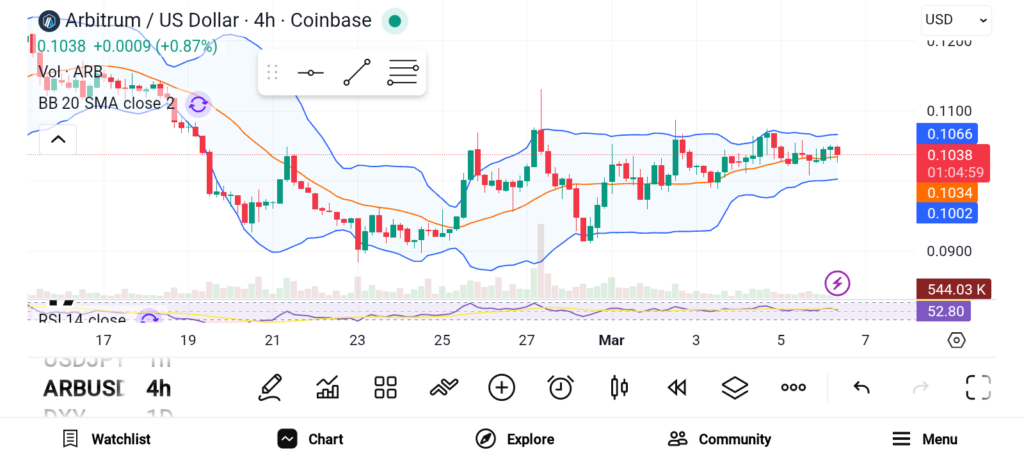
3 Promising Altcoins to Buy for Long-Term Investment: ARB, DOT, and TRX
Altcoin Season Searches Hit Rock Bottom: According to an Analysis Company, the Market May Prove the Crowd Wrong

Trending news
MoreCrypto prices
More





