
Paving the way for the release of the new CPO plan? Nvidia heavily bets on optical interconnects, aiming to build CPO "supply protection"

Nvidia has invested $4 billion in two leading optical communication giants, securing critical production capacity for the upcoming “optical interconnect” era of next-generation AI computing architecture.
On March 2nd local time, Nvidia announced it has established multi-year partnerships with optical component manufacturers Coherent and Lumentum. The cooperation covers joint research and development of optical technology, arrangements for priority access to future production capacity and supply, as well as Nvidia’s “multi-billion dollar” multi-year procurement commitments. At the same time, Nvidia is investing $2 billion in each company to support their R&D, future production, and operational expansion in the United States.
According to Chasing Trends Trading Desk, JPMorgan’s North America Equity Research team analyzed that the two deals are “substantially similar” in structure and intent:
Both are non-exclusive, multi-year advanced optical collaborations;
Both involve “multi-billion dollar procurement commitments”;
Nvidia is investing $2 billion in each of Coherent and Lumentum to expand U.S. manufacturing capacities and support R&D; both companies mentioned that Nvidia will receive common stock in exchange for the investment.
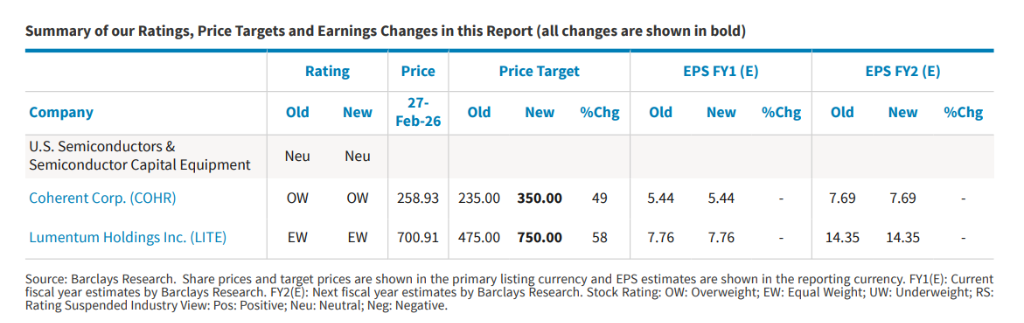
In its latest research report, Barclays directly pointed out that the core demand of Nvidia’s investment is to secure the supply of co-packaged optics (CPO).
The report stated: “The primary reason behind the deal is for Nvidia to protect supply for two types of CPO: scale-out (rack-to-rack) and scale-up (intra-rack) optical interconnects.” In their view, this move is more like “stockpiling” in advance for the larger-scale optical interconnect era, rather than a short-term supply-demand fluctuation.
It’s like booking the entire orchard before it actually bears fruit. As AI clusters expand, traditional pluggable optical modules will face physical limits in power consumption and density. Co-packaged optics (CPO) technology, which directly packages optical components with GPUs, has become an inevitable trend. CPO integrates pluggable transceivers into the interior of switches, reducing hardware procurement costs for data center operators and significantly lowering network energy consumption.
“Where the Money Goes”: Lasers, InP Production Lines, and U.S. Factory Construction
From the details disclosed, Nvidia’s bet is not on generic “optical interconnect modules” but rather on the critical light sources and core device production capacities needed for CPO.
Barclays believes, “We think most of this deal targets 400mW continuous-wave (CW) lasers.” JPMorgan also emphasized that the partnership with Coherent covers multiple products, “including ultra-high-power CW lasers used in CPO.”
JPMorgan revealed specific details about the investment’s implementation. Nvidia’s funding is primarily intended to expand the U.S. manufacturing capabilities and support R&D of both companies.
For Coherent, this unrestricted investment of up to $2 billion will primarily go toward capital expenditures, especially expanding Indium Phosphide (InP) capacity at its Sherman, Texas plant. The multi-billion dollar procurement commitment will start in early 2027 and continue until 2030.
For Lumentum, the majority of the funds will be used to build a “brand new” wafer fab in the U.S. Previously, Lumentum had disclosed a “hundreds of millions of dollars” procurement order expected to be fulfilled in the first half of 2027. Nvidia’s latest order is fully incremental, with additional revenue expected to materialize from the second half of 2027 onwards.
Timeline: Order Realization is Later, Pointing to the Post-2027 Supply-Demand Landscape
For the market, a key concern is whether the revenue realization pace will be “immediately reflected in financial reports.” The researchers’ conclusion leans toward “a later realization.”
JPMorgan says Coherent’s “multi-year, multi-billion dollar procurement commitment” is expected to start in early 2027 and will extend through 2030. Regarding Lumentum, the bank emphasizes the new collaboration is incremental to existing orders: previously disclosed “hundreds of millions dollar-level” procurement is expected to be fulfilled in the first half of 2027, while additional revenue from this new deal is more likely to show up from the second half of 2027 and beyond.
This in part explains why Nvidia’s move is seen as “pre-embedded capacity”: CPO addresses the interconnect bottleneck for AI clusters demanding higher bandwidth and lower power consumption, and its rollout looks more like an industry migration rather than a one-quarter shipment spike.
Industry Chain Impact: Electrical Interconnects Won't Disappear Immediately, but Signals of “Phased Substitution” Are Stronger
Barclays expects two types of rapid market reactions may emerge:
Firstly, “This is negative for companies related to electrical interconnects (such as CRDO),” because securing supply means short-distance CPO deployment could be coming closer. But the bank jokingly offered a “phased” perspective—“Does this mean all electrical connections will be immediately eliminated? (Of course, we're joking),” reaffirming that electrical interconnects will remain important in the short term, with the real impact manifesting over a longer-term structural change.
Secondly, the deal further reinforces the theme of expanding the U.S. domestic supply chain. Barclays believes the transaction “does not directly target optical modules,” but might lead the market to become more cautious toward some “non-U.S.” module manufacturers.
Additionally, Barclays noted that the timing of the deal’s disclosure is “not surprising,” since Nvidia is “very likely to discuss new CPO solutions at its GTC conference.” If subsequent GTC events provide a clearer path to commercialization, the significance of the above “capacity locking” may be more readily used by the market to reevaluate the pace of CPO deployment.
~~~~~~~~~~~~~~~~~~~~~~~~
Disclaimer: The content of this article solely reflects the author's opinion and does not represent the platform in any capacity. This article is not intended to serve as a reference for making investment decisions.
You may also like
MDJM's Animated Pivot: A Growth Investor's Analysis of the "Journey to the West" Play
MDRRs Earnings Show Wider Losses Despite Revenue Growth
XRP news today: What’s next as escrow unlock sends 1B tokens into circulation?
Chewy's Tech Conference: A Narrative Play Ahead of March 25th Earnings
Trending news
MoreCrypto prices
More





