
The US Senate includes a ban on CBDCs in a major housing reform

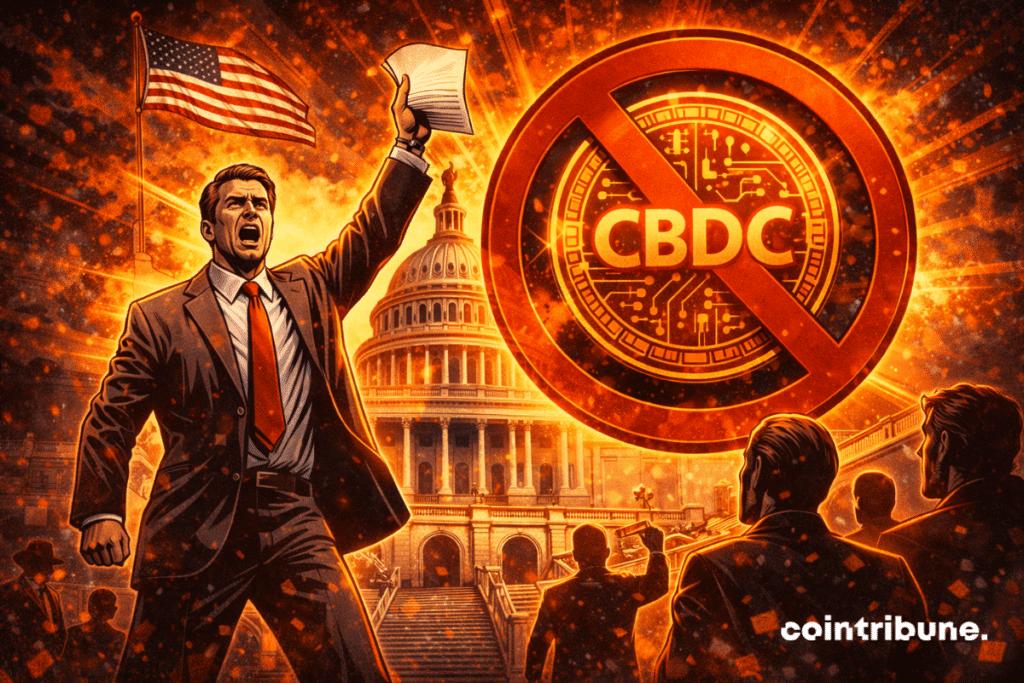
Trump’s group hates CBDCs viscerally. Biden’s team dreamed of a digital dollar led by the Fed. The new masters of Congress are preparing the burial: first class, with flowers and speeches. And guess where they slipped the coffin? Into a huge housing bill. A law that nobody would dare sink, for fear of being seen as an enemy of families. The move is of rare elegance.
In brief
- The Senate voted 84 to 6 for a housing reform including a CBDC ban.
- The Fed will not be able to issue a digital dollar until December 31, 2030, six years.
- House Republicans imposed this measure in exchange for their support on other bills.
- Trump’s White House officially supported this historic ban.
The three-cushion billiard shot of the anti-CBDC crowd
A few years ago, it was reported that CBDCs interested 98% of the global economy. But Donald Trump’s America diverges from this group. The idea comes from House conservatives. For months, they have demanded the pure and simple ban of the digital dollar. Their arguments? Privacy, surveillance, the specter of a state controlling every transaction. They secretly negotiate with their colleagues. Promise to vote for other crypto bills.
In exchange, they are guaranteed to include their measure in a major law. Heading to the NDAA, the defense bill. Then, a change of plan without notice. Their amendment ends up in the “21st Century ROAD to Housing Act.” A bipartisan housing bill, voted by 84 senators to 6.
Burgess Everett, journalist, tweeted: “84-6, the Senate advances a bipartisan housing proposal. You don’t see a vote like that every day.” The amendment goes unnoticed in the mass. Yet it locks the American position for six years.
CBDC ban: The Fed muzzled until 2030
The text is brutally clear. The Fed cannot “issue or create a central bank digital currency, or any substantially similar digital asset“. Ban until December 31, 2030. Eleanor Mueller, journalist, confirms:
Senators included this CBDC ban in today’s housing compromise legislation, at the request of House Republicans.
The Fed, which repeatedly said it wouldn’t issue anything without Congress’s green light, finds itself with its hands tied. The language is broad, impossible to bypass with a “substantially similar” asset. Trump’s White House validates. The president will sign, says the statement.
Brendan Pedersen tweeted: “The White House quickly releases a statement saying it SUPPORTS the law, praising the ban on institutional investors as well as the ban on a digital currency“.
The verdict is in.
Meanwhile, China advances without complex
The anti-CBDC crowd has won their ideological crusade. No more digital dollar, no more state surveillance. Libertarians rejoice. Yet, a pebble in their shoe worries them.
In Beijing, the digital yuan is not waiting. It is being deployed, tested, and is imposing itself in exchanges. Europe is also exploring its digital currency. The ECB advances, cautious but determined.
Meanwhile, private stablecoins, USDC and USDT, rule the American crypto market unchallenged. Without public competition, they reinforce their throne. So, the burning question: can the dollar remain king without a digital version? When China has fully deployed theirs, when international exchanges are in programmable yuans, will America regret its choice?
The battle was ideological. The war is geopolitical. And on this field, the United States may have just played a strong card away.
CBDC ban in key figures
- 84 to 6 votes: the massive Senate score for the housing law;
- Until 2030: the ban runs for six years, well beyond Trump’s term;
- 0 public debate: the amendment went unnoticed in a giant text;
- 100% of transactions: what the Fed will not be able to trace with a digital dollar;
- Billions of digital yuans: already in circulation in China, which is advancing.
Crypto enthusiasts have never seen any interest in CBDCs. They prefer their stablecoins, their bitcoins, their freedoms. Meanwhile, Ray Dalio warns: China, India, and the ECB dream of increased state financial control. America says no for now. But on the global chessboard, this refusal could cost it dearly.
Maximize your Cointribune experience with our "Read to Earn" program! For every article you read, earn points and access exclusive rewards. Sign up now and start earning benefits.
Disclaimer: The content of this article solely reflects the author's opinion and does not represent the platform in any capacity. This article is not intended to serve as a reference for making investment decisions.
You may also like
Why Resideo Technologies (REZI) Might be Well Poised for a Surge
Dover's DFS Boosts Portfolio With ProGauge LR120 Radar Launch
Theravance Biopharma Plummets As Phase 3 Study Falls Short
Wolverine's Brand Momentum Sets the Stage for Solid Growth in 2026
Trending news
MoreCrypto prices
More





