
EXCLUSIVE: Cocoa's Epic 70% Plunge Should Mean Cheaper Chocolate - So Why Are Americans Still Getting Hit At Checkout?

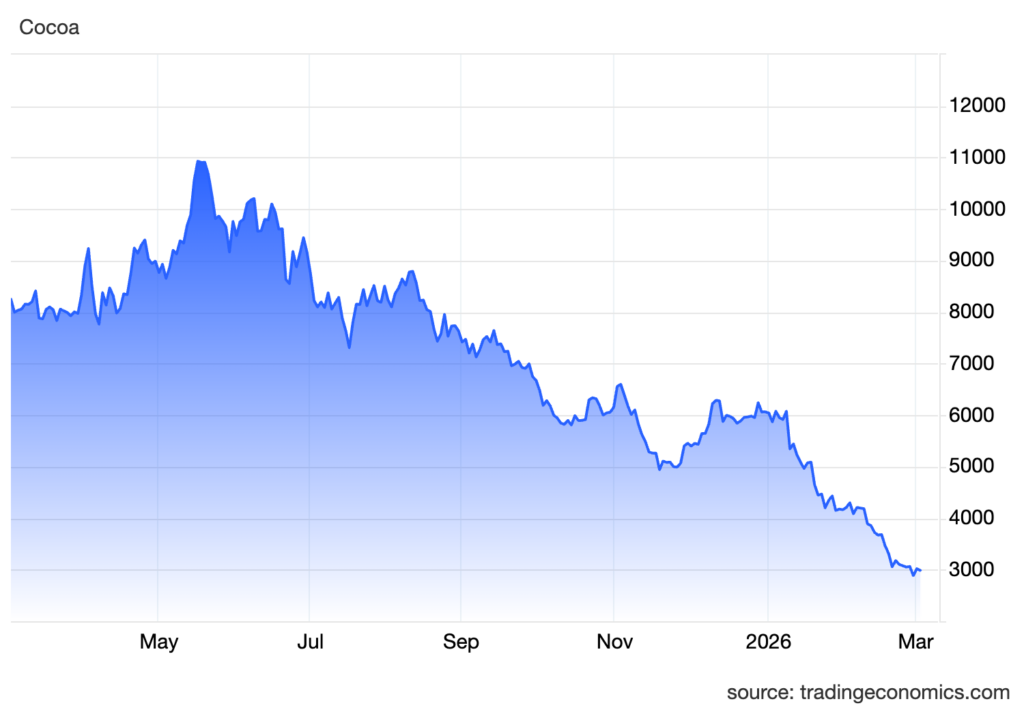
Cocoa futures have lost nearly 70% of their value since hitting an all-time high of around $12,000 per metric ton in late 2024, sliding to under $3,000 as of early March. For those who winced at a $50 box of full-size chocolate bars last Halloween, or noticed Reese’s getting smaller without getting cheaper, that sounds like relief on the way. But experts say not yet.
The U.S. is the world’s largest chocolate market in terms of revenue, and American brands absorbed the full force of the cocoa price spike. Hershey (NYSE:HSY) raised prices. In February, Cadbury-owner Mondelez (NASDAQ:MDLZ) forecasted a subdued 2026 as price hikes turn away cost‑conscious shoppers.
Now, even as raw material costs fall, there’s a significant lag built into the system. The largest manufacturers hedged their cocoa exposure months in advance. This means many are still sitting on inventory locked in at last year’s elevated prices.
Consumers won’t feel the difference until those hedges roll off, which, for most major players, means late 2026 at the earliest and, more meaningfully, in 2027, according to industry analysts.
The Demand That Didn’t Return
Two years of elevated prices changed how Americans buy chocolate. Consumers switched to private-label alternatives, bought less, or left the category entirely during peak holiday periods.
Edward Nikulin, head of trading at European broker Mind Money and a weather-model specialist who closely tracks soft-commodity markets, sees this as more than a temporary pullback. “These are not marginal adjustments but signals of demand destruction,” he says, which is “a force powerful enough to reprice even structurally tight markets.”
The shift in American buying behaviour has been particularly telling. U.S. shoppers moved toward bulk packs and value channels during the spike, a pattern that Mondelez executives flagged on their most recent earnings call as a persistent headwind even as prices begin to stabilize. Non-chocolate confectionery like gummies, hard candy, and the rest has quietly grown its share of the American sweet market, a category shift that would have seemed unlikely when cocoa was cheap and plentiful.
For manufacturers, the response has been to maintain quality messaging publicly while quietly adopting ingredient technologies designed to reduce raw cocoa exposure. Nikulin framed this as the logical outcome of a commodity shock that lasted long enough to force structural change.
“Shrinkflation and skimpflation allowed manufacturers to defend profitability while testing the limits of consumer tolerance,” he noted. “Confectionery is discretionary spending, and prolonged inflation reshapes purchasing patterns.”
A Surplus And A Tariff Problem
Meanwhile, the supply picture has, on paper, improved sharply. A global cocoa surplus is now widely forecast for the 2025/26 crop year, indicating a dramatic reversal after several consecutive years of deficit. Ghana and the Ivory Coast, which together supply more than 60% of the world’s cocoa, are sitting on more beans than they can currently sell.
But the physical market is more complicated than the futures price suggests, analysts said. Exporters at West African ports are reportedly turning away a meaningful share of new-crop arrivals over quality concerns, mould, and poor bean counts, meaning the headline surplus and the available premium-grade supply are two different numbers.
For U.S. importers and chocolate makers, there’s an additional layer of complexity: tariffs. The Ivory Coast faces a 21% U.S. import levy, while Ghana carries a 10% baseline rate. Those costs don’t disappear because the underlying commodity gets cheaper, because they sit on top of the spot price and erode how much of the futures decline can realistically pass through to American producers and, eventually, consumers.
Candy maker Mars’s decision to announce a $2 billion U.S. manufacturing investment last year could be partly read as a hedge against exactly this kind of exposure.
The Next Spike Is Already Being Priced In
Mondelez CEO Dirk Van de Put, speaking at an industry conference in mid-February, acknowledged the price collapse but flagged something most investors haven’t fully absorbed: the surplus may be sowing the seeds of the next shortage.
With cocoa prices down sharply, farmers and the government bodies that represent them in Ghana and the Ivory Coast are facing significant losses — because they promised growers prices that no longer reflect market reality. Van de Put’s read is that their likely response, in the coming years, will be to restrict supply. “There’s a risk that this will happen again four or five years down the road,” he said.
It’s a concern that maps directly onto Nikulin’s analysis. The structural vulnerability that drove the 2024 spike, including aging trees, concentrated production, and climate sensitivity, hasn’t been engineered away.
Ghana is currently dealing with excess rainfall that threatens bean quality in the mid-crop; Ivory Coast faces heat stress; Nigeria remains under drought pressure. None of these conditions alone guarantees another supply shock. Together, they describe a market that, as Nikulin puts it, has moved toward “a more measured equilibrium” but remains “exposed to meteorological disruption” in a way that offers little cushion if conditions turn hostile.
What has changed is how the best-resourced buyers are responding. The largest chocolate manufacturers are pushing climate intelligence upstream into procurement by monitoring West African planting conditions and rainfall patterns months ahead of harvest rather than reacting to futures markets after the fact.
For U.S. consumers, the near-term message is to expect shelf price stabilization in the back half of 2026, not a meaningful rollback.
Price Action: Cocoa futures were just below $3,000 per tonne on March 3, recovering from near three-year lows of $2,888 hit in late February, but still down 50.75% yeat-to-date, according to data from Trading Economics.
Image via Shutterstock
Disclaimer: The content of this article solely reflects the author's opinion and does not represent the platform in any capacity. This article is not intended to serve as a reference for making investment decisions.
You may also like
Steel stocks have been soaring lately. The chart suggests another significant surge may be on the horizon.
The Demise of Traditional Energy Security
SANAE TOKEN’s Turbulent Debut on Solana Draws Scrutiny and Official Refusal
Kyndryl’s Morgan Stanley Event: A Strategic Opportunity for a Dormant Share Price
Trending news
MoreCrypto prices
More





