
US attacks in Iran are expected to drive a significant increase in defense budgets. Three major contractors are positioned to gain the most.

US Stock Markets Face Sharp Declines
Major US stock indices, including the Dow Jones Industrial Average, S&P 500, and Nasdaq, are seeing significant losses as a widespread sell-off grips the market.
Kristine Liwag of Morgan Stanley believes that this downturn is temporary, suggesting that investors may discover valuable opportunities if they look in the right sectors.
Defense Stocks Offer Potential Amid Market Turmoil
The recent geopolitical tensions, particularly following the US-Israeli strike on Iran, have rattled the broader market. However, Liwag points out that leading defense companies are currently valued at a 20% discount compared to the S&P 500 when measured by free cash flow.
Liwag also highlighted that the large-scale Operation Epic Fury is likely to accelerate government defense spending, ushering in a period of extended production contracts for defense firms.
She recommends several defense stocks as strong picks during this period of volatility, including General Dynamics with a target price of $410, RTX at $235, and Northrop Grumman at $765.
Liwag further notes that the market has yet to fully account for the anticipated surge in profits that defense contractors are expected to receive as the Pentagon shifts its focus to urgent military needs.
Technology and Defense: A New Frontier
The operation is heavily utilizing advanced technology from Silicon Valley, such as Anthropic's Claude 4 Opus and Palantir's AIP platform. However, Anthropic faces challenges after being labeled a "supply chain risk" by the Pentagon due to its stance on AI safety, which now prevents government contractors from working with the company.
Despite the use of cutting-edge technology—reportedly instrumental in the capture of Venezuelan President Nicolás Maduro—the market downturn continues, especially as President Trump has indicated the conflict could persist for weeks.
Further reading: What an extended war with Iran could mean for gas prices
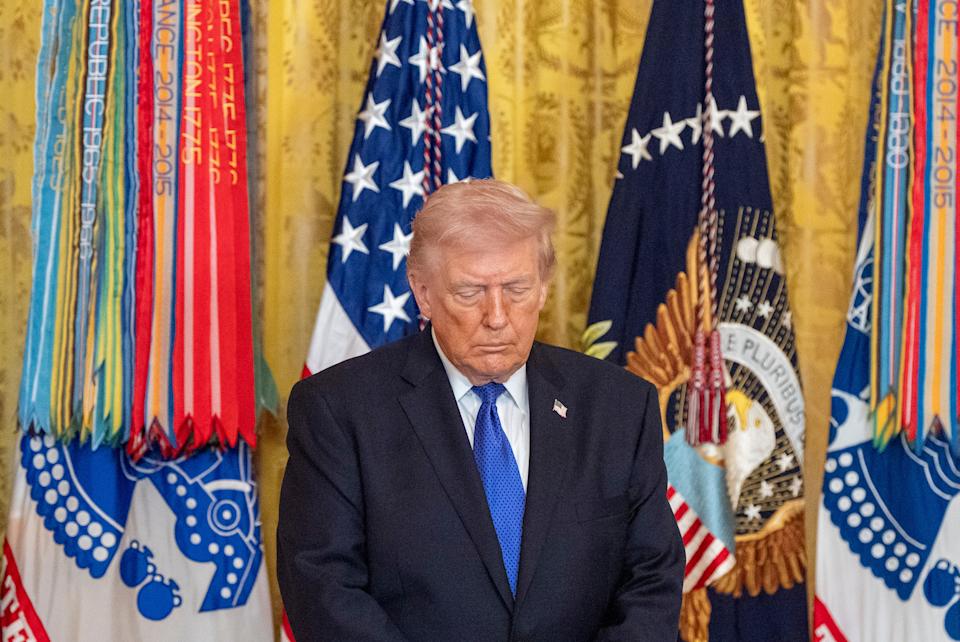
President Trump participates in a prayer during a Medal of Honor ceremony at the White House on March 2. (AP Photo/Alex Brandon) · ASSOCIATED PRESS
Industry Perspectives on Defense Spending
Tony Bancroft, who manages the Gabelli Commercial Aerospace & Defense ETF, attributes much of the market's caution to concerns over "missile math."
Bancroft, also a lieutenant colonel in the US Marine Corps Reserve, explained on Yahoo Finance's Market Catalyst that while current supplies are adequate, they are not limitless, and ramping up production will require time.
He described the situation as precarious, noting that Iran is launching hundreds of drones and missiles daily in a strategy designed to overwhelm Western defense systems—a tactic he called "saturation."
Like Liwag, Bancroft remains optimistic about the defense sector, citing the Department of Defense's aggressive plans to significantly increase interceptor production. He mentioned that companies such as Lockheed Martin and RTX are already securing major contracts to boost output.
Challenges and Opportunities Ahead
However, Bancroft cautioned that investors should consider the substantial investments required to expand production capacity, emphasizing that this process will not be quick. He also pointed out that Gulf nations do not have the same level of defensive infrastructure as Ukraine.
At present, the 20% discount on defense stocks may represent a rare opportunity for investors to enter a sector that is rapidly becoming a top government priority.
Disclaimer: The content of this article solely reflects the author's opinion and does not represent the platform in any capacity. This article is not intended to serve as a reference for making investment decisions.
You may also like
Bitcoin Dip Has Institutions Scrambling To Buy, Insider Reveals

Iran Turns to Stablecoins to Navigate Sanctions and Military Tensions
Global Crisis Highlights Onchain Finance Shift
Shiba Inu Sees Massive Spike in Derivatives Volume and Futures Inflows

Trending news
MoreCrypto prices
More





