
00:30, 03:40, two bailouts, narrowly escaped a crisis

Source: Wall Street Intelligence Circle
The market trades first according to the "worst-case scenario".
Before Chinese investors went to bed, the global markets were still experiencing brutal declines: after the US stock market opened, the S&P 500 and Nasdaq indices quickly expanded their losses to 2%, gold fell below $5,000, and the 10-year US Treasury yield briefly touched 4.10%;
But when Chinese investors woke up, everything changed again: US stock losses narrowed to around 1%, gold prices regained the $5,000 mark, and the 10-year US Treasury yield fell back to 4.06%.
The turnaround in the market was influenced by news headlines. On the first day everyone feared war, on the second day inflation, and on the third day, faith in Trump.
At 00:30 (UTC+8), Reuters reported that Trump is considering a proposal to help insure oil tankers passing through conflict zones. This news caused oil prices to plunge during trading, and stocks to rise. Initially, the market’s recovery was limited, but then Trump confirmed the news in a tweet around 03:40 (UTC+8), causing stock prices to soar and oil prices to plummet—correcting the market's worst expectations.
If not for the above news, last night's market trend might have spiraled out of control. Keep in mind that the S&P at one point was down 2.5%, the Dow plunged nearly 1,300 points, and oil prices surged by as much as 9%.
As mentioned today: Trump’s words do not equal actual policy implementation; this wave of market rebound is more like emotional repair, not actual risk removal.
· First, it’s very difficult in reality to provide escort protection. The Strait of Hormuz is only about 33 kilometers wide at its narrowest point, and most of the passage is within Iran's strike range.
· Second, the legal hurdles are also significant. Insurance guarantees of this magnitude involve complex legal procedures—distant water can't put out a local fire.
Trump's remarks acted more like "wartime expectation management." Trump also stated that he expected oil prices to fall once US military action in Iran ends.
The biggest question next is whether this conflict can end "quickly and decisively."
Generally, military action disrupts markets in the short term, but as long as the economic loss is limited, and the extent of intervention becomes clearer, the market will fully recover. Unless oil supplies are interrupted for a long time, this conflict is unlikely to end the cyclical bull market in stocks by itself. However, if signs emerge that the market believes the conflict cannot be ended quickly, the downtrend could accelerate.
Currently, the market is oscillating between two pathways:
· Path A (escalation of conflict): Oil hits $100, inflation returns to 3%, rate cuts are delayed, and valuations compress;
· Path B (conflict eases): Oil falls back below $70, inflation subsides, rate cuts resume, and the bull market continues.
There is still not enough information to prove which path will materialize; the market swings between "war panic" and "rational pricing." So for now—it will swing first, then decide.
Every piece of news is repricing risk.
Disclaimer: The content of this article solely reflects the author's opinion and does not represent the platform in any capacity. This article is not intended to serve as a reference for making investment decisions.
You may also like
QSR Shares See Modest Rise Following Strategic Shift and Analyst Upgrades, Even as Trading Volume Ranks 463rd
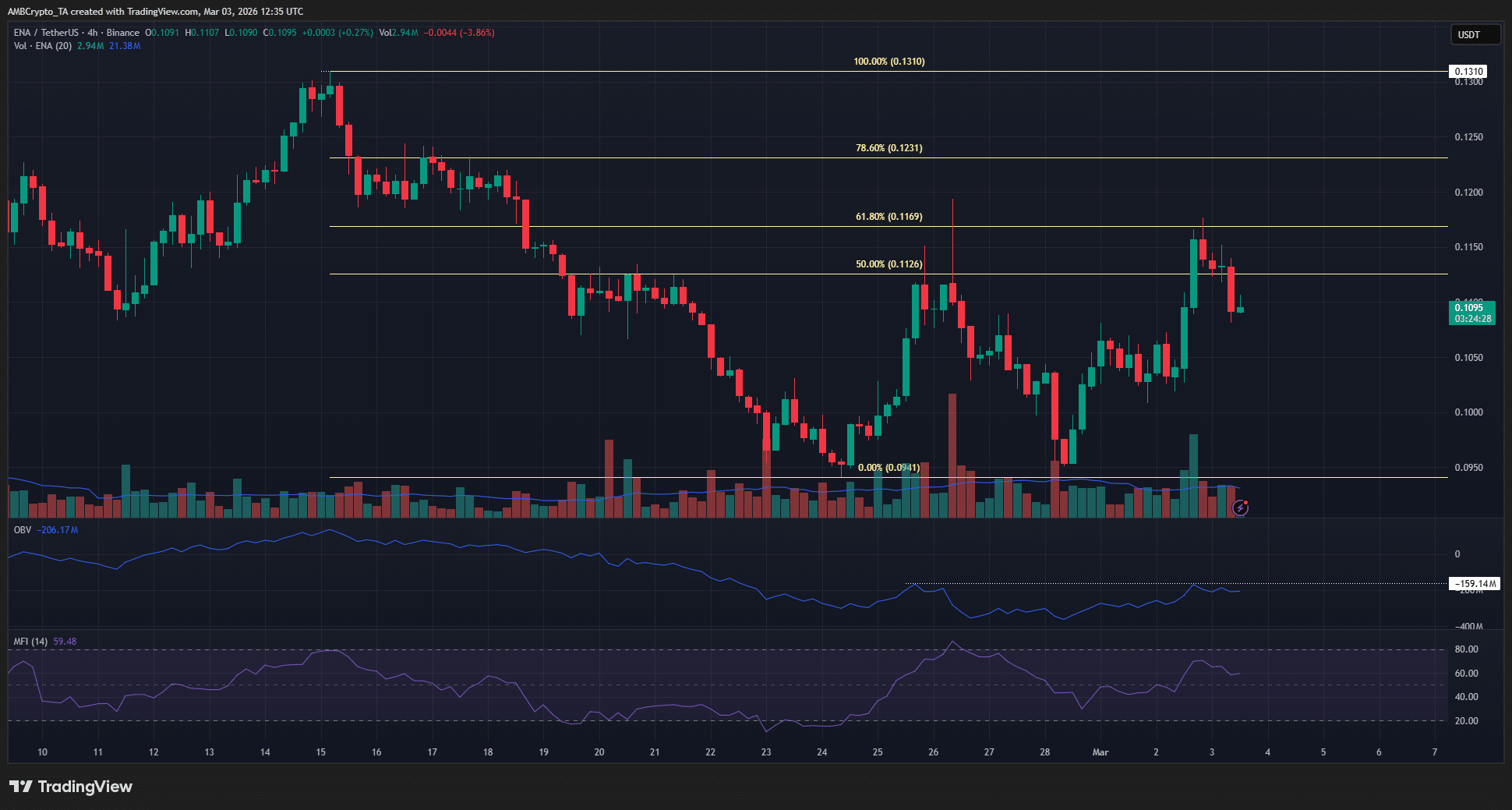
Ethena’s retracement rally, explained: Heavy volume, light conviction
DTE Energy Experiences 56% Jump in Volume, Moving Its Stock to 490th Place in Daily Trading Rankings
ASE Technology's 7.81% Plunge Amid Earnings Miss and Institutional Splits as $320M Volume Surges to Rank 446th
Trending news
MoreCrypto prices
More





