
Korea halts trading as key indexes drop 10% on Middle East crisis

The Korean Stock Exchange was forced to halt trading after the escalating conflict in the Middle East prompted a major share price plunge on Wednesday.
The South Korean Kospi and Kosdaq each plunged more than 10% during morning trading in Seoul, triggering a circuit breaker as the indexes saw their worst session since August 2024, Channel News Asia on Wednesday.
Japan’s stock markets also saw heavy losses on Wednesday, with the Nikkei and Topix both down almost 4%. Meanwhile, Hong Kong’s Hang Seng Index was down 3%, and China’s Shanghai Composite had dropped 1.3%.
“Investors sold down risk assets, and in particular, the Nikkei as well as the Kospi, which outperform other major indexes, have become a target of the heavier selloff as they try to book profits,” Kazuaki Shimada, chief strategist at IwaiCosmo Securities, told CNA.
“South Korea imports 94% of its oil, with 75% coming from the Middle East. So, it is easy to see why its ‘degens’ are panicking,” said Bianco Research CEO Jim Bianco.
Thailand, another major Middle East oil importer, saw its stock exchange slide 7.8% on Wednesday.
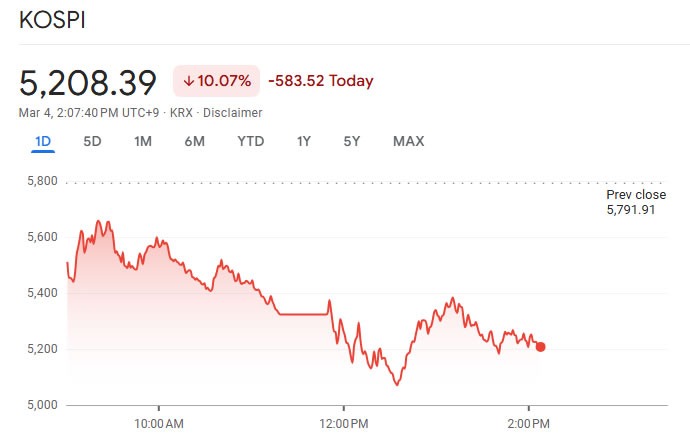 South Korea’s Kospi drops more than 10%. Source:
Google Finance
South Korea’s Kospi drops more than 10%. Source:
Google Finance
Wars can be fought forever, says Trump
The Trump administration said that attacks on Iran are intensifying, with the US targeting a meeting of the nation’s top leaders while they were deciding who would lead, Fox News on Wednesday.
The move follows the closure of the Strait of Hormuz after threats from Iran to target oil and cargo ships passing through the critical waterway.
“If necessary, the United States Navy will begin escorting tankers through the Strait of Hormuz, as soon as possible,” said Donald Trump on Truth Social.
On Tuesday, he said the US has a “virtually unlimited supply” of weapons and wars can be “fought forever.”
Related: Middle East tensions boost gold as investors seek safe havens
As a result, crude oil prices have skyrocketed, with Brent oil surging 14% to $82 per barrel and WTI crude jumping 12% to $75 per barrel since the airstrikes began on Feb. 28, according to OilPrice.
Black swan event unfolding, says crypto researcher
Crypto researcher SungHoon Lee called it a black swan event, explaining that trading in Korea was halted “because the crash was too fast for the system to handle,” and noting that $3.2 trillion in global stock market value has evaporated in the past four days.
“This isn't just a war. This is the WORST geopolitical shock since 1973,” referring to an oil crisis that crashed markets for two years in the 70s.
Crypto asset markets, which have already lost 21% so far this year, haven’t had as sharp a reaction, with total capitalization down just 0.5% on the day to $2.39 trillion, according to CoinGecko.
Magazine: Would Bitcoin really be at $200K if not for Jane Street? Trade Secrets
Disclaimer: The content of this article solely reflects the author's opinion and does not represent the platform in any capacity. This article is not intended to serve as a reference for making investment decisions.
You may also like
US spot Bitcoin ETFs add $225M as BlackRock’s IBIT offsets redemptions
Analyst to XRP Traders: This Is Where the Reaction Should Be Taking Place
Morpho Bolsters Its Standing as Institutional Crypto Custody Evolves
Trending news
MoreCrypto prices
More





