Institutional interest in tokenization is on the rise, and stablecoins sit at the heart of this trend. As real-world asset (RWA) markets and payment infrastructures shift to blockchain, certain cryptocurrencies are taking center stage, promising new opportunities for growth. While Ethereum immediately comes to mind, smaller but ambitious rivals are also staking out their claims. Looking ahead, two important data points help illuminate which platforms may capture a larger portion of this rapidly expanding sector.
Crypto Assets with Real-World Staying Power
Even if you’ve only dipped your toes into crypto in recent years, you’ll have witnessed numerous altcoins fading to zero. The spectacular $40 billion collapse of Terra, massive meme coin frauds in early 2025, and many other failures repeatedly remind us that long-term bets don’t always pay off in this volatile arena. Tokens that once topped the hype lists can easily end up worthless, forcing investors to rethink what constitutes lasting value in the sector.
Stablecoin Networks: Shifting Market Share
So how should one navigate this landscape? Focusing on networks that facilitate blockchain-based financial transformation and offer real-world use—especially those at the forefront of tokenization—appears a prudent strategy. Industry forecasts suggest the tokenization market could reach trillions of dollars, with stablecoins as the backbone of these payment rails. This means platforms that see widespread stablecoin use will be well-positioned to secure a portion of the expanding RWA market.
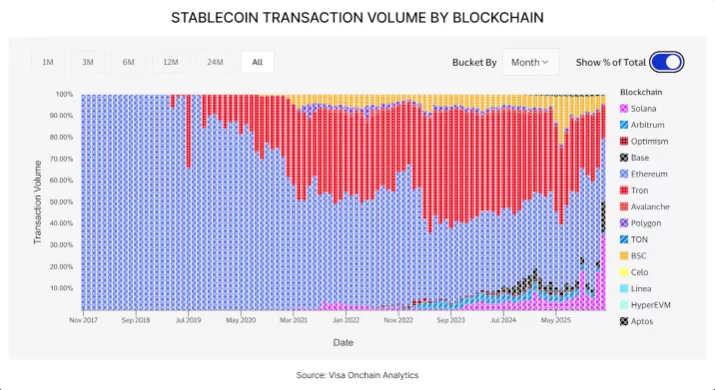
From 2017 to 2021, Ethereum overwhelmingly dominated the stablecoin market, as shown by the large blue segment. Around 2021-2022, however, Tron began claiming significant market share—largely because USDT transfers on Tron are both cheaper and faster than on Ethereum.
Fast forward to today, the share of supply looks approximately like this: Ethereum at 45%, Tron at 25%, Solana and BNB Chain each ranging between 8–10%. Yet, supply alone doesn’t tell the full story. Despite holding just about 5% of stablecoin supply, BNB Chain now processes roughly 40% of all stablecoin transactions. Unlike Ethereum, where large sums are moved occasionally, BNB Chain caters to millions of users making frequent micro-payments—highlighting a dramatic shift toward smaller, everyday transactions on alternative networks.
This snapshot points to fierce competition among ETH, TRX, SOL, and BNB as leading contenders for future dominance in both RWAs and payment solutions. The recent push by financial giants to issue tokenized assets on public blockchains has further supercharged this transition. Ethereum and Solana, in particular, already play host to a variety of tokenized assets, underscoring their pivotal roles.
Who Leads the RWA Race?
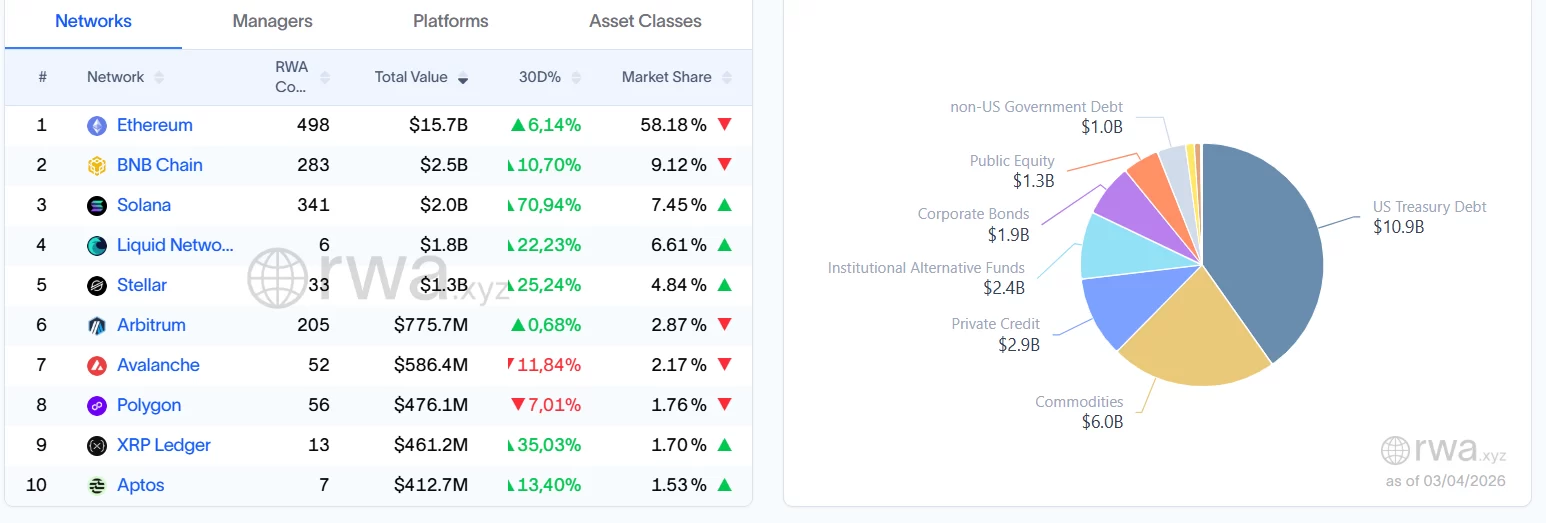
While the dominant forces in payments are clear, leadership in real-world asset tokenization is also emerging. Ethereum heads the RWA leaderboard, securing $15.7 billion in assets. BNB Chain and Solana are both serious competitors, each accounting for around $2 billion. Further down the list, other networks trail in both adoption and scale.
But is the spotlight solely on public networks like Ethereum? Not quite. Canton, a private network designed by Digital Asset, has emerged as a major player—especially for large financial institutions like Goldman Sachs and BNY Mellon that require both privacy and regulatory compliance. While Ethereum is open and permissionless, Canton has been purpose-built to meet the rigorous standards institutions demand for onboarding and tokenizing assets.
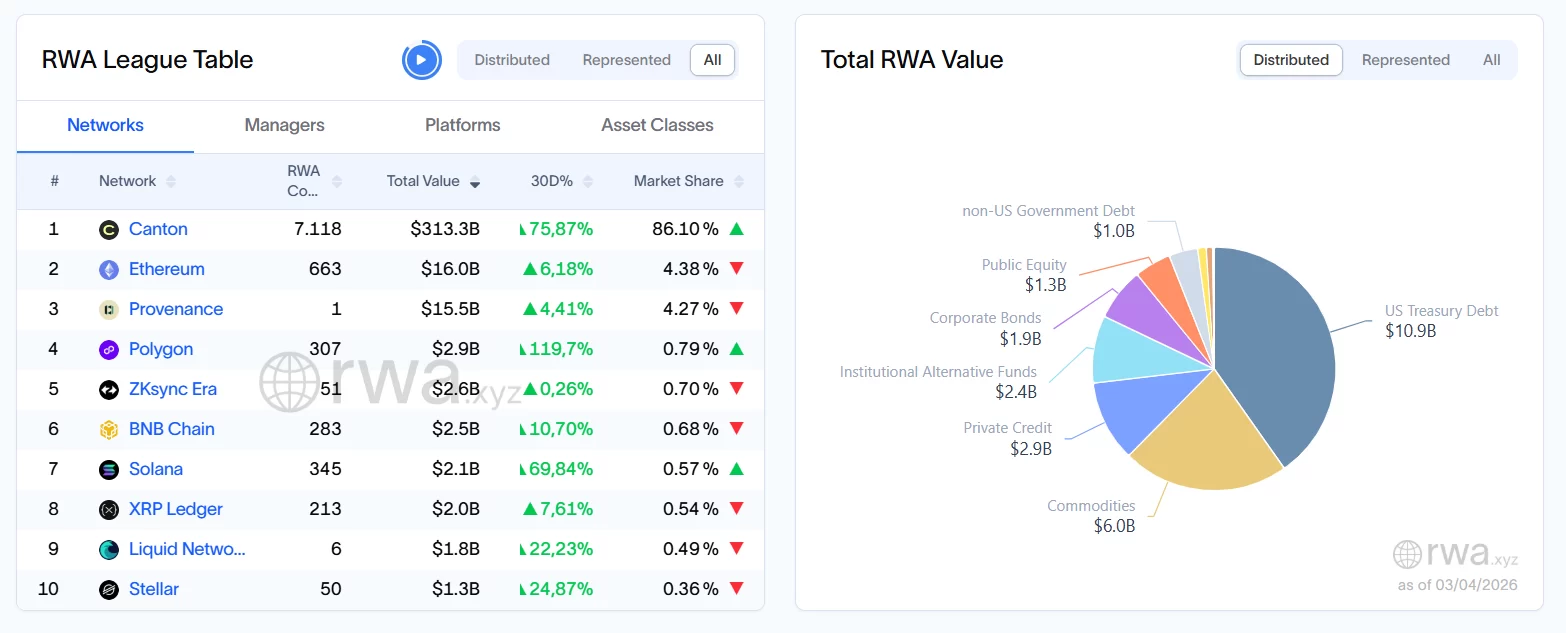
Data shows that Canton hosts 7,118 distinct financial instruments—ranging from bonds to equities—now tokenized on its platform. The overall market value of these assets has reached an impressive $313 billion, signaling the growing significance of private networks in the broader blockchain ecosystem.