
Britain’s jobless rate has now surpassed that of Italy

UK Unemployment Surpasses Italy for the First Time Since the Financial Crisis
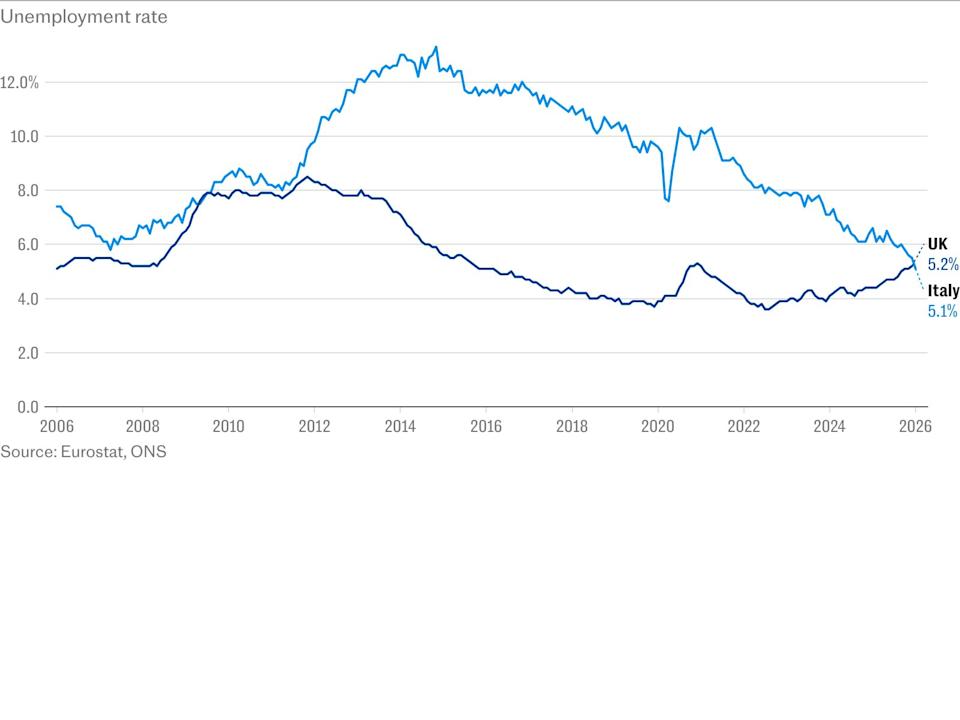
For the first time since the global financial crisis, the UK's unemployment rate has overtaken that of Italy.
Recent figures reveal that Italy's unemployment has dropped below the UK's, as Sir Keir Starmer leads Britain in a markedly different economic direction compared to Giorgia Meloni's leadership in Rome.
At the end of last year, unemployment in Britain climbed to 5.2%, the highest since the pandemic's peak, rising from 4.4% the previous year.
Meanwhile, Italy saw its jobless rate fall sharply from 6.6% to 5.1% in January.
This is only the second time in over thirty years that the UK has experienced higher unemployment than Italy, highlighting the UK's worsening situation as Italy's economy strengthens.
Italy's GDP per person, a key indicator of living standards, surpassed the UK's in August of last year.
According to Claus Vistesen of Pantheon Macroeconomics, Italy's steady economic progress has led to a drop in unemployment. The proportion of Italians employed has increased from under 60% before the pandemic to 62.6% in January.
"From a structural perspective, Italy appears to have permanently raised its employment rate by 3.5 percentage points, which is significant. This represents a major transformation," Vistesen explained.
He also noted a notable rise in female employment, stating, "A growing number of people are entering the workforce."
Vistesen credited some of this progress to Prime Minister Meloni's administration, suggesting that the government stands to benefit from increased tax revenues due to more people working.
"This is a win for the government, both in terms of politics and finances. Lower unemployment means less spending on benefits and higher tax income, which improves the fiscal outlook," he added.
These improvements follow Meloni's efforts to streamline bureaucracy and speed up legal processes, injecting new energy into Italy's previously stagnant economy.
In contrast, the UK government has chosen a different path, opting to raise taxes, increase the minimum wage, and introduce new employment rights. Critics argue that these measures have contributed to the recent surge in unemployment.
Currently, UK unemployment is at its highest since the pandemic, with 16.1% of those aged 16 to 24 out of work—the highest youth unemployment rate in over ten years.
A Reversal of Fortunes
This shift marks a dramatic change between the two countries. Throughout the 1990s and 2000s, the UK consistently enjoyed a stronger labor market than Italy.
During the 2009 credit crunch, the UK's unemployment briefly exceeded Italy's for two months. However, as the sovereign debt crisis unfolded, UK joblessness peaked at 8.5%, while Italy's rate continued to climb above 13%.
Italy's Image Transformed
Italy was once labeled the "sick man of Europe" and became the subject of international ridicule, as seen in the infamous moment when Angela Merkel and Nicolas Sarkozy shared a laugh in 2011 when asked about Italy's then-leader Silvio Berlusconi and the nation's economic woes.
However, reforms under Meloni have dramatically improved Italy's standing.
Concerns Over the UK's Outlook
Meanwhile, some economists warn that the UK now faces the risk of persistently high unemployment.
Fergus Jimenez-England from the National Institute of Economic and Social Research has expressed skepticism about the Office for Budget Responsibility's (OBR) forecast that unemployment will decline after 2026.
"The OBR predicts unemployment will rise to 5.3% this year, reflecting ongoing high labor costs that discourage hiring. It expects the rate to settle at 4.1% in the long term, but we believe this is overly optimistic and below the consensus among academic economists," he said.
"Such projections make the fiscal outlook appear more favorable by assuming higher tax revenues and lower welfare costs."
Disclaimer: The content of this article solely reflects the author's opinion and does not represent the platform in any capacity. This article is not intended to serve as a reference for making investment decisions.
You may also like
Equinix's Earnings Miss and 198th-Ranked Volume Can't Dampen 27% YTD Surge
When is the Australian Trade Data and how it could affect AUD/USD?

Sight Sciences, Inc. (SGHT) Reports Q4 Loss, Beats Revenue Estimates
Trending news
MoreCrypto prices
More





