
War in Iran ‘could increase energy bills by £160’

Global Markets React to Middle East Conflict
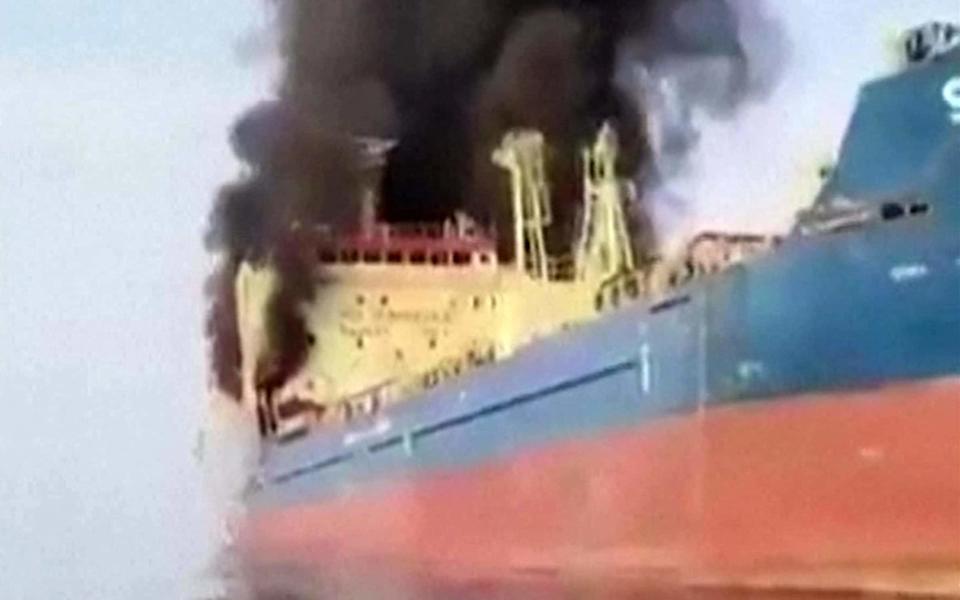
Iran claims responsibility for striking an oil tanker in the Gulf of Oman, which was set to travel through the Strait of Hormuz. - AFP
Energy Costs Surge Amid Escalating Tensions
Industry analysts caution that the ongoing conflict involving Donald Trump and Iran could result in an additional £160 on annual energy bills for UK households. Cornwall Insight projects that average energy bills may climb to at least £1,801 from July, driven by soaring gas prices.
Although Ofgem's price cap is set to decrease from £1,758 to £1,641 in April, following reductions in wind farm subsidies, Cornwall Insight foresees a 10% increase in household bills this summer if Iran continues efforts to restrict passage through the vital Strait of Hormuz, a major route for global oil and gas exports.
According to Cornwall Insight, "The immediate spike in prices mirrors the surge in global gas markets, and as the UK imports much of its gas, these costs are quickly reflected in domestic bills."
The ultimate impact on bills will depend on how long and how intense the conflict becomes.
Market Volatility and Hopes for Diplomacy
Oil and gas prices eased slightly, and stock markets rebounded as investors responded to reports suggesting Iran had made indirect overtures to the CIA for potential talks. However, these diplomatic signals reportedly emerged only a day after hostilities began.
Key Market Updates
- FTSE 100: Closed up 83.52 points (0.8%) at 10,567.65 after two days of losses.
- FTSE 250: Gained 202.46 points (0.9%) to finish at 22,896.67.
- Wall Street: The Dow Jones rose 0.2% to 48,574.36, the S&P 500 climbed 0.4% to 6,841.57, and the Nasdaq Composite advanced 0.8% to 22,694.60 after previous declines.
Interest Rates and Inflation Concerns
Economists warn that if energy prices continue to rise, interest rates in the UK could surpass 4% again. The National Institute of Economic and Social Research (NIESR) notes that higher oil and gas prices could push inflation up by 0.7 percentage points in 2026 if oil remains at $100 a barrel for a year, with economic growth suffering as a result.
Ben Zaranko of the Institute for Fiscal Studies highlights that the Bank of England may need to raise rates to control inflation, especially if energy-driven price spikes persist.
Higher interest rates may be required to manage inflation. Pictured: Bank of England Governor Andrew Bailey - Carl Court/PA
Shipping and Corporate Responses
Maersk, the Danish shipping conglomerate, has halted bookings in the Gulf region until further notice due to the expanding conflict. This suspension does not apply to Jordan and Lebanon, and exceptions will be made for essential goods such as food and medicine. The company currently has two vessels in the Gulf.
Maersk currently has two vessels in the Gulf - RENE VAN QUEKELBERGHE/REUTERS
Impact on the Oil Sector
Gulf Marine Services, a UK-listed oil services provider, has withdrawn staff from the Persian Gulf at the request of a client, citing safety concerns. The company operates 14 liftboats, each typically staffed by 150 crew members. Maintenance on four vessels has been suspended, affecting all clients relying on their services.
GMS/GMS
Inflation and Energy Prices
ING forecasts that UK inflation could reach 3.5% this year if energy prices remain elevated due to the Middle East crisis. Despite this, ING’s James Smith believes the Bank of England may still cut rates in April, unless tensions ease rapidly.
Rising Fuel Costs for Drivers
The RAC reports that petrol and diesel prices have increased since Saturday, with petrol up by 1.36p and diesel rising by over 3p per litre, as oil prices surged above $81 a barrel. The RAC expects petrol prices to remain below 136p per litre if oil prices stabilize, but diesel costs are rising more quickly.
Regulators and Energy Price Warnings
Ofgem’s chief executive, Jonathan Brearley, warns that a prolonged closure of the Strait of Hormuz could significantly increase energy prices for UK consumers, as gas continues to set the price for electricity much of the time. He cautions that it is too early to predict the full impact, given the uncertainty in global gas markets.
Banking Sector Braces for Prolonged Uncertainty
Deutsche Bank’s CEO, Christian Sewing, expressed concerns that the Iran conflict could usher in an extended period of heightened volatility in financial markets, with significant economic consequences for Germany and Europe.
Deutsche Bank boss Christian Sewing warned of a ‘longer phase’ of higher volatility - Liesa Johannssen-Koppitz/Bloomberg
Flight Disruptions Escalate
Over 15,000 flights have been cancelled due to the conflict, with Qatar Airways grounding planes and airports in Dubai and Doha among the worst affected. British Airways has suspended flights to several Middle Eastern destinations, and shares in its parent company IAG have dropped 17% since the conflict began.
Flights have been cancelled from Heathrow over the Iran conflict - REUTERS/Isabel Infantes
Cryptocurrency and Global Markets
Despite turmoil in Asian stock markets, bitcoin rebounded by up to 4.8% to surpass $71,000, although it remains significantly below its all-time high from October.
Government and Economic Policy Responses
UK ministers emphasize ongoing efforts to strengthen the economy’s resilience in the face of global shocks. James Murray, Chief Secretary to the Treasury, highlighted measures to reduce inflation, borrowing, and support growth, expressing confidence in the government’s economic strategy despite recent downgrades in growth forecasts.
Oil and Gas Price Movements
Oil prices have climbed further as Iran’s Revolutionary Guards claim full control over the Strait of Hormuz, threatening to target any vessel passing through. Brent crude rose over 3.5% to exceed $84 a barrel, while US West Texas Intermediate increased by 2.8% to more than $76. The US has responded by pledging naval escorts and insurance for shipping in the region.
Asian Markets Experience Sharp Declines
Asian stock markets have been hit hard, with South Korea’s Kospi index suffering its steepest two-day drop since 2008, and Japan’s Nikkei 225 falling by 3.6%. The sell-off is attributed to the region’s reliance on energy imports from the Persian Gulf, with trade through the Strait of Hormuz severely disrupted.
Trading was temporarily halted on South Korea’s Kospi stock index as losses were so steep - REUTERS/Kim Hong-Ji
Morning Brief: Key Developments
- Unemployment Concerns: The OBR warns that nearly two million jobs could be at risk, with taxes and AI potentially worsening the situation.
- Spring Statement Highlights: The OBR has downgraded growth forecasts and cautions about rising unemployment.
- Energy Transition: The Business Secretary advocates for increased investment in renewables to reduce reliance on oil and gas.
- Military Spending: The army faces scrutiny over spending on protective measures amid efforts to rebuild the armed forces.
- Political Impact: The Iran conflict has overshadowed Rachel Reeves’s recent economic speech.
Overnight Market Movements
Asian markets experienced dramatic declines, with South Korea’s Kospi index plunging over 12%. Brent crude oil surpassed $83 a barrel, and the US dollar strengthened by 0.7%. Gold prices remained steady around $5,133. US stock indices closed lower, with the S&P 500 falling below its 100-day average for the first time since November.
Further Reading
For more updates on business and economic developments, visit the latest business and economic news here.
Disclaimer: The content of this article solely reflects the author's opinion and does not represent the platform in any capacity. This article is not intended to serve as a reference for making investment decisions.
You may also like
Cardano Risks a 31% Drop as Whales Dump 210 Million ADA
Putin hints that Russia might halt gas deliveries to Europe immediately
Bull Signal Flashing Amid Hotel Stock Pullback
Gap Stock With Contrarian Potential Ahead of Earnings
Trending news
MoreCrypto prices
More





