
Processors have regained popularity within data centers

The Shifting Landscape of Data Center Processors
In recent years, graphics processing units (GPUs) have dominated the tech market, with major cloud providers and tech companies investing heavily in these advanced chips to power their artificial intelligence (AI) initiatives.
Meanwhile, central processing units (CPUs)—the essential components that run the majority of data center operations and everyday digital services—have seen less attention as the spotlight shifted to GPUs.
CPUs Regain Importance in the AI Era
This trend is beginning to reverse. Earlier this month, Meta (META) and Nvidia (NVDA) announced a significant expansion of their partnership, with Nvidia supplying Meta with its largest deployment yet of Grace CPU-only servers.
Shortly after, AMD revealed a new agreement with Meta, featuring servers equipped with AMD’s Venice and upcoming Verano CPUs. During Intel’s (INTC) January 22 earnings call, CEO Lip-Bu Tan highlighted AI as a key factor driving CPU demand.
“The rapid growth and diversification of AI workloads are putting pressure on both traditional and modern hardware, underscoring the critical role CPUs play in today’s AI-driven world,” Tan noted.
Although it may seem surprising for CPUs to attract renewed interest amid the AI boom, the rise of AI inference and autonomous AI agents is positioning CPUs for a resurgence.
CPUs: The Backbone of Computing
CPUs serve as the core of nearly every computer system. Since Amazon (AMZN) introduced AWS in 2006, CPUs have been the foundation of large-scale data centers, enabling services like ride-sharing, document collaboration, and web browsing.
However, after OpenAI (OPAI.PVT) launched ChatGPT in late 2022, the industry shifted focus to GPUs, benefiting companies like Nvidia, which became the world’s most valuable company by specializing in data center GPUs.
While GPUs require CPUs to manage data flow, investment in standalone CPU servers declined as organizations prioritized GPU infrastructure.
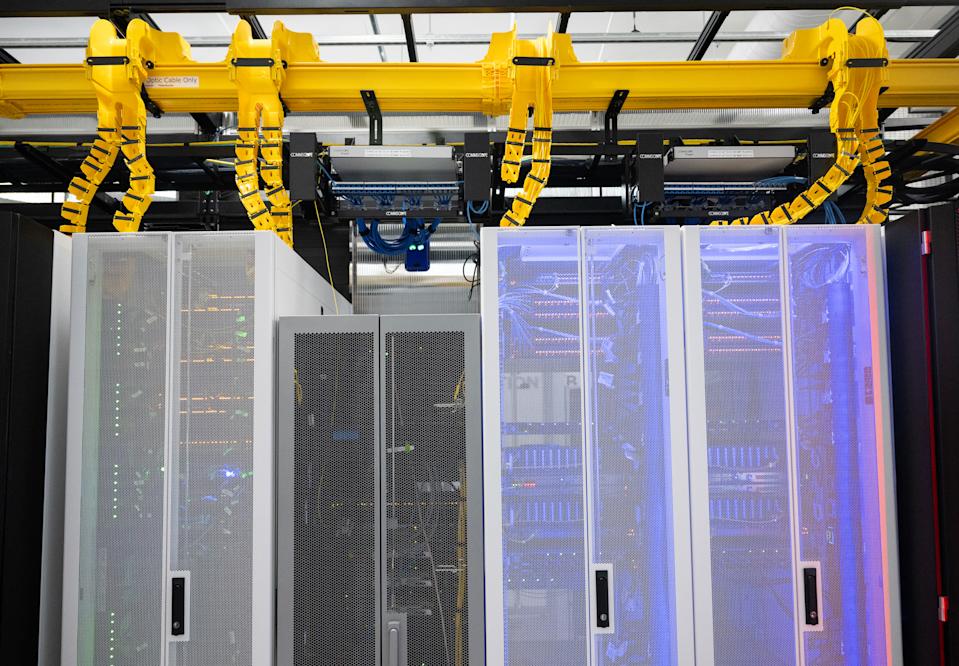 Server racks at the Digital Realty Innovation Lab in Ashburn, Virginia, November 12, 2025. (ANDREW CABALLERO-REYNOLDS / AFP via Getty Images)
“We saw a clear shift in investment toward GPU infrastructure for both training and deploying AI models at scale,” said Ian Buck, Nvidia’s VP of hyperscale and high-performance computing. “This led to stagnation in the CPU market.”
For example, Intel’s Data Center and AI division experienced a 5.2% year-over-year decline in 2023, remained flat in 2024, and saw a modest 4.9% rebound in 2025, during a period when Intel was also undergoing a broader transformation.
GPU Growth vs. CPU Revival
In contrast, Nvidia’s Data Center revenue soared—up 41% in 2023, 217% in 2024, and 142% in 2025—as demand for GPUs surged among hyperscalers for AI workloads.
However, as businesses increasingly adopt smaller AI models and autonomous digital agents, CPUs are regaining favor. These agents—semi- or fully autonomous bots that handle tasks—are driving up CPU usage.
“As customers shift toward inference, they’re using smaller, more specialized language models, which often run more efficiently on CPUs,” explained Dan McNamara, senior vice president and general manager of compute and enterprise AI at AMD.
AI agents, which perform tasks like web browsing and file management, further boost CPU utilization.
“Imagine an AI agent booking travel for you,” said Bernstein analyst Stacy Rasgon. “The initial request is processed by the model, but the actual booking happens on the airline’s servers, which are powered by CPUs—not GPUs.”
CPUs are also crucial for data mining, personalization, and the contextual analysis that supports GPU-driven AI models.
“All that data must be gathered from various databases. While a user’s query may be a few hundred words, the underlying process involves thousands of words and complex data management, all handled by fleets of CPUs,” added Buck.
The Future Market for CPUs in AI
BofA Global Research analyst Vivek Arya predicts that the growing role of CPUs in AI will significantly boost chipmakers’ revenues. He estimates the CPU market could expand from $27 billion in 2025 to as much as $60 billion by 2030, with AI servers accounting for about 70% of that market and non-AI servers making up 19%.
This doesn’t signal the end of the GPU era. In fact, as GPU workloads increase, so does the need for CPUs to support them.
“It’s not a zero-sum game,” McNamara emphasized. “CPU demand is rising, but GPU growth isn’t slowing down—there are simply more workloads overall.”
Sign up for Yahoo Finance's Week in Tech newsletter. · yahoofinanceDisclaimer: The content of this article solely reflects the author's opinion and does not represent the platform in any capacity. This article is not intended to serve as a reference for making investment decisions.
You may also like
Is the options market signaling a potential surge in PRU shares?
NCS Multistage: The Expected Downturn Reflected, What Lies Ahead?
Broadcom forecasts second-quarter revenue above estimates
Canada's Scotiabank launches multi-crypto ETF with 3iQ

Trending news
MoreCrypto prices
More





