
Janus (NYSE:JBI) Surpasses Q4 CY2025 Revenue Forecasts

Janus (JBI) Q4 2025 Earnings Overview
Janus, a company specializing in self-storage and construction solutions, surpassed Wall Street’s revenue projections for the fourth quarter of 2025, posting $226.3 million in sales—a 1.9% decrease compared to the same period last year. For the full year, Janus anticipates revenue of $960 million at the midpoint, which is 8% higher than what analysts had forecast. However, the company’s adjusted earnings per share came in at $0.11, falling short of consensus estimates by 10.2%.
Curious if Janus is a good investment right now? Read our comprehensive research report for a deeper analysis.
Q4 2025 Performance Highlights
- Revenue: $226.3 million, exceeding analyst expectations of $216.3 million (down 1.9% year-over-year, 4.6% above estimates)
- Adjusted EPS: $0.11, compared to the $0.12 anticipated by analysts (a 10.2% shortfall)
- Adjusted EBITDA: $37.2 million, closely matching the $37.19 million estimate (16.4% margin)
- EBITDA Guidance for FY2026: $175 million at the midpoint, above the $172.5 million forecasted by analysts
- Operating Margin: 9.2%, up from 5.5% in the prior year’s quarter
- Free Cash Flow Margin: 8.5%, a decrease from 19.6% in the same quarter last year
- Market Cap: $920.4 million
CEO Ramey Jackson commented, “Despite a tough year marked by economic uncertainty and persistently high interest rates, we concentrated on execution, safety, and customer service to stabilize our business. Our international division performed well, and our Nokē Smart Entry products saw a 25.5% increase in installed units. We also achieved strong free cash flow conversion and maintained net leverage within our target range.”
About Janus
Janus (NYSE:JBI) distinguishes itself by offering digital, keyless entry technology for self-storage units, making storage solutions more accessible and secure for customers.
Revenue Trends
Consistent sales growth is a hallmark of a high-quality business. Over the past five years, Janus has delivered a robust 10% compound annual growth rate in revenue, outperforming the average for industrial companies and demonstrating strong market demand for its products.
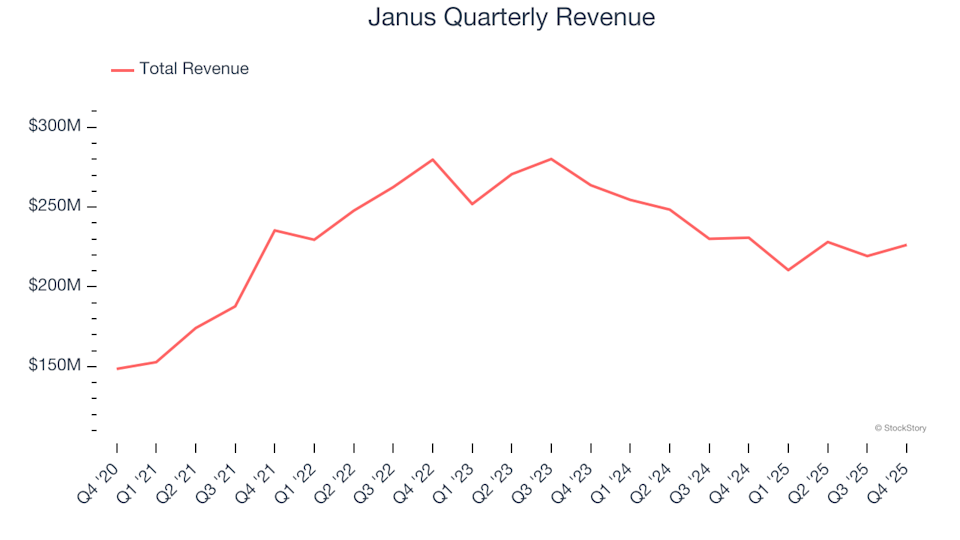
While long-term growth is crucial, recent results show a shift: Janus’s revenue has declined at an annualized rate of 8.9% over the last two years, diverging from its previous growth trajectory.
Janus Quarterly Revenue Janus Year-On-Year Revenue GrowthIn the latest quarter, revenue dropped 1.9% year-over-year to $226.3 million, but still came in 4.6% above analyst expectations.
Future Outlook
Looking forward, analysts expect Janus’s revenue to remain largely unchanged over the next year. Although new products and services may drive future growth, this forecast still lags behind the industry average.
Bonus Insight: The Overlooked $21 AI Stock – While much attention is on AI developers, one company is quietly leveraging AI to process a trillion consumer signals each month and trades at a fraction of the price of AI chip stocks. This opportunity may not go unnoticed for long. Access the FREE report before the market catches on.
Profitability: Operating Margin
Operating margin is a key indicator of profitability, reflecting how much profit remains after covering production, marketing, and R&D costs. Over the past five years, Janus has maintained an average operating margin of 16.7%, which is impressive for an industrial company and highlights its cost efficiency and scale.
Despite some fluctuations, Janus’s operating margin has remained relatively stable, raising questions about whether the company is fully leveraging its revenue growth to improve profitability through economies of scale.
Janus Trailing 12-Month Operating Margin (GAAP)In Q4, Janus achieved a 9.2% operating margin, a notable improvement of 3.6 percentage points from the previous year. This gain was likely due to effective cost management, as both revenue and gross margin declined during the period.
Earnings Per Share (EPS)
While revenue growth tells part of the story, long-term changes in earnings per share (EPS) reveal how profitable that growth is. Janus’s EPS has grown at a modest 1.9% compound annual rate over the past four years, underperforming the broader industrial sector.
Janus Trailing 12-Month EPS (Non-GAAP)Examining more recent results, Janus’s EPS has fallen by 23.2% over the last two years—outpacing the decline in revenue and indicating challenges in adapting to reduced demand.
A closer look at Janus’s earnings shows that, despite a recent uptick in operating margin, the two-year trend is downward, which has been a significant factor in lower EPS. While interest and taxes also play a role, they are less indicative of the company’s core performance.
For Q4, Janus reported adjusted EPS of $0.11, up from $0.05 a year ago, but still below analyst forecasts. Wall Street expects Janus’s full-year EPS to reach $0.56 over the next 12 months, representing an 18% increase.
Summary of Q4 Results
Janus delivered a strong revenue beat this quarter and issued optimistic full-year guidance, although EPS fell short of expectations. Overall, the quarter showed positive momentum in several areas, but the market reacted with caution, sending the stock down 2.6% to $6.65 after the report.
Is Janus a buy at this point? While the latest quarter offers valuable insights, it’s just one factor in assessing the company’s long-term prospects. Evaluating both business quality and valuation is essential for investment decisions. Read our full research report for actionable insights—available for free.
Disclaimer: The content of this article solely reflects the author's opinion and does not represent the platform in any capacity. This article is not intended to serve as a reference for making investment decisions.
You may also like
Roblox Stock Rises 0.64% Despite Shrinking $460M Volume Ranking 269th Growth vs Profit Dilemma Lingers
Agnico Eagle Mines' Trading Volume Plummets 46% to 271st in Activity Amid Mixed Analyst Outlooks
What Aristeia’s significant investment in IAC reveals about the strategies of savvy investors
Trending news
MoreCrypto prices
More





