
Oil Prices Continue to Surge as Ongoing Conflict Intensifies Pressure on Worldwide Energy Markets

Oil Prices Surge Amid Ongoing Middle East Conflict
Recent hostilities between the US, Israel, and Iran have severely disrupted global oil shipments, causing crude prices to climb higher. As the fighting continues, both sides have pledged to escalate their actions, while China—the world's largest oil importer—has moved to conserve its fuel supplies.
Brent crude approached $84 per barrel after a dramatic 12% rise earlier in the week, and West Texas Intermediate hovered near $77. Despite the uncertain timeline for military operations, US President Donald Trump voiced optimism about the campaign. Meanwhile, Iran’s Islamic Revolutionary Guard Corps announced plans to intensify their attacks in the coming days.
Top Stories from Bloomberg
Reflecting the growing strain on global fuel supplies, Chinese authorities have instructed major refiners to halt exports of gasoline and diesel, prioritizing domestic consumption. Japanese refiners have requested government intervention to release oil from national reserves, and earlier in the week, a leading Indian refiner informed clients of a temporary suspension in product exports.
Strait of Hormuz: A Critical Chokepoint
The Strait of Hormuz remains at the heart of market anxiety. Although Iranian military officials have stated they do not intend to close the passage, the effective shutdown over several days has trapped oil shipments from Iran and other Gulf producers, forcing some to reduce output.
The ongoing conflict, now entering its sixth day, has sent shockwaves through global energy markets. Oil, gas, and refined product prices have soared, shipping costs have increased, and disruptions are spreading, impacting both producers and countries dependent on Middle Eastern energy flows.
“Should another tanker or oil facility be successfully targeted, or if the disruption continues, we could see prices spike even further,” warned Priyanka Sachdeva, a senior analyst at Phillip Nova Pte.
The immediate price gap between Brent contracts has widened to $3.94 per barrel, indicating a tight supply in the near term—up from just 57 cents a month ago. Longer-term contracts are trading much lower, with October futures nearly $11 below May’s price.
On Thursday, Iranian media reported that the Islamic Revolutionary Guards Corps Navy had struck an oil tanker in the northern Persian Gulf.
Efforts to Ease the Crisis
To address the bottleneck at the Strait of Hormuz—a vital link between the Persian Gulf and the Indian Ocean—the US has proposed offering insurance guarantees for ships and possibly providing naval escorts. However, Marsh, the world’s largest insurance broker, cautioned that implementing such measures could take several weeks.
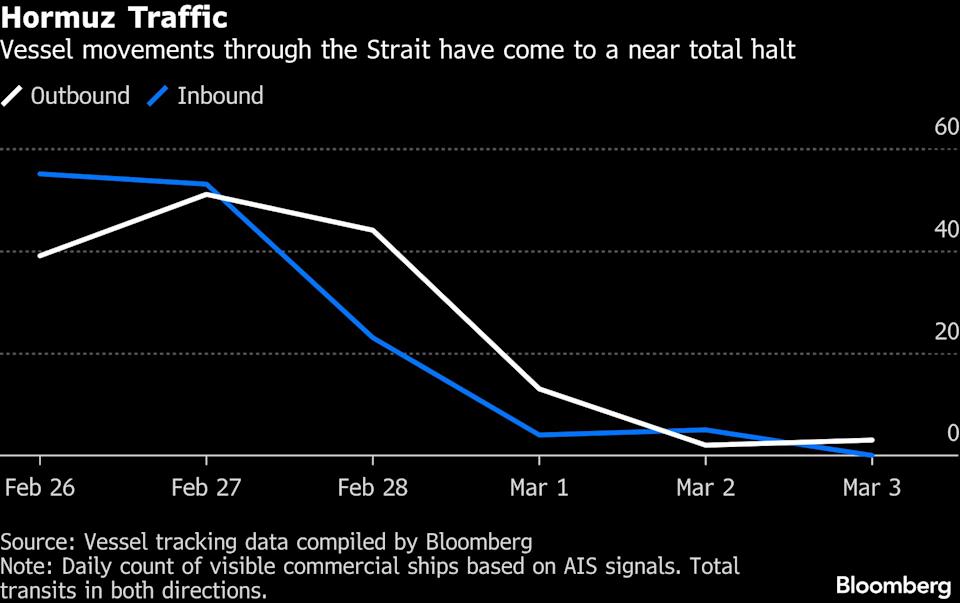
Bloomberg’s vessel tracking data reveals that traffic through the strait has dropped by more than 95%, as most oil and gas tankers avoid the area. The few vessels still departing the Gulf are operating with their tracking systems disabled, a common tactic in conflict zones.
According to the International Energy Agency (IEA), around 15 million barrels of oil and an additional 5 million barrels of refined products passed through the strait daily in 2025.
The IEA emphasized, “Given the enormous volume of oil transported via the Strait of Hormuz and the limited alternatives, any disruption would have far-reaching consequences.”
Market Perspectives and Supply Outlook
Goldman Sachs CEO David Solomon says he is surprised by the benign reaction to the Iran attacks but doesn’t see complacency in the markets during an interview with Haidi Stroud-Watts on “Bloomberg: The Asia Trade.”Goldman Sachs CEO David Solomon, speaking to Bloomberg Television in Sydney, noted that there is still significant uncertainty about how the Middle East conflict will unfold. Investors are closely watching for developments and trying to gauge the potential impact.
Before the outbreak of war, analysts—including those at the IEA—had warned of a global oil surplus, with inventories at comfortable levels, especially in China.
“There’s still excess supply,” said Alvin Lee, client manager at IG Asia Pte. “China, for instance, maintains large reserves. If tensions ease, crude prices could drop back into the $60s.”
Meanwhile, US crude inventories rose by approximately 3.5 million barrels last week, reaching their highest point since the previous May, according to the Energy Information Administration.
Most Read from Bloomberg Businessweek
©2026 Bloomberg L.P.
Disclaimer: The content of this article solely reflects the author's opinion and does not represent the platform in any capacity. This article is not intended to serve as a reference for making investment decisions.
You may also like
Berkshire’s Abel Commits Entire Salary to Purchasing Company Shares

ITV maintains that the Sky sale remains in progress despite a decline in advertising income

AREC's ReElement Increases Advanced Rare Earth Lab Capabilities
Q4 Overview: Comparing Radian Group (NYSE:RDN) with Other Property & Casualty Insurance Equities
Trending news
MoreCrypto prices
More





