
How two legal decisions this week changed the discussion around tariff reimbursements

Progress in Tariff Refund Efforts
This week saw significant developments in the ongoing push by businesses to secure tariff refunds from the cautious Trump administration.
On Monday, a federal court dismissed the Justice Department's attempt to delay proceedings for 90 days, reaffirming that the US Court of International Trade would remain the central venue for refund-related lawsuits.
By Wednesday, the Manhattan-based court moved swiftly, ruling that the government must return all tariffs that were unlawfully collected.
Senior Judge Richard Eaton issued a broad order in response to a case brought by a filtration company, but his instructions applied to "all importers of record."
The judge declared that every affected business "is entitled to the benefit" of the ruling and directed US Customs and Border Protection to comply. Eaton also stated he would preside over all future refund cases.
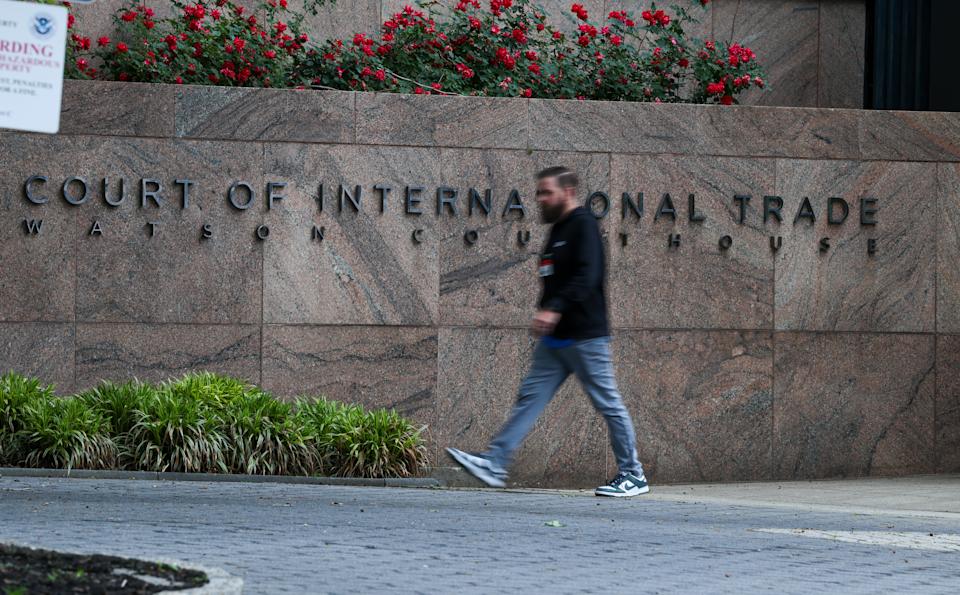
The US Court of International Trade in lower Manhattan, May 2025. (Spencer Platt/Getty Images)
Although appeals are expected, these back-to-back decisions marked a dramatic shift, especially after the administration had tried to freeze the refund process for three months at the start of the week.
At the heart of the matter are up to $175 billion in "blanket" tariffs imposed by Trump since returning to office, justified under the 1977 International Emergency Economic Powers Act (IEEPA). While the Supreme Court recently ruled these tariffs illegal in a 6-3 decision, the majority opinion did not address the issue of refunds.
The legal battles are unfolding as the political stakes rise. Senator Elizabeth Warren has criticized the administration's delay tactics, calling them "theft in broad daylight."
Legal Decisions Reshape the Tariff Refund Conversation
This week's court actions—especially Judge Eaton's sweeping order—have prompted international trade attorneys to reassess their strategies, though many caution that more legal disputes are inevitable.
Greg Husisian, a partner at Foley & Lardner who represents importers seeking refunds, noted that the order signals the trade courts' intent to move these cases forward rapidly. However, he emphasized, "we believe there is a 100% chance that this will be appealed."
He added that the central question now is whether the trade court can provide relief to all affected parties.
Ted Murphy, an international trade lawyer at Sidley Austin, told his clients that the order "is going to shift the nature of the tariff refund debate" toward whether broad relief is possible.
Murphy suggested that the next phase will likely return to the US Court of Appeals for the Federal Circuit—the same court that recently denied the Justice Department's request to pause the process.
He also pointed out that the D.C. court has previously been skeptical of the US Court of International Trade's authority to issue sweeping injunctions.
For now, at least one advocacy group for tariff refunds called the ruling "a victory for the small businesses." However, We Pay the Tariffs, a coalition of small businesses, cautioned that "the job's not done."
A Rapid Shift in Legal Momentum
The legal landscape has changed dramatically in just a few days.
Only recently, the Trump administration's Justice Department had sought a 90-day pause on the refund issue "to allow the political branches an opportunity to consider options."
The US Court of Appeals for the Federal Circuit rejected that request, allowing the US Court of International Trade to proceed. Judge Eaton's subsequent order on Wednesday was broader than anticipated and addressed a key issue for businesses: the distinction between unliquidated and liquidated tariff entries.
In trade, "liquidation" refers to the final calculation of tariffs owed on imported goods, typically completed within a year of importation.
Even before the Supreme Court's decision, companies had already filed lawsuits focused on the liquidation process, fearing that once tariffs were finalized, obtaining refunds would become more difficult.
Judge Eaton directed the administration to act on unliquidated entries and ordered that "any liquidated entries for which liquidation is not final shall be reliquidated without regard to IEEPA duties."
Currently, more than 2,000 lawsuits are pending on this issue, involving major companies such as Costco (COST), FedEx (FDX), Revlon, and others.
The White House did not comment, but Trump's team has indicated they will not establish an automatic refund process, insisting that refunds will be resolved through the courts.
Trump previously remarked, "I guess it has to get litigated for the next two years," and recently suggested on social media the possibility of a "Rehearing or Readjudication" of the Supreme Court's decision.
Ben Werschkul is a Washington correspondent for Yahoo Finance.
Disclaimer: The content of this article solely reflects the author's opinion and does not represent the platform in any capacity. This article is not intended to serve as a reference for making investment decisions.
You may also like

Zcash Faces Potential Drop to $120 Amid Bearish Momentum
Kraft Heinz: Potential Bear Flag
A treasure hidden beneath the sea
Trending news
MoreCrypto prices
More





