
3 Reasons to Avoid TWLO and One Alternative Stock Worth Buying

Twilio’s Recent Performance
In the past half-year, Twilio has outperformed the S&P 500 by 7.8%, with its share price rising to $122.68—a gain of 12.9%. This growth was fueled in part by strong quarterly earnings, prompting investors to consider their next steps.
Should you add Twilio to your portfolio now, or is caution warranted?
Why We’re Not Enthusiastic About Twilio
Despite its recent momentum, we’re choosing to stay on the sidelines. Here are three reasons why Twilio doesn’t stand out to us, along with a stock we prefer.
1. Billings Indicate Sluggish Demand
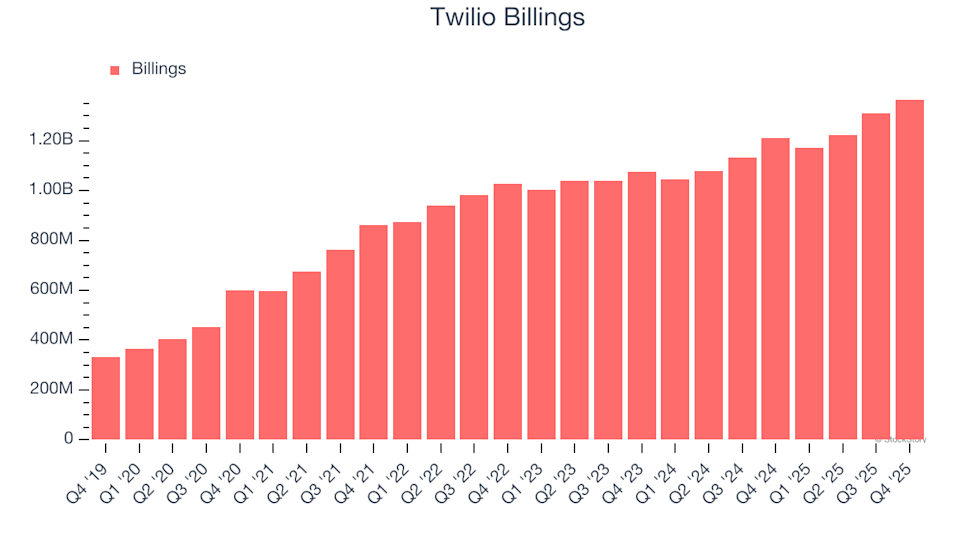
Billings, often referred to as “cash revenue,” reflect the actual funds received from customers during a specific period, differing from revenue which is recognized gradually over contract terms.
Twilio reported billings of $1.37 billion in Q4, with year-over-year growth averaging 13.4% over the past four quarters. This rate trails the industry average, suggesting that heightened competition is making it harder for Twilio to attract and retain clients.
2. Low Gross Margin Signals Structural Challenges
For software companies, gross profit measures what’s left after covering essential costs like servers, licenses, and personnel. These expenses are typically low compared to revenue, which is why software is generally a profitable sector.
Twilio’s gross margin is notably below the industry norm, indicating higher infrastructure expenses compared to asset-light competitors such as ServiceNow. Over the past year, Twilio’s average gross margin was 49%, meaning it spent $51.03 for every $100 earned.
Investors pay attention not only to gross margin levels but also to their trajectory, as improvements can boost profitability and free cash flow. Twilio’s gross margin has dropped by 0.3 percentage points over the last two years, a decline that’s slightly worse than the sector average.
3. Operating Margin Improvement and Profit Growth
While many software firms adjust profits for stock-based compensation (SBC), we focus on GAAP operating margin since SBC represents a real cost for recruiting and retaining talent. This metric reveals how much revenue remains after all core expenses, including sales, R&D, and cost of goods sold.
Looking at Twilio’s profitability trends, its operating margin has increased by 4.3 percentage points over the past two years, benefiting from sales-driven operating leverage. The trailing 12-month operating margin stands at 3.1%.
Our Verdict
Twilio isn’t a poor company, but it doesn’t meet our quality standards. Although its shares have recently outperformed the market, the stock is trading at 3.3 times forward price-to-sales (currently $122.68 per share). While this valuation isn’t excessive, we don’t see significant upside right now. We believe there are more attractive opportunities elsewhere. Explore for better alternatives.
Top Stocks for Any Market Environment
ALSO WORTH WATCHING: The Top 5 Momentum Stocks. The ideal moment to invest in a standout stock is when the market starts to recognize its value. These companies aren’t just high-quality—they’re experiencing notable developments right now. Strong fundamentals combined with short-term momentum make them compelling choices.
Discover which stocks our AI platform is highlighting this week. Access this week’s Strong Momentum stocks for free. .
Our list features well-known names like Nvidia, which soared 1,326% from June 2020 to June 2025, as well as lesser-known companies such as Kadant, which delivered a 351% return over five years. .
Disclaimer: The content of this article solely reflects the author's opinion and does not represent the platform in any capacity. This article is not intended to serve as a reference for making investment decisions.
You may also like
Neo’s 2025 Financial Report Offers a Window Into Its $461M Treasury And Plans For Future Cycles
Wind farms increase the average household energy bill by £70

DOGEBALL vs Eggman vs Ozak AI: Which Project Qualifies as the Next 100x Crypto Presale in 2026

Here’s Why XRP’s Links to the Derivatives Market Are Important
Trending news
MoreCrypto prices
More





