
Best Crypto to Buy in a Bear Market? LiquidChain’s Cross-Chain Model Stands Out

Bear markets change what investors prioritize. In bullish phases, capital flows toward momentum and narrative-driven tokens. When markets cool, focus moves toward projects building core infrastructure with clear utility.
Liquidity fragmentation remains one of crypto’s persistent structural issues. Bitcoin, Ethereum, and Solana each hold deep pools of capital, yet they operate in separate silos. Moving assets across ecosystems often requires bridges, added fees, and multiple execution layers.
LiquidChain ($LIQUID) positions itself around solving that fragmentation. Instead of launching another isolated chain, it introduces a Layer 3 settlement protocol designed to unify liquidity across BTC, ETH, and SOL. In a climate where capital is cautious and efficiency matters, infrastructure-focused models tend to become popular.
Why $LIQUID Could Shine in a Bear Market
LiquidChain operates through a Cross-Chain Virtual Machine capable of referencing multiple blockchains within one execution environment. That allows transactions to coordinate across ecosystems without relying purely on traditional wrapped asset models.
At the verification layer, a Unified Proof Engine validates Bitcoin UTXOs, Ethereum accounts, and Solana states in real time. The goal is atomic execution across chains. For developers, this reduces the need to build multiple versions of the same application. For liquidity providers, it opens the door to shared order books and unified capital pools.

In bearish conditions, capital efficiency becomes critical. Projects focused on infrastructure continue building regardless of short-term price cycles. Liquidity coordination, transaction settlement, and staking mechanisms remain active whether markets are euphoric or defensive.
The $LIQUID token underpins the entire ecosystem by serving as the fuel for cross-chain transaction execution, enabling liquidity staking that helps secure the network, incentivizing validator participation to maintain consensus integrity, and funding ecosystem grants designed to accelerate developer adoption and application growth across the platform.
This model ties token demand to network usage. If adoption grows, transactional activity scales alongside it.
Infrastructure Highlights and Tokenomics Overview
Tokenomics play a central role in the long-term structure:
- Development – 35%
- LiquidLabs – 32.5%
- AquaVault – 15%
- Rewards – 10%
- Growth & Listings – 7.5%
- Total Supply – 11.8 billion tokens
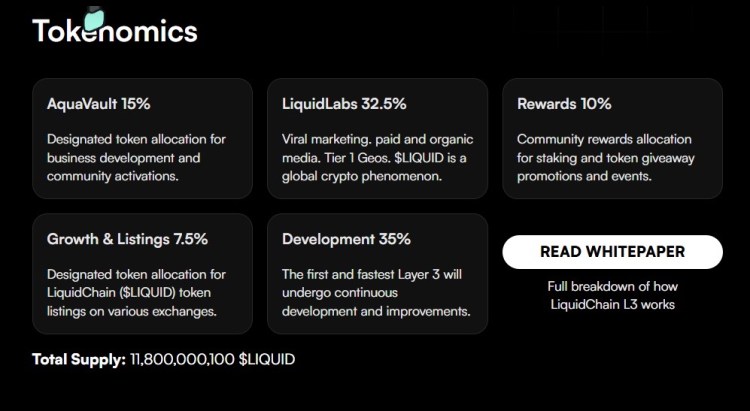
A large allocation toward development and ecosystem expansion highlights emphasis on engineering and network growth. Rewards allocation supports validator participation, while growth funds support future listings and adoption strategies.
Why $LIQUID Is Among the Best Altcoins to Buy in a Downtrend
In volatile markets, large-cap assets often provide relative stability. However, early-stage infrastructure tokens can offer asymmetric upside tied to long-term network growth.
LiquidChain targets one of the largest inefficiencies in crypto: fragmented liquidity across major ecosystems. If cross-chain coordination continues gaining adoption, Layer 3 settlement models could occupy a larger role in the next expansion cycle.
No project is immune to broader market cycles. Adoption, delivery, and ecosystem growth will ultimately determine long-term performance. Yet infrastructure protocols built during consolidation phases often emerge stronger when capital flows return.
As liquidity unification becomes a central theme across DeFi, early exposure to settlement-layer infrastructure may prove significant in the next market cycle.
Infrastructure continues to develop beneath the surface.
Whitepaper:
Disclaimer: The content of this article solely reflects the author's opinion and does not represent the platform in any capacity. This article is not intended to serve as a reference for making investment decisions.
You may also like
DOGE Hovers Near Key Support as Mixed Signals Cloud Recovery Outlook
Tango Therapeutics Announces Inducement Grants Under Nasdaq Listing Rule 5635(c)(4)

Bridgford: Overview of First Fiscal Quarter Earnings
BC-Select Stock Indices
Trending news
MoreCrypto prices
More





