
Economist Eswar Prasad cautions that a diverse collection of mid-level powers is unable to halt the 'doom loop' endangering the world economy

Global Order in Turmoil: Middle Powers Face New Challenges
Earlier this year at the World Economic Forum in Davos, Mark Carney, the former Governor of the Bank of Canada, delivered a stark warning. He described a significant breakdown in the established international system, noting that major players like the United States and China are now leveraging economic ties as strategic tools—using tariffs for pressure, manipulating financial systems for influence, and treating supply chains as weaknesses to exploit. Carney’s advice to nations outside these superpowers was clear: “If you’re not participating in decision-making, you risk being sidelined.”
The Complexity of Middle Powers
According to Eswar Prasad, a trade policy professor at Cornell University, the group known as “middle powers” is highly diverse, encompassing a wide range of countries beyond the U.S. and China. These nations vary greatly in size, wealth, and interests, making unified action difficult. Prasad points out that alliances among these countries often lack a foundation of shared values or deep trust.
Carney has advocated for a flexible approach—what he calls “variable geometry”—where countries form partnerships based on overlapping interests. However, Prasad warns that without genuine trust, such arrangements are unlikely to replace the robust international institutions that once governed global relations. He believes that without strong, trust-based alliances, it will be challenging to establish a new, stable global order, and existing tensions between wealthy and less-developed nations are likely to intensify.
The Doom Loop: Globalization Under Strain
Since Donald Trump’s election in 2016, the political foundation of globalization has appeared increasingly fragile. The U.S. has taken steps to reduce its economic exposure to China through tariffs, export restrictions, and tighter investment rules, while also showing a greater willingness to act independently rather than through international organizations.
Prasad, author of The Doom Loop: Why the World Economic Order Is Spiraling into Disorder, argues that the very forces intended to stabilize the world—globalization, international institutions, and the rise of emerging markets—are now contributing to greater instability.
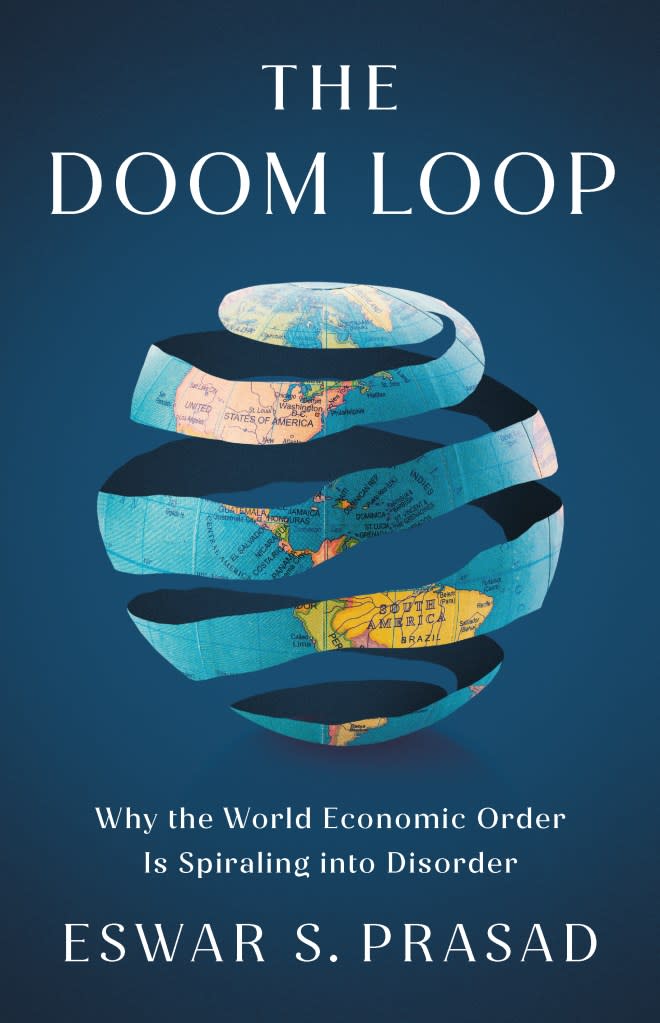
In an interview with Fortune, Prasad explained that he initially hoped the growing influence of emerging economies would create a more balanced and secure global system. Instead, he found that the current trajectory of globalization is fueling volatility rather than reducing it.
Many citizens now perceive globalization as benefiting only political and economic elites, further skewing the system in their favor. This dissatisfaction drives domestic policies that push back against globalization, such as new tariffs, which then feed into the international arena and heighten global instability.
Fragmented Trade and Investment
Despite these challenges, global trade reached a record value of about $35 trillion last year. However, much of this trade now happens within geopolitical blocs rather than between them. Prasad notes that trade and financial flows are becoming more fragmented, deepening divisions between countries.
Research by McKinsey shows that “geopolitical distance” in trade and investment is narrowing, as nations increasingly prioritize economic relationships with allies that share their security interests.
China and India: Uncertain Prospects
Prasad sees little reason for optimism in Asia’s economic outlook. The International Monetary Fund recently forecasted that China’s economy would expand by 4.5% this year, but also cautioned that excessive investment and industrial policies are undermining productivity, creating financial risks, and leading to oversupply in certain sectors. In December, China’s retail sales growth slowed to 0.9%—the weakest since late 2022—and fixed-asset investment dropped by 3.8% in 2025, marking a record decline.
The IMF has repeatedly urged China to shift toward growth driven by consumer spending. While Chinese policymakers have attempted to boost domestic consumption, progress has been slow. Prasad notes that before the COVID-19 pandemic, China was making strides in rebalancing its economy, with consumption playing a larger role in growth. However, the pandemic prompted a return to investment-heavy strategies, compounded by regulatory crackdowns in sectors like technology, education, and healthcare, which have shaken private sector confidence.
“Although the government has recently tried to signal renewed support for private enterprise, many businesses remain skeptical,” Prasad observes.
India, meanwhile, appeared poised to benefit from closer ties with the U.S. and the trend of “friendshoring.” Yet, aside from some notable moves by companies such as Apple, India still lags behind smaller emerging markets like Vietnam in attracting new investment.
“It seemed that conditions were favorable for India,” Prasad says, “but the actual opportunities may be far less significant than expected.”
He also believes that India will find it difficult to deepen ties with China, even if it seeks broader diplomatic engagement. Opening Indian markets to Chinese goods could devastate local manufacturing, as India cannot compete with China’s export capacity. Additionally, India is cautious about reforms at global institutions like the IMF that could increase China’s influence, potentially diminishing India’s relative standing.
Are Businesses Worsening the Situation?
So, what can multinational companies do in this increasingly complex environment?
Prasad contends that the era of streamlined, ultra-efficient supply chains has ended. Today, business leaders focus on building resilience—by diversifying suppliers, strengthening relationships with politically aligned countries, and sometimes retreating to domestic markets. His advice to CEOs is pragmatic but not always satisfying: avoid excessive debt, maintain cash reserves, and create financial buffers.
However, the typical corporate response may be aggravating the problem. In the past, the business community was a strong advocate against decoupling the U.S. and Chinese economies, relying on China both as a manufacturing hub and a vast consumer market. This interdependence helped stabilize relations between the two powers. Now, as companies withdraw from China and other politically sensitive markets, they may inadvertently increase the very risks they hope to avoid.
“I worry that we’re trapped in a cycle of instability—a ‘doom loop’—until a major systemic correction occurs,” Prasad cautions. “And that adjustment could be quite painful.”
This article was originally published on Fortune.com.
Disclaimer: The content of this article solely reflects the author's opinion and does not represent the platform in any capacity. This article is not intended to serve as a reference for making investment decisions.
You may also like
Asseto Finance Achieves Regulatory Milestone for RWA Tokenization in Hong Kong
Transportation sector severely impacted by sudden surge in fuel prices
Erase the Fiat Illusion: 5 Altcoins Ready to Explode 10–25% This Week
Day One (DAWN) Soars 100% on $2.5-Billion Merger

Trending news
MoreCrypto prices
More





