
Global funds accelerate withdrawal from Asia, with a weekly sell-off of $11 billion, the most in four years

Global funds are exiting emerging Asian equities at the fastest pace in nearly four years. WallstreetCN previously published an article stating that Asian markets such as Japan and South Korea are heavily dependent on Middle Eastern oil imports. The escalation of the Iran conflict has sparked risk-off sentiment, forcing investors to reprice risks, which quickly spilled over into equity and foreign exchange markets.
According to data compiled by Bloomberg, global funds have sold a net total of about $11 billion in developing Asian stocks (excluding mainland China) this week, set to mark the largest single-week outflow since March 2022. Among them, about $1.6 billion came from South Korea and $1.3 billion from India.
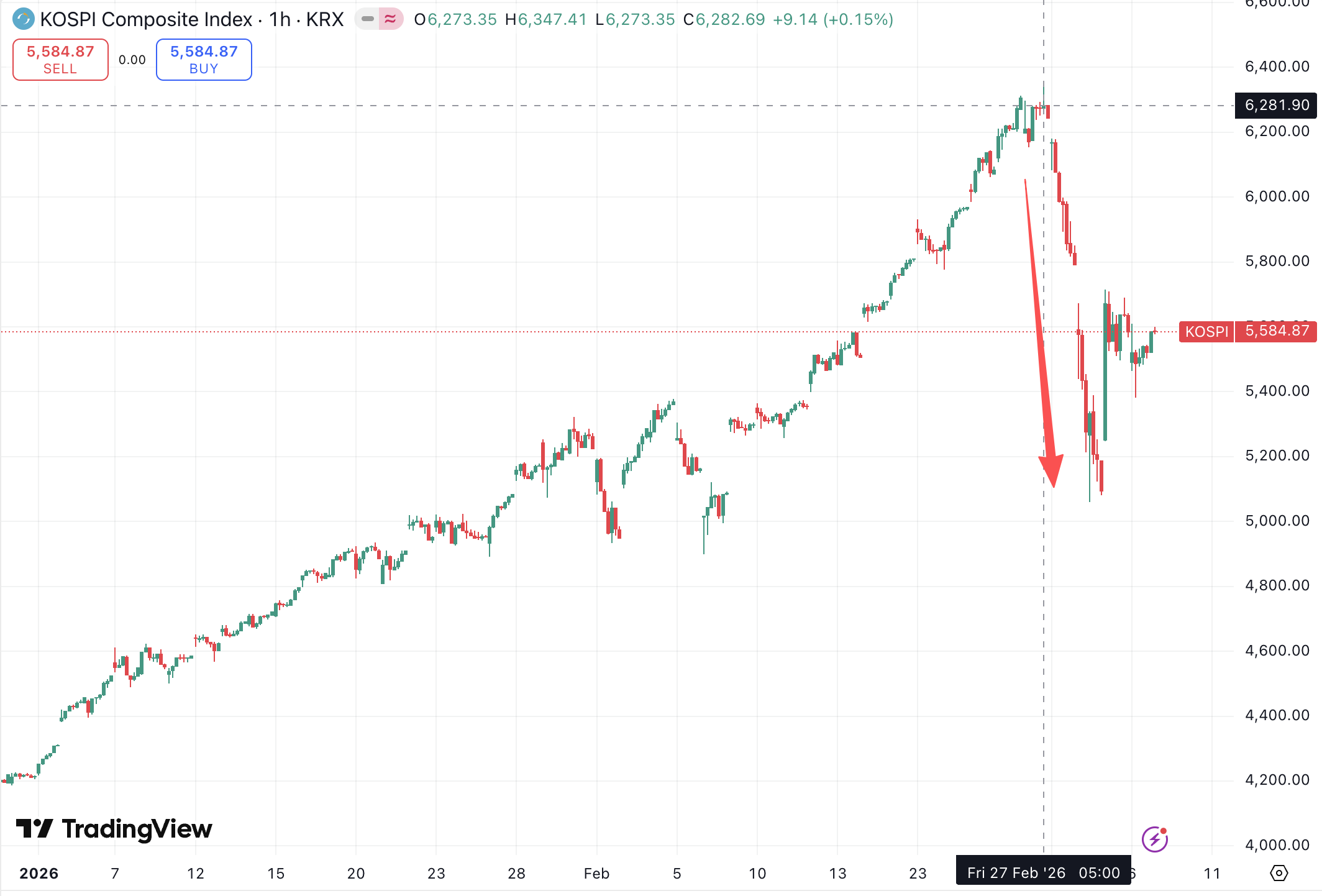
Capital outflows compounded by a sudden drop in risk appetite have triggered sharp declines in regional stock markets. The MSCI Asia Pacific Index has fallen by more than 6% this week—set for its largest one-week drop in nearly six years and the biggest underperformance relative to the S&P 500 since April. Korea’s Kospi Index saw a record one-day plunge, and multiple trading halts occurred in some markets.
Morgan Stanley strategists, due to war-related risks in Iran, have adopted a more cautious stance on Asian and emerging market equities, downgrading India and the UAE from overweight to neutral, stating that Asia “heavily depends on Middle Eastern crude oil, refined oil, and LNG supplies,” and believe the market is underestimating supply chain risks.
“Sell America, Buy Asia” Trade Reverses as Risk Reassessment Becomes Main Theme
This round of outflows marks a reversal of a recent high-yielding trade—“sell America, buy Asia.” This strategy was based on expectations of a weaker dollar, mild inflation, and AI-induced demand for regional chip stocks, rotating capital from high-valuation U.S. equities to Asian equities.
But the situation in Iran has shaken these key premises. Gary Tan, portfolio manager at Allspring Global Investments, remarked that investors had previously bought Asian stocks on the expectation of a weakening dollar and benign inflation, but the Iran situation challenges both assumptions. The market is now assessing whether prolonged dollar strength and high oil prices could reignite inflation pressures.
Rising Oil Price Sensitivity: Asia’s Dependence on Middle Eastern Energy Supplies Is Being Repriced
One reason for the deeper pullback in Asian assets is their relatively high dependence on Middle Eastern crude oil. Large fuel imports must pass through the critical Strait of Hormuz, and the escalation of conflict has increased supply chain risk premiums. The rise in crude oil has heightened concerns over a resurgence of inflation, particularly as many central banks are just building confidence in having curbed inflation.
Japan, South Korea, India, Indonesia and other economies rank among the world’s largest oil importers, while the United States has become a net oil exporter. This difference reinforces the market’s judgment that Asia, as a “net importing region,” is more prone to inflation and policy constraints under oil price shocks.
Stock-FX Linkage Deepens, Volatility and Deleveraging Concerns Rise
With risk-off trades pushing up the dollar, emerging market currencies are under pressure. The market is particularly focused on the currencies of net oil-importing countries and their impact on domestic inflation. The Korean won saw its biggest single-day closing drop since 2009 on Tuesday, prompting investors to be alert to passive deleveraging and forced liquidation risks.
Meanwhile, volatility indicators are rising. The JPMorgan Emerging Markets FX Volatility Index climbed above the comparable G7 benchmark this week, ending its previous record run “well below the G7” and highlighting that risk pricing in the market is shifting rapidly.
Institutions Adjust Positions: Morgan Stanley Turns Defensive, Citi Awaits Stability Signals
Strategically, Morgan Stanley strategists, due to war-related risks in Iran, have adopted a more cautious stance on Asian and emerging market stocks, downgrading India and the UAE from overweight to neutral, and upgrading Saudi Arabia from underweight to neutral.
Daniel Blake and Jonathan Garner wrote in a report, “We remain defensive,” and noted that Asia “heavily depends on Middle Eastern crude oil, refined oil, and LNG supplies,” believing the market is underestimating supply chain risks.
Citi is emphasizing pacing. Luis Costa and others wrote in a report that significant risk exposure has been reduced in recent days, but should there be signs of stability, they hope to reestablish emerging market long positions. Although there are “early signs of oil price stabilization,” it is still too soon to assert that oil prices will repeat the 2022 trajectory.
Beyond Middle East tensions, investors will also focus on tonight's U.S. non-farm payroll report for clues on the Federal Reserve's rate path. The repricing of dollar strength and global capital risk appetite may still determine whether this round of Asian asset “exit trades” is a temporary fluctuation or a more sustained position rebalance.
Disclaimer: The content of this article solely reflects the author's opinion and does not represent the platform in any capacity. This article is not intended to serve as a reference for making investment decisions.
You may also like
Digital Realty's 1.98% Decline and 284th Volume Rank: Analysts Optimistic, Traders Cautious
Here's the Reason Macy's (M) Declined More Sharply Than the Overall Market
Bank of America (BAC) Falls Further Than the Overall Market: Key Information You Need
First Majestic's 1.67% Decline Contrasts With Earnings Surge as Trading Volume Ranks 274th
Trending news
MoreCrypto prices
More





