
Non-farm payrolls plunge unexpectedly by 92,000, gold price surges $40—Is a bigger "trap" still ahead?

Huitong Network, March 6th—— On Friday (March 6) at 21:30 Beijing time (GMT+8), a surprisingly weak US February Nonfarm Payrolls report instantly ignited the global financial markets. The US Dollar Index plunged 25 points instantly, erasing almost all gains for the day; spot gold staged a wild surge, soaring about $40 within minutes and consecutively breaking through the $5100 and $5120 marks. This series of violent fluctuations reveals investors' panic over a sudden cooling of the labor market, as well as a repricing of dual risks of inflation and economic slowdown in the context of US-Iran conflicts.
On Friday (March 6) at 21:30 Beijing time (GMT+8), as the US February Nonfarm Payrolls report delivered an unexpected disappointment, the global financial market was instantly set off. The US Dollar Index tumbled 25 points in a short period, wiping out almost all intraday gains and turning slightly negative; meanwhile, spot gold staged a frenzy, soaring about $40 within just a few minutes and consecutively breaking the $5100 and $5120 levels. At the same time, US Treasury yields across the board fell, and the probability of a rate cut by the Federal Reserve in June swiftly jumped from 35% to 50%. This series of dramatic movements revealed investor panic over a sharply cooling labor market, and the repricing of risks of both inflation and economic slowdown driven by US-Iran tensions.
After the data was released, market reactions were swift and dramatic. Taking the
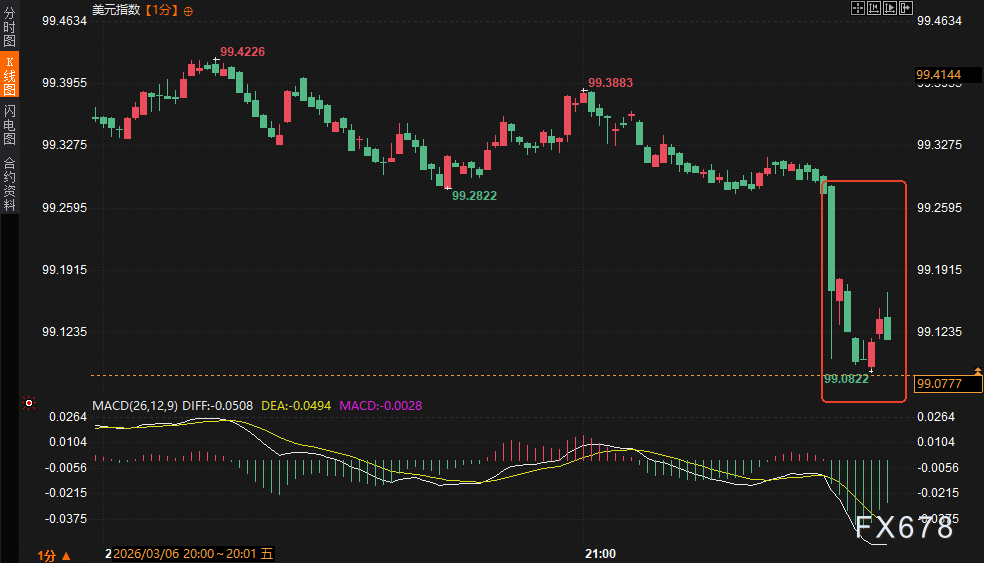
In terms of safe-haven assets,
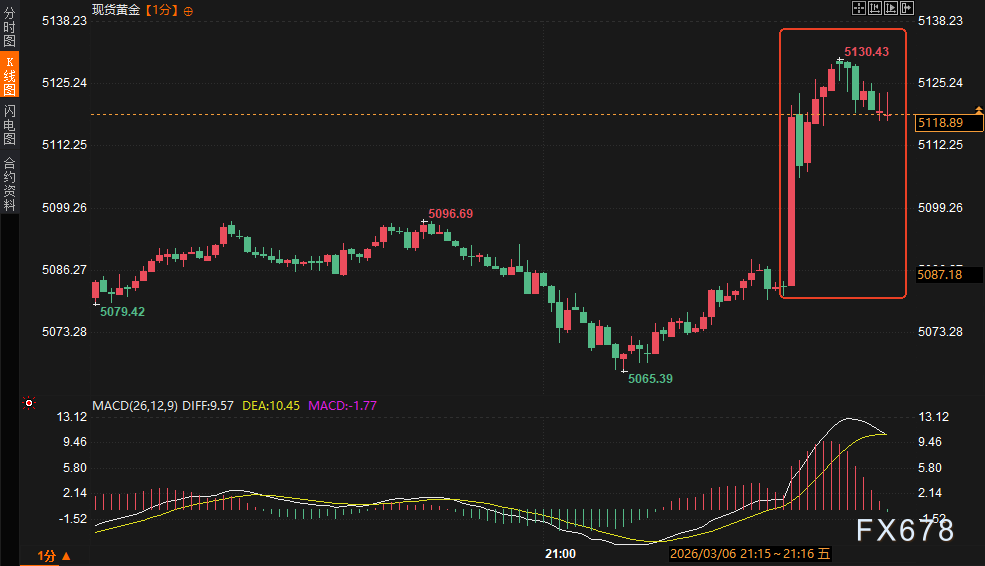
At the same time,
The impact of these data on the Federal Reserve’s policy path is worth thorough analysis. Prior to the release, traders priced about a 35% probability for a June rate cut by the Fed, but after the data, this quickly rose to around 50%. This shift was due to an abrupt cooling in the labor market: February saw much slower-than-expected job growth, the unemployment rate rose, the labor force participation rate fell to 62.0%, and the U-6 underemployment rate rose to 7.9%—an across-the-board disappointment. This stands in sharp contrast with statements made by Fed officials since March 2, who repeatedly emphasized a “stabilizing” labor market and warned lingering inflation risks. However, the weak nonfarm report is likely to pressure the Fed into reconsidering the easing path. Analysts pointed out that the current situation does not match officials’ depiction of stability and may push the Fed to discuss a possible return to rate cuts at the March meeting. On the other hand, the energy shock arising from US-Iran tensions increases complication: with Iran’s foreign minister stating opposition to two nuclear states, repeated incidents in the Strait of Hormuz, the US crude futures price rising to $86.20/barrel, Chinese INE crude breaking 720 yuan/barrel, and US unleaded gasoline futures surging above $2.70/gallon. These developments have pushed up inflation expectations, and the spike in gasoline prices may suppress consumption willingness, further testing the fragile labor market. Together with market concerns stoked by Trump’s tariff remarks, businesses have become cautious in hiring, and expectations that AI will substitute jobs are also dampening labor demand. Although wage data sends a different signal—with average hourly earnings rising 0.4% MoM, higher than the expected 0.3%—this could complicate the Fed's dilemma: cooling employment calls for a policy response, while resilient wages restrict easing room.
From the integration of technical and fundamental perspectives, the negative nonfarm surprise reinforced the risk-off sentiment in the market, pushing the Dollar Index to test support below the 99 level in the short term; historically, after such weak jobs surprises, the dollar often remains soft for several weeks until the Fed’s message becomes clear. Gold’s technical picture matches the fundamentals: driven by both geopolitical and inflation factors, gold broke upward from a consolidation range at the start of the year; the RSI is nearing overbought territory but without a clear divergence, still signaling short-term upside potential. The drop in US Treasury yields reflected the bond market’s defensive stance, and a flattening yield curve may point to rising economic slowdown risks, though rising oil prices may push long-term yields back up. Overall, these reactions highlight the dominant role of employment data in the current macro context; although retail sales came in slightly better than expected, they failed to offset the shock from nonfarm payrolls.
Institutional and retail interpretations flowed in rapidly after the data, forming a stark contrast with pre-release expectations. Prior to the release, many institutional analysts predicted a 50,000 increase in February nonfarm, a rise in the unemployment rate to 4.4%, and a 0.3% drop in retail sales, stressing that weather and strikes could lead to weak data; retail traders focused on the 55,000 consensus expectation, emphasizing the data’s relevance for the Fed. After the release, institutional views turned negative: analysts such as Chris Anstey said the report would pressure the Fed to consider rate cuts, contradicting the notion of “stability.” Retail reactions were more direct, highlighting the surprise drop in nonfarm jobs, a higher-than-expected unemployment rate, and better-than-expected retail sales, but overall seeing the data as a worrying signal for the jobs market. Compared to mild slowdown expectations beforehand, post-release interpretations stressed the surprise downside risk that may reprice the timing for rate cuts. Overall sentiment revealed heightened stagflation fears, fueling hot debate over risk-off assets. These responses reinforced a market consensus: weak data increased expectations for easing, but inflation risks limit the Fed’s space.
Looking ahead, market trends may extend the current pattern: the dollar faces short-term pressure, gold may test higher levels on safe-haven demand, and US Treasury yields may stay volatile at low levels. Given the persistence of US-Iran tensions and energy price pressures, a slowdown in the labor market may evolve into a broader economic warning, but tax cut policies may provide some cushion. If subsequent data confirm labor market cooling, market volatility will increase, and investors should monitor the latest statements from Fed officials.
【Frequently Asked Questions】
Question 1: Why was the February nonfarm data so weak, and how does it differ from January?
Answer: February nonfarm employment decreased by 92,000, mainly due to healthcare strikes, manufacturing and government job losses, with 86,000 lost in the private sector. Compared to a revised 126,000 increase in January, this reflects a sharp slowdown in job growth. Behind this are cautious employers amid policy uncertainty, expectations for AI job substitution, and higher energy costs from US-Iran tensions. Historically, such uneven growth (e.g., healthcare dominance) often signals a labor market inflection point.
Question 2: Why did retail sales data fail to lift the market, being overshadowed by nonfarm payrolls?
Answer: January retail sales fell 0.2%, with the core group rising 0.3%, slightly better than expected—but as old news, its impact is limited. The focus was on the nonfarm shock, as employment figures reflect economic vitality more directly. Retail sales show consumer resilience, but owing to weather and auto sales drag, can’t reverse the negative sentiment from weak jobs, especially under inflationary pressure.
Question 3: How do US-Iran tensions affect the Fed’s policy path?
Answer: The conflict has driven up oil prices, with US crude climbing to $86/barrel, lifting inflation expectations and restricting the Fed’s room to ease. But weak nonfarm data pushed the probability of a June rate cut up to 50%, conflicting with officials’ “stability” narrative. The Fed must balance cooling employment versus inflation risk; historic energy shocks (like 2022) often delay rate cuts.
Question 4: What do the technical trends of gold and the dollar suggest?
Answer: Gold broke through multiple levels; the expanding MACD histogram shows robust bullish momentum, helped by safe-haven and inflation dual drives. The dollar fell below the 99.10 support, and short-term weakness persists. In essence, the nonfarm disappointment boosts risk aversion, but wage growth may amplify inflation; historically, after such patterns, gold often tests support following rallies.
Question 5: What are the long-term implications of downward revisions to employment data?
Answer: December and January’s combined downward revision of 69,000 reinforces the slowest job growth since 2003 for a non-recession year. This erodes consumer confidence—58% expect higher unemployment—which may restrain consumption and investment. Looking ahead, tax cuts may boost the economy, but energy shocks introduce uncertainty; it's important to monitor labor force participation and the U-6 rate to determine if recession risks are rising.
Disclaimer: The content of this article solely reflects the author's opinion and does not represent the platform in any capacity. This article is not intended to serve as a reference for making investment decisions.
You may also like
Robinhood CEO states that every newborn will have access to a Trump account

Here’s what could happen to container shipping rates if the Iran conflict continues
Broadcom’s AI Order Backlog Hides a High-Conviction Growth Setup for Patient Capital
Trending news
MoreCrypto prices
More





