
CBSH's Organic Growth Solid: What's Fueling Top-Line Expansion?

Commerce Bancshares, Inc.’s CBSH organic growth has been driven by steady expansion in its lending activities, a diversified fee-income base and proactive balance-sheet management. Though the company’s revenues declined in 2020, the metric witnessed a six-year (2019-2025) compound annual growth rate (CAGR) of 4.6%.
Loans: Largest Contributor to CBSH’s Top-Line Growth
The bank has consistently benefited from stable demand across its commercial and consumer loan portfolios (accounting for 77% of total loans in 2025), which has supported a gradual rise in overall loan balances over the past several years. Over the five years ended 2025, CBSH’s total loans saw a CAGR of 1.7%.
This steady loan growth has been a key contributor to higher net interest income (NII), forming a strong foundation for the company’s overall revenue expansion. Over the last six years (ended 2025), the company’s NII has seen a CAGR of 5.2%.
Going forward, the Federal Reserve’s interest rate cuts are likely to create a more favorable lending environment that could support CBSH’s loan growth. Yet, the extent of the increase will depend on broader economic conditions, business confidence and credit demand across the bank’s commercial and consumer lending segments.
Commerce Bancshares’s Diversified Fee Income Base
CBSH has long relied on a diversified business model in which non-interest income contributes a sizable portion of total revenues, helping offset fluctuations in interest income and lending cycles.
A key driver of fee revenue growth is the company’s wealth management and trust services segment. Commerce Bancshares generates fees from investment advisory, trust administration and asset management services. As client assets grow and demand for financial planning and advisory solutions increases, the bank is likely to see steady growth in these recurring fee streams, providing stable, higher-margin revenues compared with traditional lending.
The bank also benefits from strong card and payment-related fee income. Commerce Bancshares has an established bank card and payment services business that generates revenues from card transactions, merchant services and related processing activities. With consumer spending and digital payments continuing to expand, these fee streams remain important contributors to overall revenue growth.
The company earns fees from deposit account services, capital markets activities and brokerage operations, which further diversify its revenue base.
Overall, sustained growth in fee income has been strengthening Commerce Bancshares’ top line, enhancing revenue stability and supporting profitability, making it an important pillar of the company’s growth strategy.
CBSH’s Balance Sheet Management Efforts
Commerce Bancshares has undertaken several balance-sheet-optimization initiatives in recent periods to enhance returns and strengthen its earnings profile. One of the key steps has been the repositioning of its securities portfolio. As interest rates rose sharply over the past few years, many banks were left holding large volumes of low-yielding securities purchased during the earlier low-rate environment.
To address this, CBSH selectively sold portions of these lower-yielding securities and redeployed the proceeds into assets with higher yields. This repositioning strategy allowed the bank to improve the overall yield on its earning assets and better aligned its investment portfolio with the prevailing rate environment.
By shifting capital toward higher-yielding loans and securities, CBSH is expected to generate stronger interest income over time. Even though such portfolio repositioning can sometimes result in short-term realized losses from the sale of securities, the strategy is generally aimed at improving long-term earnings potential by replacing lower-return assets with investments that produce better income streams.
Alongside balance-sheet adjustments, CBSH has also maintained disciplined expense management. The company has focused on controlling operating costs while continuing to invest in technology, digital banking capabilities and customer service improvements. This balanced approach helps maintain operating efficiency while supporting long-term business expansion.
CBSH’s Price Performance & Zacks Rank
In the past year, CBSH shares have declined 17.2% against the industry’s 10.7% growth.
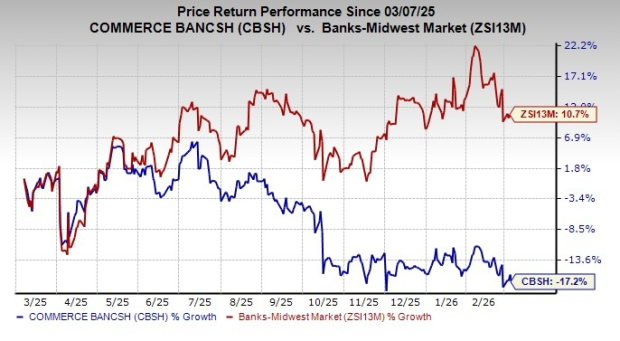
Image Source: Zacks Investment Research
Currently, Commerce Bancshares carries a Zacks Rank #3 (Hold). You can see the complete list of today’s Zacks #1 Rank (Strong Buy) stocks here.
How Have CBSH’s Peers Been Performing?
Huntington Bancshares Incorporated’s HBAN NII saw a CAGR of 13.2% over the last five years (2020-2025). HBAN is one of the top 20 bank holding companies in the United States, which remains focused on acquiring the industry's best deposit franchise. The company’s total deposits saw a five-year (ending 2025) CAGR of 12.3%.
Driven by the strong performance of its commercial and consumer portfolios, total loans saw a CAGR of 13% in the same time frame. The acquisition of Veritex added $9.3 billion in loans and $10.5 billion in deposits in 2025.
Going forward, an improving lending scenario is expected to support Huntington Bancshares’ loans and deposit growth. Huntington Bancshares projects mid to high-single-digit loan growth in 2026, driven by expansion in high-growth markets like Texas and sustained operational efficiency.
Regions Financial Corporation RF has witnessed steady growth in its loan balances, seeing a CAGR of 2.5% over the past five years (2020-2025). Robust loan pipeline, along with the company’s broad exposure across strategic Southeastern and Midwest markets, provides a solid foundation for loan growth in the upcoming period. Management expects average loan balances to increase in the low-single digits in 2026, supported by growth in commercial and real estate lending.
Regions Financial’s NII has witnessed a CAGR of 5.1% over the five years ending 2025. RF expects NII to grow 2.5-4% in 2026, supported by fixed-rate asset turnover, prudent funding cost management and loan growth.
Disclaimer: The content of this article solely reflects the author's opinion and does not represent the platform in any capacity. This article is not intended to serve as a reference for making investment decisions.
You may also like
$805B Wiped Out in Sudden US Stock Market Crash
Erste Group Downgrades Walmart (WMT) to Hold from Buy; FTC Settlement Adds Pressure

Costco Says Tariff Refunds Could Lead to Lower Prices for Customers

BofA Boosts Johnson & Johnson (JNJ) Price Target as Pipeline Outlook Improves

Trending news
MoreCrypto prices
More





