
Data Infrastructure Stocks Q4 Earnings Analysis: Teradata (NYSE:TDC) Stands Out

Q4 Data Infrastructure Earnings Recap
As the latest earnings season wraps up, let's revisit some of the most noteworthy—and some underwhelming—results from the fourth quarter, with a focus on data infrastructure companies. We begin with Teradata (NYSE:TDC).
Modern businesses are increasingly prioritizing the extraction of insights from their vast system data. Achieving this requires connecting and analyzing information scattered across various isolated databases. This need is fueling demand for cloud-based data infrastructure solutions, which offer more seamless integration and processing capabilities compared to traditional on-premises software.
Q4 Performance Overview
The five data infrastructure firms we monitor delivered mixed results in Q4. Collectively, their revenues fell short of analyst projections by 4%, and their guidance for the upcoming quarter was 0.5% below expectations.
Stock performance has reflected these challenges, with the group’s share prices declining by an average of 10.2% since their earnings announcements.
Top Performer: Teradata (NYSE:TDC)
Teradata, a pioneer in data warehousing since the 1980s, now offers cloud-based analytics and AI platforms that enable large organizations to unify, analyze, and maximize the value of their data across diverse environments.
For the quarter, Teradata posted $421 million in revenue, marking a 2.9% year-over-year increase and surpassing analyst forecasts by 5.4%. The company also provided next quarter EPS guidance above expectations and delivered a strong EBITDA beat, making it a standout quarter overall.
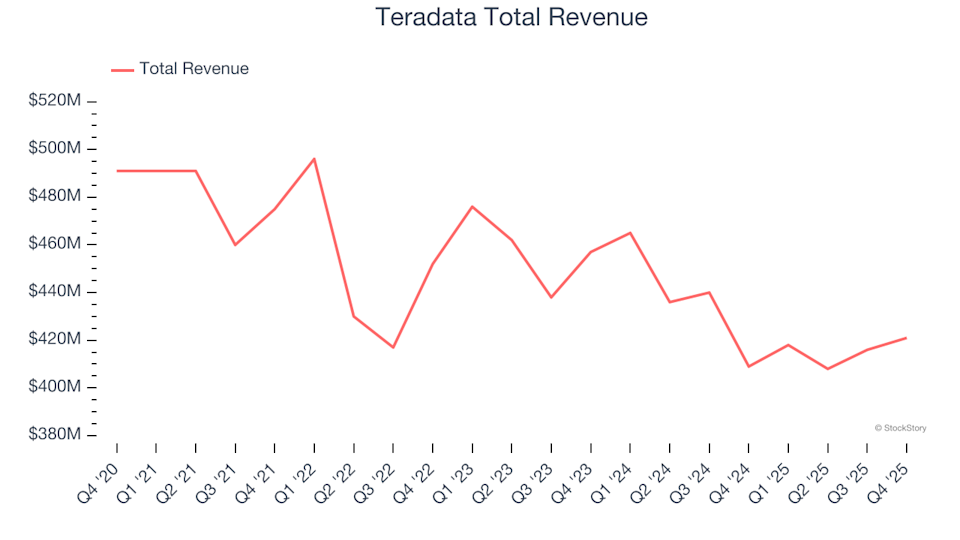
Teradata Total Revenue
Teradata achieved the largest positive surprise relative to analyst estimates among its peers. However, this strong performance appears to have already been factored into the stock price, which has remained steady since the report and currently sits at $29.05.
Elastic (NYSE:ESTC)
Elastic, built on the widely-used open-source Elasticsearch technology, delivers a search and AI platform that helps organizations extract insights, monitor systems, and enhance security across their data.
The company reported $449.9 million in revenue for the quarter, a 17.7% increase year over year, beating analyst expectations by 2.6%. Elastic also outperformed on EBITDA and raised its full-year EPS guidance above consensus estimates.
Elastic Total Revenue
Elastic led its peer group in raising full-year guidance. Despite a solid quarter, the market reacted negatively, with shares dropping 13.1% since the announcement. The stock is currently trading at $53.54.
Weakest Q4: C3.ai (NYSE:AI)
C3.ai, whose name reflects its original focus on carbon, cloud computing, and customer relationship management, offers enterprise AI software that enables organizations to build and operate large-scale AI applications across industries.
The company reported $53.26 million in revenue, a steep 46.1% decline year over year, missing analyst estimates by 29.6%. Both its full-year and next-quarter revenue guidance fell significantly short of expectations, making for a disappointing quarter.
C3.ai posted the weakest results among its peers, with the slowest revenue growth and the most negative guidance update. The stock has dropped 8.3% since the report and is now trading at $9.45.
Confluent (NASDAQ:CFLT)
Founded by the creators of Apache Kafka, Confluent provides a platform that connects applications, systems, and data layers through real-time data streams.
Confluent reported $314.8 million in revenue, up 20.5% from the previous year and exceeding analyst forecasts by 2.2%. The company also delivered a strong EBITDA beat and outperformed revenue estimates.
Confluent led its peers in revenue growth, adding 34 new enterprise customers paying over $100,000 annually, bringing the total to 1,521. The stock price has remained unchanged since the earnings release and is currently at $30.77.
Oracle (NYSE:ORCL)
Oracle, established in 1977 as a database company and now a global provider of enterprise software and hardware, supports mission-critical systems for organizations worldwide.
For the quarter, Oracle generated $16.06 billion in revenue, a 14.2% year-over-year increase, but this result was 0.8% below analyst expectations. The company also missed on billings and revenue estimates, making for a softer quarter overall.
Oracle’s stock has fallen 29.8% since the earnings report and is currently priced at $156.61.
Market Insights
Following the Federal Reserve’s rate increases in 2022 and 2023, inflation has steadily declined from its post-pandemic highs, moving closer to the Fed’s 2% target. Despite higher interest rates, the economy has managed to avoid recession, achieving the “soft landing” many investors hoped for. Recent rate cuts—0.5% in September and 0.25% in November 2024—have further boosted equities, making 2024 a strong year for the stock market. Donald Trump’s presidential victory in November led to additional market gains, with indices reaching new highs in the days after the election. However, ongoing debates about tariffs and corporate taxes are fueling uncertainty about economic prospects in 2025.
About StockStory: Our team of experienced analysts leverages quantitative research and automation to deliver timely, high-quality market insights that help you stay ahead.
Disclaimer: The content of this article solely reflects the author's opinion and does not represent the platform in any capacity. This article is not intended to serve as a reference for making investment decisions.
You may also like
Inside Colossus's Mission to Swap Out Visa and Mastercard for Crypto Cards Without KYC
XRP Loses Aggregate Holder Cost Basis. Here’s Why This Is Risky
Should PEPE traders brace for volatility as short squeeze potential builds?
SPIE's 2028 Margin Upgrade Creates New Expectation Gap as Management Transitions
Trending news
MoreCrypto prices
More





