
The $200 Billion Dilemma: Has the Time Come for Amazon to Issue a Dividend?

The Evolution of Tech Stocks and Their Impact
Technology stocks have consistently captured public attention, and for good reason. The tech sector has a history of introducing innovations that redefine daily life. Personally, I find it hard to picture a day without frequently checking my iPhone.
When tech firms are established, they typically secure funding through both debt and equity—essential tools to launch their operations. The ultimate aim is to achieve profitability that outpaces revenue growth. However, as these companies mature, their rapid expansion inevitably slows. At that stage, businesses must adapt to maintain investor interest and prevent a sell-off.
Related Stories from Barchart
Comparing Growth: Amazon vs. Dividend Giants
Consider Amazon’s impressive performance: its stock price has soared by approximately 637% over the past decade. In contrast, a traditional dividend payer like Coca-Cola has seen a 66.05% increase in the same period. Why do investors remain loyal to stocks like Coke? The answer lies in their consistent and growing dividend payments. If Coca-Cola isn’t appealing, PepsiCo offers a similar approach.
Over time, it becomes unrealistic for companies to maintain extraordinary share price growth. Double-digit annual gains can’t last forever. When faith in a company’s growth potential wanes, investors often seek alternatives, leading to periods of underperformance. Introducing dividends is one strategy companies use to retain shareholder interest.
While Apple began distributing dividends in 1987 and Microsoft followed in 2003, these are exceptions among tech giants. As these industry leaders matured, their share price growth slowed, prompting them to reward shareholders with dividends. In 2024, Meta and Alphabet joined the ranks. Amazon may be next in line.
Amazon.com Inc (AMZN): A Closer Look
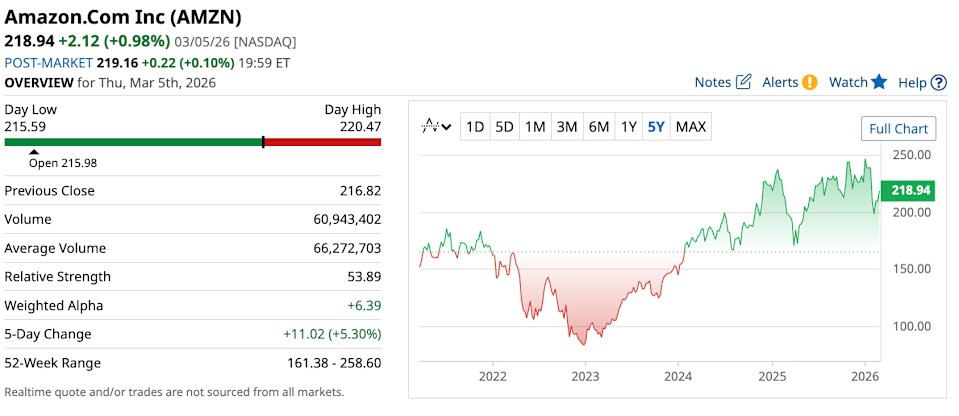
Amazon stands as a global leader in technology and e-commerce, renowned for its expansive online marketplace. Beyond retail, Amazon’s influence extends to cloud computing through AWS, which supports organizations worldwide. The company is also active in digital advertising, streaming, and logistics, with several of these sectors still developing. Ultimately, Amazon is deeply integrated into both consumer habits and the broader digital ecosystem.
Amazon’s Investment in AI: Is It Justified?
Amazon is now scaling its infrastructure to accommodate the next generation of artificial intelligence, with plans to invest over $200 billion in capital expenditures by 2026.
This significant investment has sparked debate, but Amazon’s recent financial results suggest it is well-positioned to handle such spending. In its latest quarter, sales climbed 14% year-over-year to $213 billion, and net income rose 6% to $21 billion.
Looking at the bigger picture, Amazon’s business model has gained momentum since 2022. However, free cash flow has declined recently, largely due to increased investment in growth initiatives.
| Fiscal Year | Revenue (USD Billions) | Operating Income (USD Billions) | Net Income (USD Billions) | Free Cash Flow (USD Billions) |
|---|---|---|---|---|
| 2025 | 702.0 | 90.7 | 77.7 | 7.7 |
| 2024 | 638.0 | 68.6 | 59.2 | 32.9 |
| 2023 | 574.8 | 36.9 | 30.4 | 32.2 |
| 2022 | 514.0 | 12.2 | -2.7 | -16.9 |
| 2021 | 469.8 | 24.9 | 33.4 | -14.7 |
Beyond the financials, it’s important to consider how Amazon intends to deploy its AI investments. For example, the company recently announced plans to increase its total investment in Spain to €33.7 billion, focusing on expanding AWS data centers and enhancing AI capabilities across Europe. This move strengthens the AWS presence in Aragón and positions Spain as a key location for cloud and AI development.
Why prioritize these areas? The past two years have shown that Amazon’s most profitable segments are software and services, not logistics. High-margin businesses like advertising, subscriptions, and AWS generate more cash, making AI expansion a logical step.
Nevertheless, this aggressive investment strategy comes with risks. The company’s heavy spending depends on sustained demand for cloud and AI services, and success will require Amazon to execute efficiently while competing with other major players.
Amazon’s Stock Performance
Currently, Amazon shares trade around $219. Year-to-date, the stock has declined about 5%, largely due to investor concerns over ambitious spending plans. However, this dip could present a buying opportunity. Over longer periods—two, five, or ten years—the company’s growth story remains compelling.
Dividend Trends Among the Magnificent Seven
Within the MAG7 group, only Amazon and Tesla have yet to introduce dividends. Apple began its dividend program in 1987, while Alphabet was the most recent to join. What’s driving this shift? By offering dividends, companies attract a new class of long-term investors who tend to hold shares through market fluctuations. For instance, I’ve held Microsoft stock since 2014—not solely for its dividend, but the steady income is reassuring during volatile periods.
| Company | Ticker | Dividend Status | Start Date | 2026 Yield (Est.) |
|---|---|---|---|---|
| Microsoft | MSFT | Paying | 2003 | 0.90% |
| Apple | AAPL | Paying | 1987 | 0.39% |
| Nvidia | NVDA | Paying | 2012 | 0.02% |
| Meta | META | Paying | Feb 2024 | 0.32% |
| Alphabet | GOOGL | Paying | Apr 2024 | 0.28% |
| Amazon | AMZN | None | N/A | 0.00% |
| Tesla | TSLA | None | N/A | 0.00% |
Is Amazon Financially Ready to Pay Dividends?
The key question remains: Is Amazon in a position to start distributing dividends?
To evaluate this, let’s examine some projections. Analysts anticipate Amazon will report $1.69 in earnings per share (EPS) for the first quarter of 2026, and $7.78 for the entire year.
| Period | Average EPS Estimate |
|---|---|
| Q1 2026 | $1.69 |
| Q2 2026 | $1.80 |
| FY 2026 | $7.78 |
These figures are consistent with Amazon’s recent quarterly performance:
| Quarter | EPS |
|---|---|
| Q4 2025 | $1.98 |
| Q3 2025 | $1.98 |
| Q2 2025 | $1.71 |
| Q1 2025 | $1.62 |
| Q4 2024 | $1.91 |
Currently, the average dividend yield among MAG7 companies that pay dividends is about 0.42%. With Amazon’s share price near $219, a 0.38% yield would equate to roughly $0.83 per share annually, resulting in a payout ratio of about 10.7% based on projected 2026 earnings. This is a moderate level compared to its peers.
| Company | Payout Ratio |
|---|---|
| Microsoft (MSFT) | 22.01% |
| Apple (AAPL) | 12.95% |
| Amazon (AMZN) Estimated | 10.66% |
| Alphabet (GOOGL) | 7.60% |
| Meta (META) | 6.93% |
| NVIDIA (NVDA) | 0.87% |
In summary, Amazon’s financial health suggests it could comfortably initiate dividend payments at a level comparable to other MAG7 companies. While there’s been no official announcement, it’s worth noting that other tech giants are also ramping up AI investments while maintaining dividends. It may only be a matter of time before Amazon follows suit.
Conclusion
A panel of 57 analysts currently rates Amazon as a “Strong Buy,” with an average score of 4.81 out of 5. If the stock reaches its highest target price of $360, there’s potential for a 64% gain.
When so many Wall Street professionals agree on a stock, it’s a sign of strong confidence in the company’s future. Amazon is not a speculative newcomer—it’s a well-established business that continually reinvests and adapts to technological shifts.
Regarding dividends, Amazon has the capacity to join its peers—Meta, Nvidia, Microsoft, Apple, and Alphabet—in providing regular payouts. Whether it will do so remains to be seen.
Of course, while analyst opinions and forecasts are helpful, they should not replace your own research. Still, when expert consensus aligns with robust financials and a clear growth strategy, it’s worth taking note.
Disclaimer: The content of this article solely reflects the author's opinion and does not represent the platform in any capacity. This article is not intended to serve as a reference for making investment decisions.
You may also like
Oil Jumps Above $90 as Iran Tensions Rise, Crypto Markets React
Middle East Crisis Drives Palantir Technologies Inc. (PLTR)'s Recovery

Bank of America Resumes Coverage on Tesla, Inc. (TSLA), Upgrades to Buy

Shopify Inc. (SHOP) a Strong Buy, Per Wall Street

Trending news
MoreCrypto prices
More





